
Written by Harry Child
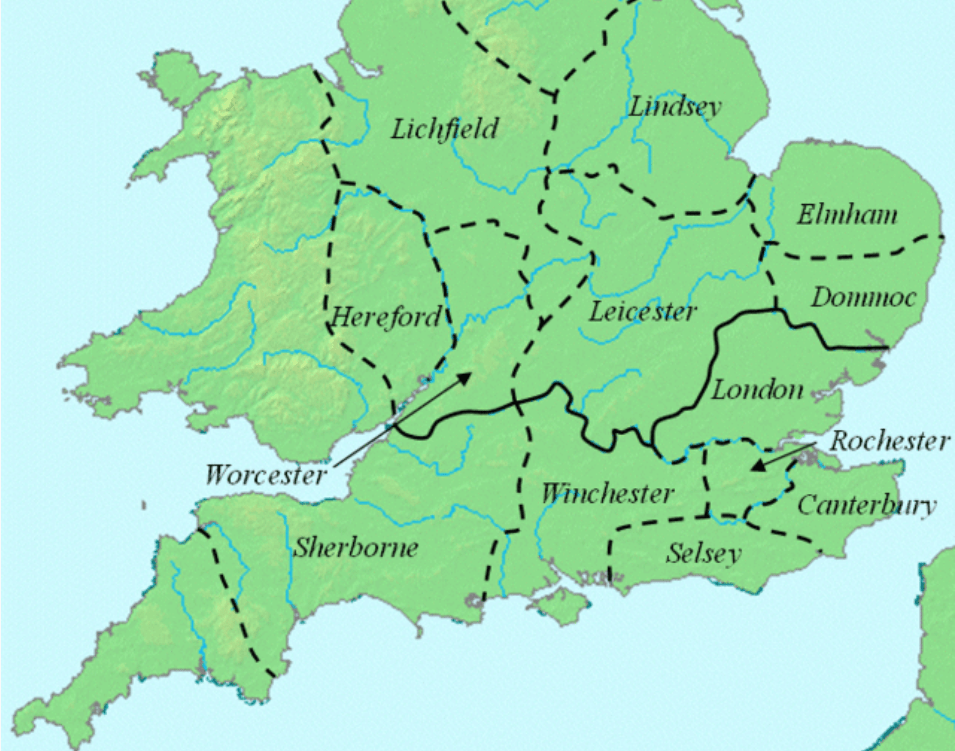
If you have studied any English Church history before, or even if you just have an idea about how the Anglican church works at present, you will likely know that there are two Archbishoprics: Canterbury and York. Indeed, this is how it was for most of English history. However, what if I told you that there used to be a third. For a brief decade or so, during the late eighth century, this was the case. This Archbishopric was centred in the town of Lichfield and led by a man called Hygeberht. I intend to describe the events surrounding the creation of this office and its eventual demotion back to a Bishopric. Perhaps, more importantly, I aim to make the case that Hygeberht was merely an expedient puppet for the King who elevated him, Offa, and the subsequent Mercian rulers. An Archbishop in Lichfield was able to challenge the authority of the Archbishop of Canterbury in Kent, driving him into submission to their Mercian overlords. With this, the Kings of Mercia had achieved what they wanted – to have the most prominent man in Kent in their employment and, as such, an assured right to rule the Kingdom.
To understand why Hygeberht was elevated to his high office, we must first look at his life before becoming Archbishop. The year is AD 777, and Hygeberht appears as a witness to an agreement between the Abbot of Medehamstede (Modern day Peterborough), Beonna, and an ealdorman (a high-ranking local lord, this title would later morph into that of Earl), Cuthbert, in which the Abbot leases land to the ealdorman in return for hospitality once a year and some rent. The Anglo-Saxon Chronicle, which highlights Hygeberht’s presence here, also lists other figures who were present. It is not just local regional lords who are witnesses to the agreement, but the King and his heir too. In fact, Hygeberht is one of four named witnesses, of whom he is the third, succeeded only by the King and his heir. The chronicle explicitly states that there were many other witnesses, who were not named. This placed Hygeberht in a very special group of powerful individuals in the Kingdom. The compiler of the chronicle evidently thought he was one of the most important figures at the event. This must be taken with a pinch of salt though, as the chronicler admits he is writing with hindsight, describing Hygeberht as ‘Archbishop’ even though he would not go on to be elected to this office until 10 years later. The fact that Hygeberht even appears as a witness, alongside the King, to an agreement between two prominent regional figures is telling. He must have been loyal to Offa, otherwise the King would not have chosen him to be present alongside him at this event. Consequentially, Hygeberht’s support of the Mercian King would make him the perfect candidate for high office as an archbishop. Perhaps this notion is cemented in that two years after this event he is elected as a Bishop of Lichfield.
It would seem sensible now to turn to the context of the period. Namely, Offa’s ambition to control the Kingdom of Kent. Offa had quite a hard time with this. He first gained control of Kent in 764, choosing to keep the King, Ecgberht, in place. This did not work out too well though. Ten years later, the King of Kent was free from Offa’s control, issuing his own charters again. Offa puts his hat in the ring again in 784, determined this time not to fail. He successfully takes Kent, ousting its King. There is another problem though: the Archbishop of Canterbury, whose seat is in Kent. Walter Hook has highlighted that Archbishops were very powerful men, only one rung down in the social hierarchy from the King themselves. Jaenberht, the Archbishop at this time, did not want to play ball with Offa, refusing to consecrate his son as King. This created quite a problem for Offa, made worse by the fact that Jaenberht, being the most senior church official in the South, controlled the Bishoprics within Mercia. Offa needed to think of a plan to bypass this problematic snag in his ambitions. He decides that this could be combatted by elevating one of the Mercian Bishoprics to an Archbishopric. He sends this request to the Pope, Hadrian I, asking to elevate the Bishopric of Lichfield to this higher office. Hadrian agrees, and in 786 sends his representatives to Mercia. The Archbishop of Canterbury, Jaenberht, is then summoned in 787 to a council in Chelsea. There, it is decided that Lichfield should be elevated, taking under its control several of Canterbury’s diocese’s. Hygeberht, being the bishop, is named the new Archbishop of Lichfield.
As we can see, Hygeberht owed his newfound prestige entirely to the Mercian King. Consequently, the logical next step we could take is that he would always want to act in Offa’s best interest – essentially, he is firmly in the employ of the King. If he did not comply, Offa could have him replaced with another loyal subject. This idea is made particularly convincing by the seemingly good relationship between Offa and Hadrian, which is evidenced by Hadrian agreeing to Offa’s request for an Archbishopric in his territory. It would seem sensible that Hadrian would not be that concerned if Offa chose to change personnel.
Looking now at Hygeberht’s time in office, John Evans, who has written about coins found from King Offa’s reign, indicates that both Hygeberht and Jaenberht signed Offa’s charters, but interestingly, he highlights, Jaenberht signed off with ‘By the Grace of God Archbishop’ (and he was consistent in this), compared with Hygeberht’s simple ‘Archbishop’. I cannot help but see this as Jaenberht perhaps making a subtle dig at Hygeberht’s status, conveying he has been around longer, and is almost this proper archbishop that Hygeberht simply is not. Whilst Evans does suggest Jaenberht presented Hygeberht as the higher-ranking Archbishop, I feel as though Jaenberht made a very specific choice. Subtly suggesting, perhaps, that his office was more established and thus legitimate. If Offa was happy for the differences in signage to go ahead, maybe he too, believed this: Lichfield was only an expedient development, to help him secure power over Kent. Hygeberht was simply the counterweight, to challenge the authority of Canterbury: Offa’s tool.
The idea of Hygeberht being a tool to his overlords, to me, is reinforced by Hygeberht’s fate as Archbishop after Offa’s death. The King died in 796, succeeded briefly by his son, Ecgfrith, who dies soon thereafter. Coenwulf, a supposed member of the Mercian royal bloodline, succeeds as King of Mercia. At this stage, there is still a claimant alive to the Kentish throne, Eadberht Praen. He decides that it is the perfect opportunity to invade Kent, to take it back. He is welcomed with open arms by the population of his country, but the Archbishop of Canterbury (Now Aethilheard) is not supportive of his cause, subsequently being driven into exile. He condemns Eadberht’s actions which leads to an excommunication being passed against Eadberht. Coenwulf is then able to retake Kent, returning Mercian rule there. The key point here is that Canterbury was loyal to Mercia.
After Canterbury proved their loyalty to the Mercian King, Mercia knew the work they had used Hygeberht to do, was done. Through not backing the Kentish claimant in his bid to seize the throne, despite Eadberht holding the popular support of the people in the Kingdom, Canterbury had proven who their allegiance was to and illustrated to the Mercian Kings that now Canterbury was firmly in their pocket. As such, the Mercian Kings had gained the ally they needed to make their takeover of Kent last: Mercian rule would persist there. So now, Hygeberht seems more of a hindrance than a help, as to have one steadfastly loyal ally with a lot of power seems more useful than having two significantly less powerful loyal allies. King Coenwulf realises this and requests that the Pope, now Leo III, nullify the creation of the Archbishopric of Lichfield, to which he agrees. Consequentially, in 803 Lichfield reverts to a standard bishopric again.
To conclude, the nature of the way Hygeberht was elevated, and demoted, and the way in which he conducted himself as Archbishop illustrates that he was the tool of the Mercian Kings to achieve their bigger political aims. He acted as a counterbalance to the authority of Canterbury, to drive the archbishop into support for the Mercian rulers. The Kings knew they could trust Hygeberht because he owed his elevation to them, and had a history, as conveyed in the Anglo-Saxon Chronicle, of working closely with the King. When Canterbury’s allegiance was assured, Hygeberht had served his purpose, and to impose their authority even more, the Mercian Kings knew he needed to go. As such, I think my conjecture holds: Hygeberht of Lichfield was indeed the tool of the Mercian Kings.
Bibliography
Ancient Medieval and Early Modern Manuscripts, ‘Lichfield: the third archbishopric’ in British Library’s Medieval Manuscripts blog, (2018), Accessed: https://blogs.bl.uk/digitisedmanuscripts/2018/11/lichfield-the-third-archbishopric.html.
Evans, John. ‘Coins of Archbishops Jaenberht and Aethilhard.’ The Numismatic Chronicle and Journal of the Numismatic Society 5 (1865): 351-60.
Giles, John Allen. The Anglo Saxon Chronicle, (London: G. Bell and Sons, 1914).
Hook, Walter Farquar. Lives of the Archbishops of Canterbury, vol. 1, (London: R. Bentley, 1861)
Keynes, Simon. ‘The Burial of King Aethelred the Unready at St Pauls’ in (ed.) Roffe, David. The English and their Legacy 900-1200, Essays in Honour of Ann Williams, (Martlesham: The Boydell Press, 2012).
Morris, Marc. The Anglo-Saxons: A History of the Beginnings of England, (London: Penguin Random House, 2021).
Williams, Ann. Hygeberht [Higbert], Oxford Dictionary of National Biography, (2004), Accessed: https://www.oxforddnb.com/display/10.1093/ref:odnb/9780198614128.001.0001/odnb-9780198614128-e-13223.
 Retrospect Journal