
Written by Naomi Wallace
Featured image credit: Naomi Wallace.
In his stream of consciousness work A Lover’s Discourse, Roland Barthes muses on love’s performative quality, noting:
[T]o hide a passion totally (or even to hide, more simply, its excess) is inconceivable: not because the human subject is too weak, but because passion is in essence made to be seen … Every passion, ultimately, has its spectator … no amorous oblation without a final theatre: the sign is always victorious.
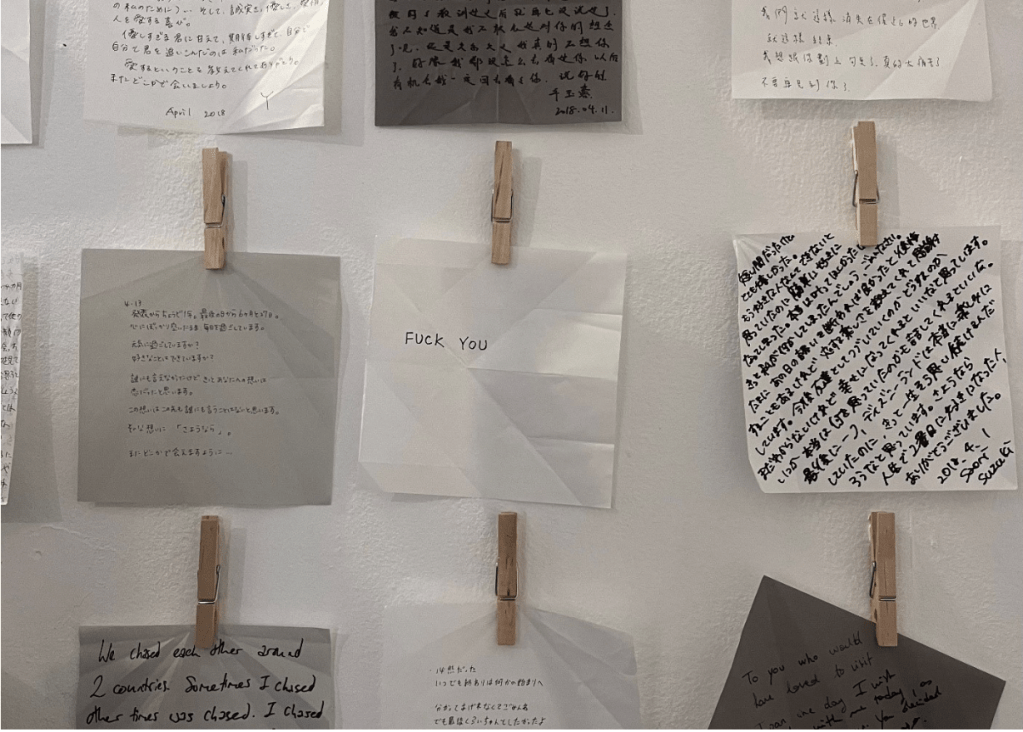
This notion that romantic love – or any manifestation of affection towards another – is theatrical in its need for the affirming presence of an audience to validate its existence, finds its material expression in Zagreb’s Museum of Broken Relationships. An auditorium of loss and love, the exhibition space houses the donated remnants of ruptured relationships, microhistories of emotional fracture. The museum invites people to contribute to its collection as a means of ‘exhibiting their emotional legacy as a sort of ritual, a solemn ceremony.’ Visitors also partake in this ritual, spectating eyes bearing witness to the souvenirs of relationships bygone. From affectionate – and at times vitriolic – words scrawled on scrap paper, to pulverised VHS wedding tapes, the Museum of Broken Relationships offers a new take on heritage, a glimpse into histories at once idiosyncratic and scored with universality.
Take, for example, one of the collection’s treasures entitled ‘Twenty-seven-year-old scab from my first love’s wound.’ Donated to the museum from Mürzzuschlag, Austria, the stomach-turning sentimentality of this preserved scab is as poignant as it is grotesque. Above the illuminated petri dish in which this coagulation of dried blood is displayed, a plaque reads:
In 1990 my friend, my first great love, had a motorbike accident. Its consequence was severe road rash with several large scabs. […] From then on, I had a constant fear that I might lose my dearest one. For that reason, I kept one of his scabs after it had fallen off, with the (not so serious) idea in mind of having him cloned in the future if need be. […] in the end, my constant fear for him led to our breakup. Paradoxically, my fear caused exactly that which frightened me most.
I have kept the scab to this day, for twenty-seven years. […] I have long lost the desire to clone my then partner. My fears, however, I still struggle with.
While the act of preserving a scab for almost three decades appears macabre, the familiar paranoia at the heart of desire reverberates through this testimony. That the donor’s palpable anxieties manifested in such a grisly pathological manner does not negate that the fear of losing a loved one, and the irrevocable damage this can cause to the relationship, is a stirring subject. The power of the Museum is in its ability to vacillate between the hyper-individual and the universal; visitors, though unlikely coveting the scabs of their own loved ones, are bound to recognise the anxiety that latently accompanies love.
The ironic potency here hinges upon the fact that the function of scabs – dried blood clots that stop bleeding and prevent infection – is to heal. Scabs fall off the body when the tissue underneath the wound has been repaired. Though the affectivity of the preserved scab derives, in part, from its physicality – from the harsh confrontation it forces the observer to have with the bodily – it bears a symbolic resonance too. The scab metonymically represents the lost lover, both as a literal piece of his body, and as an aide-mémoire for the long-over relationship. By letting go of the scab, constituting an acceptance of the loss, the donor finds themself healed. The cicatrice left behind to the Museum is a dried-up reminder to viewers that living in fear can engender the very loss that it apprehends.
Similarly striking irony tinges another item in the collection, a small steel pendant in the shape of a pair of handcuffs. Originally from Mexico City, Mexico, it commemorates, with rousing specificity, a relationship that lasted between May 18, 2008, and December 27, 2011. The accompanying anecdote is as follows:
She had been my psychologist for 3 and a half years when she told me she wouldn’t treat me anymore. Six months later, she looked me up and we started dating.
We lived together for a year and a half. She even gave me this pendant to show that our relationship represented a marriage.
Our relationship ended because she never managed to come out of the closet. I was 22 and she was 36 when we broke up. She now lives with a man and says that she could never accept being gay.
The speaker spells out the proverb of so many queer relationships that rupture due to one party’s reluctance to ‘come out of the closet.’ Reading this account, alongside the artefact it contextualises, brings the pendant into the symbolic realm; here it ominously portends the breakup and its cause. That the handcuffs signify matrimony is evinced by the donor’s ex-lover, who gifted her the pendant ‘to show that our relationship represented a marriage.’ But handcuffs, to think through this gift with a deconstructive mindset, carry a litany of negative associations; entrapment, criminality, and restraint being the most conspicuous. Same-sex marriage was not legal in Mexico at the time. Whether or not the speaker’s lost love intended to give a token of affection imbued with such bitterly appropriate connotations, is of limited relevance. Held up against the pained words of the donor, the steel handcuffs seem to embody the stigma, intolerance, and repression that destroyed the relationship. Just as the owner of the twenty-seven-year-old scab finds healing through the act of relinquishment, parting with these handcuffs seems to represent an embrace of freedom. As for the ex-lover, we can only hope that she too freed herself from the symbolic handcuffs of the closet. Suspended in the temporality of the museum, she is as trapped as the steel pendant behind the glass.
According to Eve Kosofsky Sedgwick, falling in love is:
a matter of suddenly, globally, “knowing” that another person represents your only access to some vitally
transmissible truth
or radiantly heightened
mode of perception,
and that if you lose the thread of this intimacy, both your soul and your whole world might subsist forever in some desert-like state of ontological impoverishment.
Following this, is The Museum of Broken Relationships a wasteland of love? Are the glass cases, in which the artefacts are displayed, a tomb for the relationships they once belonged to?
The very state of being a museum would suggest that the answer, to both questions, is no.
That a collection of souvenirs preserved from relationships of every kind exists, available to be viewed, interacted with, and reflected upon by the public indicates that there is potential in these losses beyond ‘ontological impoverishment.’ Displaying these relics to an audience, to return to Barthes’ proposal that there is ‘no amorous oblation without a final theatre,’ immortalises the relationships they commemorate, and asserts that there is purpose in preserving the memory even where the love no longer exists. Far from impoverishment, the Museum of Broken Relationships offers ontological richness. We might lose the threads of various intimacies throughout our lives, but these losses weave a greater thread that stitches us to every other individual who has experienced, grieved and eventually healed from a broken relationship.
Bibliography
Barthes, Roland. A Lover’s Discourse: Fragments. Penguin, 1977.
Kosofsky Sedgwick, Eve. A Dialogue on Love. Beacon Press, 1999.
 Retrospect Journal