
Written By Logan McKinnon
17/11/2024

Figure 1: Rijke, Inez de, This Scar Will Never Heal, 2022
If you take a walk through Glasgow along Bath Street towards the Mitchell Library it is quite startling to find the city come to a point where it is effectively ripped into two distinct parts, accompanied by a very visible wound running directly beneath your feet, where the city feels piercingly absent and we seem ripped from the city itself by the rounds of car after car after car screaming by. In effect, Scotland – or at least modern Scotland – pules below our feet here, with the M8 comprising the beating heart of Scotland’s road network, but in its construction, we lost so much, and the famous words that have become so associated with the road since the lightly protested 1972 opening of the road by a number of Glasgow School of Art Architecture Students still remain very much true – “this scar will never heal.” This is accepted as a universal truth in Glasgow, with Glasgow City Council voted 80-2 to recognise that the M8 “to this day acts a scar in the urban fabric of the city,” and in many ways we still see our city continue to bleed as this wound hangs open so visibly, so strikingly, and so divisively through Charing Cross, where on our walk there is no longer much reason to stop bar to admire this complete separation from peace itself. Herald columnist Cliff Hanley noted upon the opening of the Charing Cross section in 1972 that this represented nothing less than the ‘utopian fantasies’ of city planners, but in doing so they neglected the urban realities of Glasgow – our communities, our spaces, our architecture, and most importantly the people that give our city its heart.
Charing Cross was sacrificed to the noted ‘utopian fantasies’ in so losing some of the finest examples of Victorian architecture in the city, no less so than the Grand Hotel that couples en masse around the city flocked to in its closing days for one last time to take in the gorgeous venue where they had spent their honeymoons. The Grant Hotel was just one casualty however, with hundreds of buildings making way for the screaming modernity manifested in the M8 – and today the Mitchell Library sticks out like a sore thumb amongst the brutalist buildings that captured this modernity, representative of two entirely different visions for the city, one centred around the people and one which people simply existed as a cog within. It was noted in a Herald editorial the day following the opening of the Charing Cross section of the road that “the Charing Cross section… is an example of the massacre of an area by an urban motorway. Not only has Charing Cross, one of the most attractive landmarks in the city, been destroyed, but the residents of Garnethill and St George’s Road area now find themselves living in a shambles, more closely resembling a ghost town than a community.” Community after community was devasted in Glasgow including Anderston, Townhead, Cowcaddens, and St George’s Cross, alongside the most notable casualty of Charing Cross, leaving the City dotted with soulless canyons that presented one simple message – in the new city the automobile reigned supreme over the interests of the people, or more plainly the individual mattered more than the community. Glasgow is a city that now struggles at the fundamental level to come into itself – a city that has to fight for character – the city’s tourism slogan may state ‘People Make Glasgow’ but with such an evidently damaging effect on communities presented by the lingering impact of the M8 motorway and its arterial developments, it is clear that the city works against Glaswegians in its modern design.
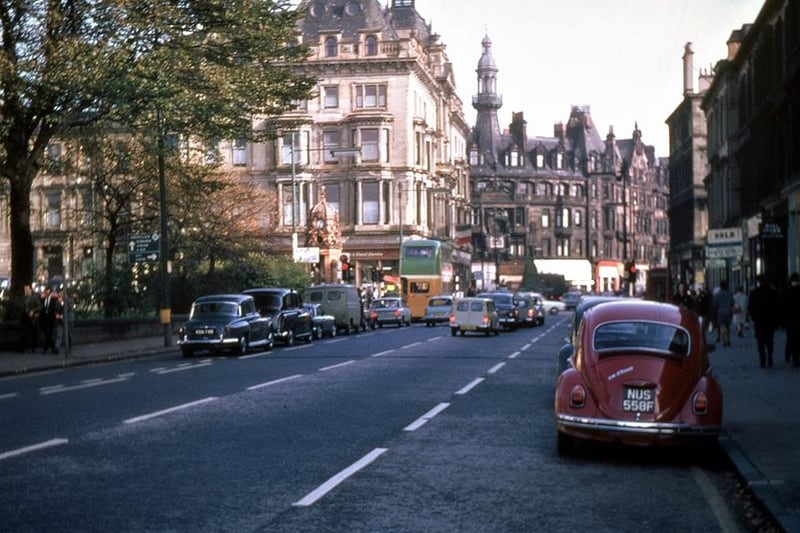
Figure 2: Douglas Thomson, Charing Cross, 1968
The idea of a cohesive and interlinked Glasgow was completely ripped apart through the lack of foresight seen within the transport developments from the 1950s to the 1970s. One crucial factor of the transportation policy of the period, which first emerged in the United States and was used to further segregation and isolate minority communities entirely, was that transport policy was not often linked to transport, but rather in many cases to social control. Thus, supposed ‘socially undesirable’ areas of the city had to go and the development of transport infrastructure largely aligned with the wider goals of slum clearances of the period. Those who were more well off closed their doors on the city at this point and settled into comfortable middle-class bliss in suburbs including Newton Mearns and Lenzie. This was, as Deborah Archer notes in relation to the US, aided by the convenience of the new motorways that allowed them to still be attached to the city while separated from it – in comfortable suburban bliss that was taken away from the harsh realities of what it now meant to live in a city. The new suburban unit redefined the nature of social units entirely to focus on the individual family rather than the community as a holistic and interlinked entity.
This is a trend that seems inherent in motorway developments, with it being found by Professor Frédéric Robert-Nicoud and Professor Raphaël Parchet in relation to Switzerland that Swiss motorway developments led to a 41 per cent decline in the population of urban centres in favour of a 42 per cent increase in suburban municipalities, and in the below figure you can see the redistributed emphasis on these suburban communities centred around cities including Geneva, Zurich, Bern, Lausanne, and Lugano. These communities centrally favoured the rich who had the privilege of access through the automobile and the income benefits that the rise of suburbia have generated, which have overwhelmingly favoured those of the wealthiest backgrounds, even if results generally economically as expected have been positive. With such suburban re-distribution this has an extremely significant consequence for our cities – the deprivation of tax revenue that can go towards funding our urban centres, and for Glasgow this means that the incomes of some of the cities highest earners are going towards funding developments in East Renfrewshire and East Dunbartonshire rather than focusing on the city that these individuals so often consider themselves part of. It is for this reason that Paul Sweeney MSP in his backing of phasing out the M8 motorway notes that we can rebuild our urban tax base through moving away from these developments as our priority in the city and instead we can prioritise homes, businesses, and green spaces in a manner that can allow us to grow a new sustainable city with the Glaswegian people at its heart.
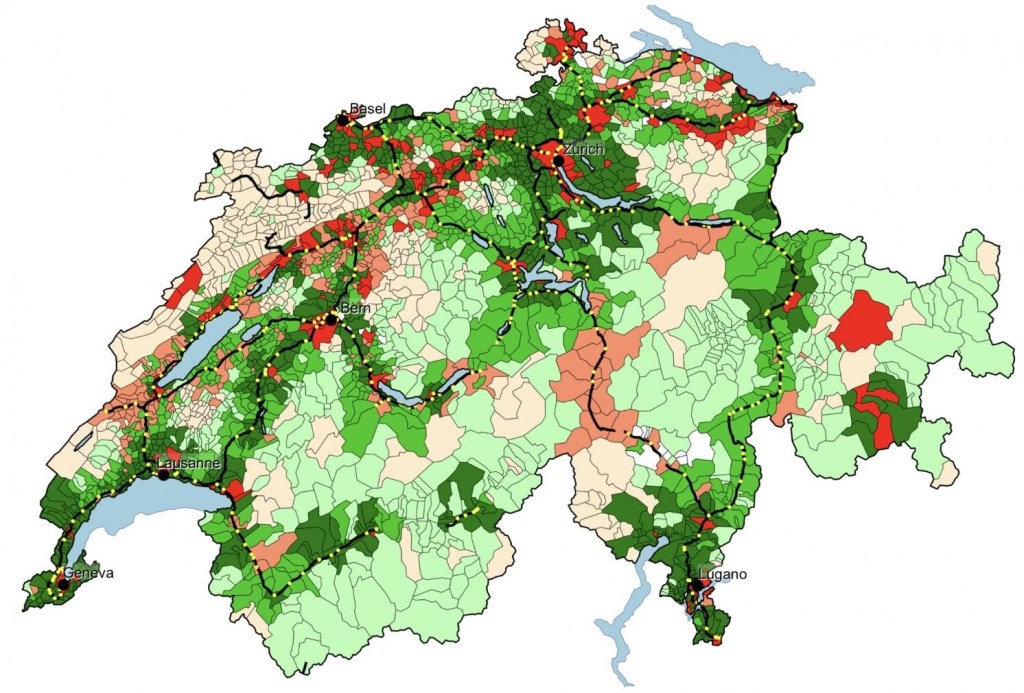
Figure 3: Relative Population Gains by Swiss Municipality 1960-2010.
We find that flights towards the suburbs in Glasgow, particularly as notions of ‘undesirable communities’ became more developed in our current conceptions of Glasgow reflects the present realities of the city, a city that experiences some of the most dreadful poverty, drug deaths, and violence not only in the entire country, but in Europe as a whole. The city is condemned to failure because it loses much of its wealthy urban tax base and thus the city is supported flimsily and more focused with survival rather than growth. Not only this, but while those who were more well off were able to shut their doors on the city in the 1960s, many were not, and those who could not afford such a luxury moved to the ‘villages of the sky’ dotted around the edges of Glasgow in large tower blocks that saw communities such as Anderston decrease two thirds in their population from a high of 32,000 in 1950 within twenty years. We can see certain now ostracised developments, including those in Castlemilk, Carntyne, and Parkhead are zoned off by careful road placements in what cuts our city into little pieces and removes the idea of a united Glasgow entirely. We can illustrate this by simply comparing map data from the Scottish Index of Multiple Deprivation (SIMD) with maps of motorways and arterial developments in Glasgow which almost perfectly align with patches of deprivation for certain enclosed communities. Thus, the malicious attitudes that surrounded American transport policy of the same period made their way to Glasgow, where the goal was to ‘kill two birds with one stone’, where Deborah Archer notes the goal was both to ‘improve traffic conditions and remove undesirable populations’ and thus motorway developments to Moses “[had to] go right through cities and not around them” and motorways in Glasgow seem to fulfil a wider goal of keeping order in this respect. This may keep the city poor, but it develops pockets of poorness that are more at ease with the modern city – where we can be divided as individuals rather than standing together as a community.
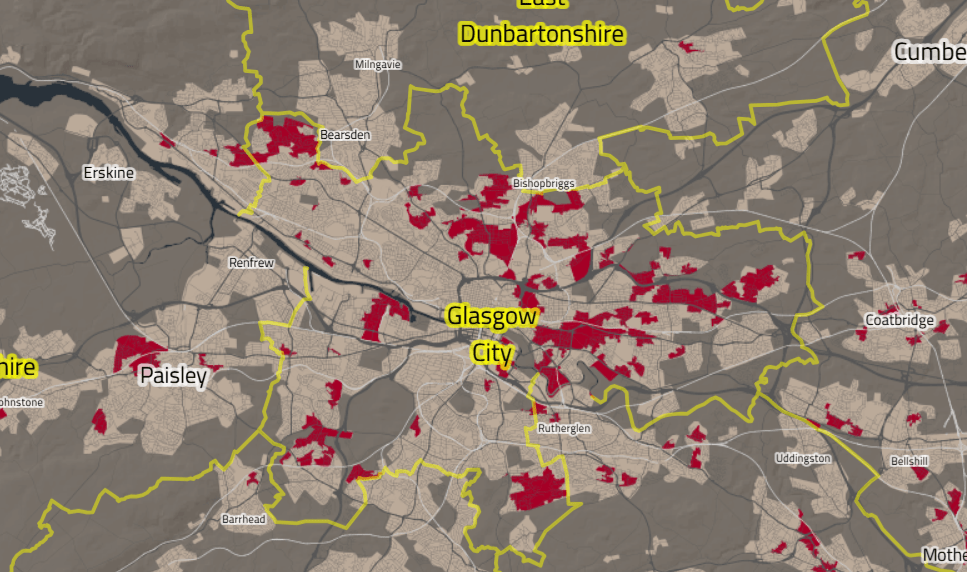
Figure 4: Top 5% Most Deprived Communities in Scotland, Glasgow City Council, Scottish Index of Multiple Deprivation.
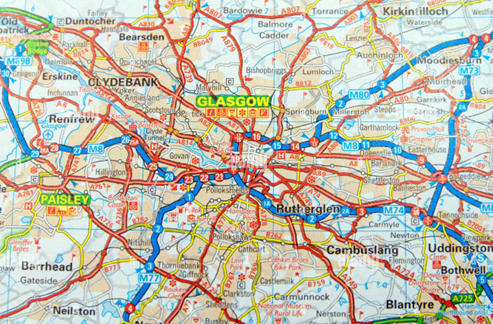
Figure 5: Map of the Motorways and Arterial Roads of Glasgow.
Glasgow is, crucially, by no means a soulless wasteland and is one of the most character filled cities in Europe, but I would like to end by pausing to reflect on what we have lost in the city by leaving the visual impact to stand on its own. If you are to walk along to the Mitchell Library now you can pause and reflect that this is crucially not natural, but rather an attempt to tear to shreds the heart of a community that has always stood together. Many of those who witnessed the scar open are still with us, and it now seems that it is our duty to complete the cycle and at long last heal this scar, for the sake of our city itself.
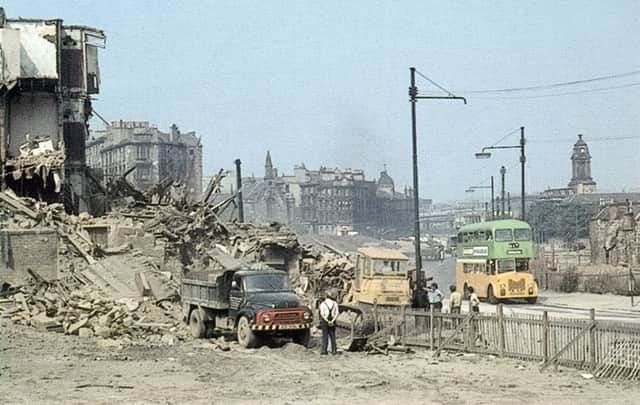
Figure 6: M8 Motorway Construction, Jim Campbell.
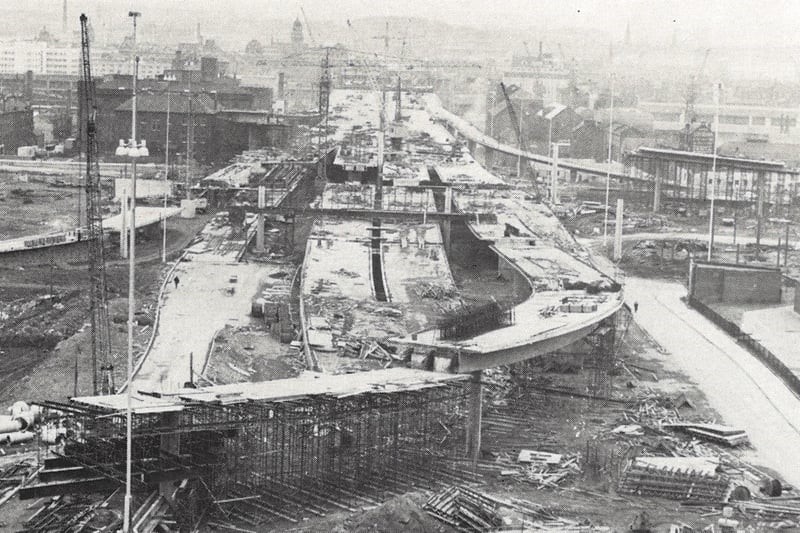
Figure 7: Kingston Bridge Construction, Glasgow World.

Figure 8: Townhead, Scottish Roads Archive.
Bibliography
Artwork
Rijke, de Inez. “This Scar Will Never Heal.” 2022. Glasgow School of Art. https://2022.gsashowcase.net/work/this-scar-will-never-heal/
Official Publications
Mearns, Baillie and Claire Millar. “Future of M8 Motorway – Motion, as Adjusted, Approved After Division.” Glasgow City Council. https://onlineservices.glasgow.gov.uk/councillorsandcommittees/viewSelectedDocument.asp?c=P62AFQDNZ30GUTZ3Z3#:~:text=Council%20reaffirms%20recent%20commitments%20made,car%20traffic%20in%20the%20city
Documentaries
BBC Four. “The Bruce Plan for Glasgow.” August 21, 2013.
Articles
Evans, Farrell. “How Interstate Highways Gutted Communities – and Reinforced Segregation” History. October 20, 2021. https://www.history.com/news/interstate-highway-system-infrastructure-construction-segregation
Smith, Mark. “They Said Glasgow’s Scar Would Never Heal. They Were Right.” The Herald. April 10, 2023. https://www.heraldscotland.com/politics/viewpoint/23444497.said-glasgows-scar-never-heal-right/
Leadbetter, Russell. “M8 in Glasgow: Should it be Scrapped?” The Herald. April 16, 2023. https://www.heraldscotland.com/news/23453466.m8-glasgow-scrapped/
Institute for Transport & Development Policy. “Highways and Zoning: Tools of Racist Policy.” Institute for Transport & Development Policy. March 10, 2021. https://itdp.org/2021/03/10/highways-and-zoning-tools-of-racist-policy/
Robert-Nicoud, Frédéric and Raphaël Parchet. “How Highways Shape Regional Disparities.” Centre for Economic Policy Research. October 15, 2021. https://cepr.org/voxeu/columns/how-highways-shape-regional-disparities#:~:text=The%20expansion%20of%20highway%20networks,of%20this%20deep%20economic%20mechanism.
Simama, Jabari. “The Roads that Tear Communities Apart.” June 28, 2024. Governing. https://www.governing.com/urban/the-roads-that-tear-communities-apart
“The Areas of Glasgow Changed Forever by the M8 Construction in the 1960s – In Pictures.” https://www.glasgowworld.com/retro/the-areas-of-glasgow-changed-forever-by-the-m8-construction-in-the-1960s-in-pictures-3418172
Kober, Eric. “Scars on the Cities.” City Journal. Autumn 2021. https://www.city-journal.org/article/scars-on-the-cities
Hampton, Shane. “60 Years of Urban Change: Midwest.” December 12, 2014. https://iqc.ou.edu/2014/12/12/60yrsmidwest/
Miller, Johnny. “Roads to Nowhere: How Infrastructure Built on American Inequality.” February 21, 2018. https://www.theguardian.com/cities/2018/feb/21/roads-nowhere-infrastructure-american-inequality
Brown, Mark R. “Reconnecting Cities through Urban Highway Removals.” Car Free America. September 11, 2017. https://carfreeamerica.net/2017/09/11/reconnecting-cities-through-urban-highway-removals/
Briggs, Jimmie and Melissa Stanton. “Decades of Highway Construction and Community Destruction.” AARP. February 1, 2023. https://www.aarp.org/livable-communities/getting-around/info-2023/before-the-highway-introduction.html
Dutzik, Tony. “The Highways had to go Somewhere. Fixing the Deficit in our Political Immagination.” Frontier Group. March 23, 2022. https://frontiergroup.org/articles/highways-had-go-somewhere-fixing-deficit-our-political-imagination/
Journal Articles
Mohl, Raymond A. “STOP THE ROAD: Freeway Revolts in American Cities.” Journal of Urban History 30, No. 5. (July 2004). https://doi.org/10.1177/0096144204265180
Featured Image Credit: Rijke, de Inez. “This Scar Will Never Heal.” 2022. Glasgow School of Art. https://2022.gsashowcase.net/work/this-scar-will-never-heal/.
 Retrospect Journal