
Written by Olivia Norbury
Tango, as music, originated in the Río de la Plata region in Argentina and Uruguay in the late nineteenth century, and initially referred to the music of enslaved Black people, which blended European and African traditions. Tango, as a dance, originated at a similar time, and had a parallel multicultural influence, combining elements of candombe, the Spanish tango (a variety of flamenco), milonga, a fast and sensual Argentinian dance, and habanera, a Cuban dance originating in the eighteenth-century Spanish colonial period. By 1900, tango was an established dance with key features of a man and a woman holding each other in a close embrace, the corte (cut), and the quebrada (break). Tango became central in Carnival parties, as well as in recreational dancing and casitas (brothels rented by the night).
Tango as both music and dance was pushed to the fringes of Buenos Aires during Argentina’s political turmoil in which brothels, dancing, and other similar merriments were prohibited. Whilst it was initially perceived to be inappropriate, it became commonplace between 1905 and 1910, and therefore, less shocking to more conservative audiences, although it still received some criticism. Its increasing popularity further led to the introduction of tango in Parisian aristocratic ballrooms in 1911, before spreading throughout Europe to places such as London and Berlin. The reception of this Argentinian dance was extremely successful, not least because of its perceived exoticism and eroticism. This impact led to the increase of both Argentinian and European tango teachers, and the introduction of standard choreography that was deemed more respectable. People in Buenos Aires were reluctant to hear about this Parisian success, but ultimately it broadened the use and popularity of tango beyond Argentinian borders.
The popularity of tango in Argentina constantly fluctuated from the 1910s onwards, with disruptions due to international events such as World War I, and the Great Depression. The latter event coincided with the overthrow of the Argentinian government, taking away opportunities for celebration and dancing. Under Juan Perón’s new government, tango became fashionable again, albeit temporarily. Perón viewed tango as a source of national pride, and therefore, made copious efforts to revive and spread the dance. Nonetheless, in the 1950s, the Argentinian military dictatorship banned public gatherings which severely repressed tango throughout the country and affected its international popularity.
There was a resurgence of tango in the 1980s, owing to a variety of factors, such as Tango Argentino, a show that opened in Paris, and the efforts of Osvaldo Peredo, who is credited with the renaissance of tango in Argentina itself. In 2009, UNESCO named tango in its Intangible Cultural Heritage List, acknowledging the impact of the dance on Argentinian culture, and cementing its place in both Argentinian and more global history.
Nowadays, tango has been popularised in mainstream media, such as Strictly Come Dancing and Dancing with the Stars. However, its subaltern origins, that are often obscured by its proliferation in Europe and amongst elites, must not be forgotten. The function of tango as a form of expression and celebration within a community historically enslaved and oppressed are integral to its modern formation. In fact, modern parallels exist in the ‘queering’ of tango that seeks to disrupt its traditional heterosexual norms in Argentinian tango, and wider society, through same-sex partnerships, or partnerships in which any gender can lead, and any can follow. Queer tango therefore undermines traditional gender roles and inserts LGBTQ+ identity into the cultural centre of Argentina. In this way, tango continues its original function in providing space for marginalised groups to celebrate and escape. Ultimately, tango is a powerful symbol of Argentinian identity, and thus, reflects the nation’s evolution and serves as a vessel for its cultural essence.
Bibliography
‘Argentinian Tango’s History – Introduction’. https://escuelatangoba.com/marcelosolis/tango-history/ [accessed November 4, 2024]
Davis, Kathy. Dancing Tango: Passionate Encounters in a Globalizing World. New York: New York University Press, 2015.
Gulledge, Steph. ‘A Brief History of Tango’. https://www.butterfield.com/get-inspired/brief-history-tango [accessed November 4, 2024]
Wendland, Kristin and Link, Kacey (eds.). The Cambridge Companion to Tango. Cambridge: Cambridge University Press, 2024.
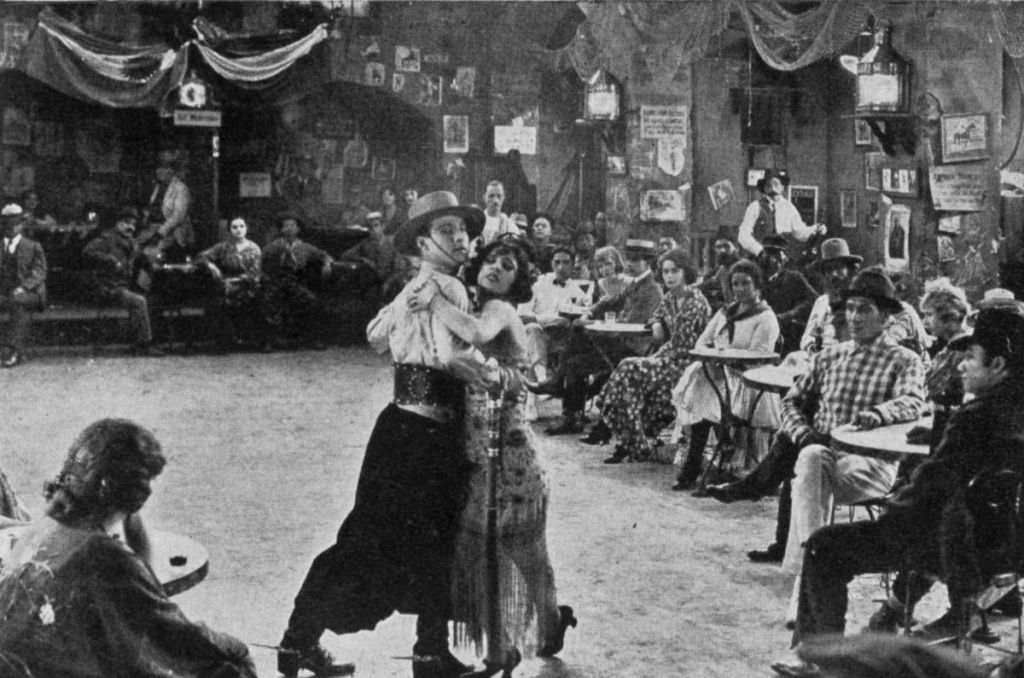
Featured image credit: Tango scene from The Four Horsemen of the Apocalypse, 1921. Accessed via Wikimedia Commons: https://commons.wikimedia.org/wiki/File:Tango_scene_from_The_Four_Horsemen_of_the_Apocalypse.jpg
 Retrospect Journal
