
Written by Arianna North Castell
“Strange divinity!” (δαιμονίη), is how Helen of Troy describes Aphrodite in the third book of the Iliad. The word in Greek has a plethora of connotations, at times translated as ‘maddening one’. ‘Maddening’ is hardly an inaccurate description for the goddess, as her polarising characteristics make her frustratingly elusive. If we were each to call to mind a story from her mythology, it is likely we would recall different ones, and the figure of Aphrodite might even be unrecognisable from one story to the next. Fickle, indecisive, selfish, a doting mother, a cheating spouse, a benevolent patron, and sadistic punisher of perceived slights, it seems almost impossible to regard Aphrodite as a singular entity. When confronted with such a puzzling character, the desire to know why such complexities have arisen is only natural – and for that we must start at the beginning.
When looking into the origins of a member of the ancient Greek pantheon, it is a reflex to look to the Mycenaeans. In the last decades, we have been able to find many names of the Greek gods in Linear B script (such as Zeus or Poseidon), but when we look for Aphrodite’s name, we draw a blank. Her absence suggests that by the collapse of Mycenaean civilisation around 1200 BC, Aphrodite as we recognise her was not yet worshipped. However, she appears as a codified deity in Homer’s Iliad, meaning that she was not only an accepted member of the Pantheon at the time that the text was written, but easily a couple of hundred years prior considering the oral transmission of the epic. Sometime between these two dates, we see Aphrodite not only emerge as a goddess but become a significant member of the Pantheon. Unfortunately for us, this period of Greek history is called the ‘Dark Ages’, the centuries-long chasm between the disuse of Linear B and the emergence of the Greek or Phoenician script, meaning we have no written materials from this time.
This, however, is far from a dead end. Our next port of call is Kythera, the mythological birthplace of the goddess. Though the story of her birth is decidedly mythological (no questions of historical veracity have ever been offered surrounding from her birth from seafoam and the ichor from Ouranos’ severed genitals) her first appearance in the Greek sphere being Kythera is not devoid from historical truth. Though it is not possible to pinpoint exactly when (some scholars speculate around the 1400s BCE), the Phoenicians settled in Kythera, bringing with them their cult of the goddess Astarte. Her cult flourished among Phoenician trade routes, and Kythera was a key trading hub. Though Cyprus is a popular location for Aphrodite’s birth, the first historical evidence of her cult lies in Kythera. Aphrodite rising from the sea and landing on the island can therefore be seen as a mythological representation of the cult of Astarte coming from the sea and making landfall. The goddess Astarte shows the roots of what will eventually become the Aphrodite we recognise.
Astarte was the Phoenician goddess of war, fertility and sex. Her Mesopotamian counterpart, Inanna or Ishtar, is perhaps more widely recognisable, identifiable from her role in the Epic of Gilgamesh. Inanna’s repertoire of divine responsibilities is even more broad, being the goddess of justice, love, sex, political power and war. She was also called ‘the Queen of Heaven’. Within the mythology and characteristics of these two goddesses, we see the origins of what will become Aphrodite’s recognisable qualities and stories. One of Ishtar’s most significant stories is her descent into the Underworld, where she undertakes a katabasis to see her deceased husband Tammuz, but comes into conflict with Ereshkigal (the Queen of the Underworld). This story provides the framework for what will become the story of Adonis, whom Persephone and Aphrodite come into conflict over. Aphrodite’s birth via the castration of Ouranos can also find its counterpart here. Ishtar’s father Anu has his genitals bitten off by the god Kumarbi, who was then impregnated and gave birth to the god Teshub. The influence between Astarte and Inanna was significant, both were Ancient Semitic goddesses that fulfilled similar roles in their worship as goddesses of fertility and war.
If there is one feature from these goddesses that differs from our understanding of Aphrodite, it is the notion of her as a war goddess. In fact, the Iliad goes to great lengths to emphasise that the battle place is the last place she should be, Aphrodite being wounded by Diomedes and later being chided by Zeus for being on a battlefield in the first place. However, the initial worship of the goddess in Kythera and Sparta saw no contradiction in a goddess that was both of love and war. She was worshipped as Aphrodite Areia, and archaeological evidence shows statues of Aphrodite clad with armour. Though the Spartan ideology lent itself well to a war-love goddess, the rest of the Greek city-states found this to be contradictory, and already had prominent figures for war in Athena and Ares. Therefore, as the worship of Aphrodite spread throughout Greece, we see her shed her status as a war goddess and become strictly a goddess of love, fertility and sex. This is unlikely to have been an easy transition – the fact that Homer seems to comment on this debate of ‘Aphrodite in war’ in the first place tells us that this was a point of contention in the first place.
It is here that the dichotomous nature of Aphrodite starts to be brought into question. The first literary sources that feature the above characterisation of Aphrodite are contemporary to each other, and immediately contradict. In the Iliad, Aphrodite is described as the daughter of Zeus and the Titaness Dione, but in Hesiod’s Theogony, Aphrodite is born from seafoam that forms when the genitals of Ouranos are flung into the sea. As discussed, throughout her mythology Aphrodite hardly offers a coherent characterisation; she is known to graciously grant favours to mortals, but also be cruel and selfish to them. She is a doting maternal figure, yet a faithless wife. These differences did not go unnoticed by Greek philosophers, who took Aphrodite’s contrasting birth stories as a tidy solution to the problem of her dual nature and promptly divided her into two. The distinct versions of the goddess are given the epithets Aphrodite Ourania and Aphrodite Pandemos.
Aphrodite Ourania was the consequence of Ouranos’ castration and represented a divine, heavenly, and pure love. In this version she is gracious, maternal, and giving. She is seldom represented in literature but has a large cult presence. She is the goddess of celestial love, devoid of physical attraction. It is important to note that this characterization of Aphrodite Ourania was heavily cemented by later Christian theologians, whose own ideologies undoubtedly shaped this description. The tendency to distance sex from divinity seems to stem here (as it was certainly no issue for the contemporary Greeks) and is entirely reminiscent of the madonna/whore dichotomy, wherein to respect and venerate affection and love, it cannot overlap with physical attraction. The contemporary splitting of Aphrodite’s character in this way more likely came from the Greek concepts of the division of love (into storge, philia, eros, etc.). Though the reason for the split is contested, there was an evident division, and Aphrodite Ourania heavily contrasts Aphrodite Pandemos. Aphrodite Pandemos means Aphrodite of ‘all the people’ and it is this Aphrodite that is most recognisable from the literature. Born from Zeus and Dione, this Aphrodite focuses more on the physical side of love, and is impulsive, petty and flighty. The epithet ‘Pandemos’ also signifies her role in unifying the Greek people under her worship; it is even said that Theseus invoked her in his efforts to unite scattered townships. Interestingly, the division between the two Aphrodites is first proposed by Plato in his Symposium. He argues that the goddesses are entirely distinct, the ‘older’ Aphrodite Ourania representing homosexual and pederastic love and the ‘younger’ Aphrodite Pandemos representing heterosexual desire and promiscuity. To him, homosexual love was exclusively male and for the ‘education of the soul’, whereas heterosexual love is dedicated to sensual pleasure. It is worth noting that women, to his perception, are only capable of love as classified under one of these figures.
Though the faint beginnings of Aphrodite’s political use can be seen under her ‘Pandemos’ denomination, this actually lends to a key phase of her development. Across the sea in Rome, Aphrodite (now conflated with a local fertility goddess, Venus) was a vital figure. She was the mother of Rome’s ancestral founder, Aeneas, and therefore seen as the mother of Rome itself. She was commonly worshipped under the epithet ‘Genetrix’, meaning founder of the family line, or simply mother. This maternal characterization only expands, with Venus often being conflated with maternal goddesses such as the Egyptian Isis. It is also during this time that Venus becomes the mother of Eros, whereas previously he was her attendant. Julius Caesar even claims to be descended from her, adding to her political significance as the maternal figure for Rome. In this way, we can almost see Aphrodite’s characterisation returning to her roots and she gains militaristic significance once again.
Aphrodite is far from a simple goddess and has never pretended to be. As the embodiment of something as polarising as love, it is unsurprising that her nature and worship would mirror this. Her many phases are not just revealing of the nature of her worship, but also of the societies that venerated her. The tailoring of her features as a goddess are entirely indicative of the distinctive cultures that made the ancient world, and represent the rich cultural exchange that shaped their communities. Though her denominations are markedly distinct, they underscore the true inclusivity of her worship, making her truly a goddess for all.
Bibliography
Breitenberger, B. (2013). Aphrodite and Eros: The development of erotic mythology in early Greek poetry and cult (Chapter 1). Routledge.
Collins, P. (1994). The Sumerian goddess Inanna (3400–2200 BC). Papers from the Institute of Archaeology, 5, 103–118.
Downing, C. (2006). Plato: The Symposium (Chapter 15). In Myths and Mysteries of Same-Sex Love (pp. 243-263). iUniverse.
Lattimore, R. (Ed.). (1951). The Iliad of Homer (1st ed.). University of Chicago Press.
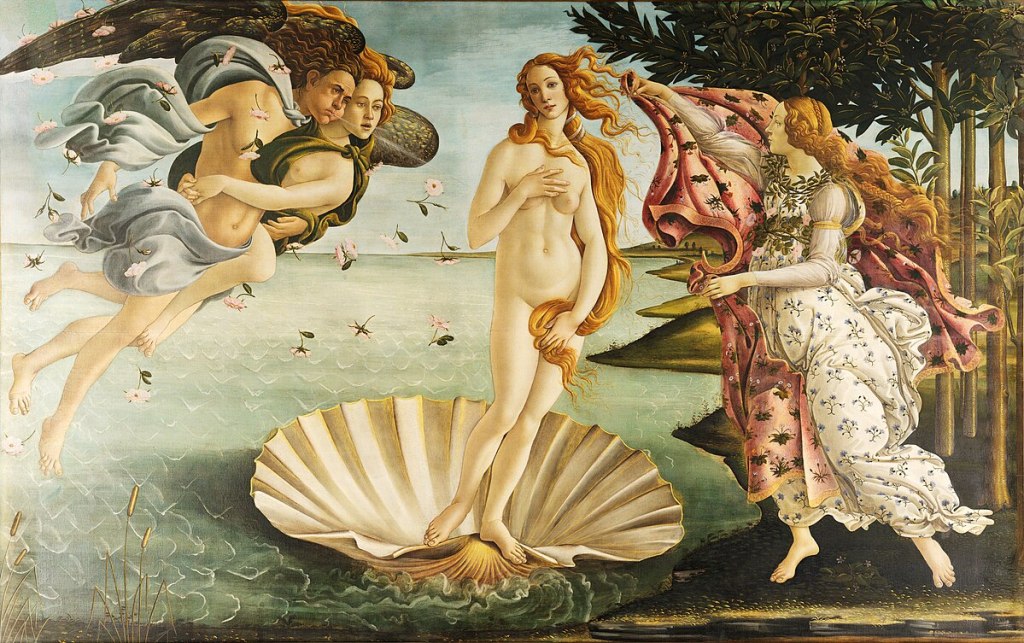
Featured image credit: The Birth of Venus by Sandro Botticelli (c. 1485). Accessed via Wikimedia Commons: https://commons.wikimedia.org/wiki/File:Sandro_Botticelli_-_La_nascita_di_Venere_-_Google_Art_Project_-_edited.jpg
 Retrospect Journal
