
Written by Anjaleen Hussain
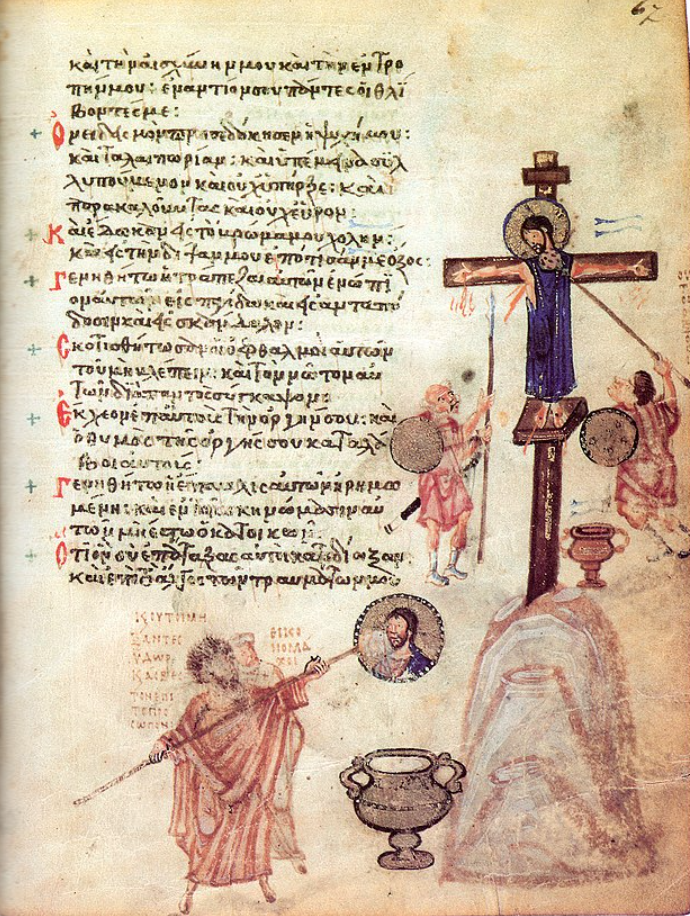
Iconoclasm is one of the most significant religious controversies in the history of Christianity. The term itself can be defined as a belief in the destruction of images and icons associated with religion, and a general opposition to ‘icon-veneration’. The manifestation of Iconoclasm under the Isaurian Emperors of the Byzantine Empire, Leo III and Constantine V Copronymus, can provide a significant insight into how religion was utilised by Byzantine imperial authorities to consolidate their powers and authority.
Within the Byzantine Empire, the Iconoclastic movement reached its peak during the eighth and ninth centuries AD, under Emperor Leo III and his son Emperor Constantine V. In response to Iconoclasm, the Iconophile movement also developed during this period, which ‘defended’ the use of icons in religious practice. While Leo III was the first to publicly attack icon veneration, it is known that the early Church avoided creating images and icons of Christ due to the Second Commandment, which renounced paganism and idol worship. Despite limited support for Iconoclasm in early Church history, legislative attempts to curb Iconophile action began with Leo III, the first emperor to issue an official decree in AD 725/26 which forbade icons of Mary and Jesus. It is no coincide that this move came after much political and social calamity struck the Byzantine Empire.
The rise of Islam began to pose a serious threat to the stability and power of Constantinople, with an increase of successful incursions into Byzantine territory. Along with ongoing warfare, natural disasters such as the Santorini volcanic eruption in AD 726 could have also contributed towards superstitious beliefs of divine displeasure and apocalypticism within the collective conscience of Byzantine society. It can be argued that due to ongoing conflict and disturbances to the structure of the empire, Iconoclasm was introduced by Leo III in policy, as a religious response that sought God’s favour. The removal of the icon of Christ over the Chalke Gate, the main entrance to the imperial palace not only symbolised the beginning of the Iconoclast movement but also the start of violent and bloody religious conflict.
Interactions with Muslims may have provided a basis for the theological reasoning behind Leo III’s Iconoclastic rule. In AD 721, shortly before Emperor Leo’s anti-Icon decree, Yazid II of the Umayyad Caliphate had issued an Iconoclastic edict which banned the veneration and creation of icons, unusually extending the prohibition to the Christian churches found within the boundaries of the Islamic Empire. In polemical debates, the Islamic doctrine of shirk, polytheism, allowed Muslims to accuse Christians of idolatry due to their use of icons, while also providing a basis for criticism of the doctrine of the Holy Trinity. Some scholars have proposed that contact with Arabs and exposure to Muslim influence at Germanicea, a direct area of conflict and interaction could have influenced Leo, who aimed to reform the Byzantine Christian population, engaged in ‘idol-worshipping’. However, Hussey and Louth hold the viewpoint that there could have been no direct contact nor relation between Yazid and Leo. This is significant in assessing the possible theological influences in Leo’s decree, indicating the shifting religious and political nature of the empire at the time.
Following his father, Constantine V’s rule saw the theological development of Iconoclasm with more drastic measures taken against Iconophiles. The Council of Hiereia in AD 754, named the ‘Seventh Ecumenical Council’, was called by Constantine and attempted to proclaim Iconodulism (the veneration of icons) as a heresy. At this gathering, Constantine is recorded as utilising Christology and Eucharistic arguments as well as religious scripture to undermine and vilify icon veneration. The heresy of Iconodulism concerns previous debates within Christianity, regarding the nature of Christ as divine and human. The Iconoclastic argument made by Constantine argued that an icon cannot depict the divine nature of Christ, but only the human which falls into the problem of dividing the two natures of Jesus. The Eucharist was also defined as the only true image of Christ, with wine and bread representing the blood and the body. The development and theological precision with which Constantine developed his argument was impactful and laid down the groundwork for further action against icon veneration.
The implications of an emperor calling an Ecumenical council and using theology to influence law, illustrates larger issues with the politics of religion. Through the virtue of being emperor, Constantine was able to dictate the practices of popular religion, establishing a significant link between imperial authority and religious authority. This is further affirmed by the mentioning of the imperial powers of the emperors and the idea of the emperor holding a ‘dominion’ as mentioned in a text from the Council of Hiereia AD 754. “The holy Council cried out… May God bring peace to your dominion. Your life is life for the orthodox. Heavenly king, preserve the earthly king!”
It may be argued that outlawing icon veneration could have consolidated the powers of the leaders as both religious authorities and divinely chosen rulers of the Christian empire. It is known that gold coins depicting the Iconoclast emperors and honouring their dynastic rule were still created, despite the ban on depictions of Christ. While icon veneration would have been more concerning due to idolatry, it is possible that Constantine may have been using such propaganda as a mean to emphasise his right as a hereditary ruler of Byzantine and saw idol-worship as a threat to this.
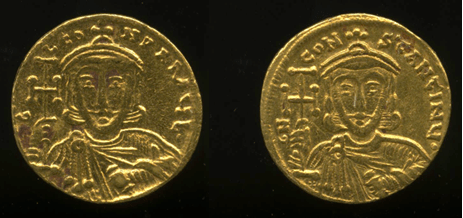
Solidus of Leo III and Constantine V from Constantinople, British Museum.
Auzépy explores how imperial oaths played an important role during the gathering of the Council, where the religious clergy and bishops were sworn to never prostrate before religious images. Imperial oaths made renunciation of Iconoclasm difficult for religious clergy when the Council of Nicaea in AD 787 met to restore the use of icons. Here, Constantine was attempting to exercise his powers as emperor as much as possible. This posed a challenge to both the Church and the Papacy in Rome, who refused to cooperate with Iconoclasm, beginning with Leo’s decree in AD 725/26.
Fifteen years after the original Council of Hiereia was gathered by Constantine, a Lateran Council was held in Rome in AD 769. During this gathering, those who were gathered declared their joint opposition to Iconoclasm and the Council was subsequently anathematised. It is significant to note that a Frankish delegation was also present at this council meeting, indicating a growing religious and cultural schism between the East and the West. The condemnation of Constantine’s imperial policy here not only challenges the authority of Constantine but also highlights the growing divergence between the Papacy and the Emperor.
The challenge the Papacy posed towards the Iconoclastic rule of Constantine can provide an insight into his harsh treatment towards Iconophiles, and monks. Stephen the Younger, a monk from Constantinople, was a key figure in the rival Iconodule movement that promoted the veneration of icons. His opposition not only resulted in persecution, but also a systematic repression of monasticism. Some scholars have explored the important role of monks in the Iconophile movement, opposing the emperor’s Iconoclasm. This highlights how monasticism was a severe threat to imperial authority. Constantine responded harshly and is known to have issued severe punishment to such opposition, resulting in the eventual execution of Stephen after he refused to accept the decisions made at Hiereia.
While monks living within the realm of the Byzantine Empire were enduring such suppression, religious figures outside appear to have been more openly opposed to Iconoclasm. John of Damascus, who had previously lived under the Umayyad Caliphate and then retreated to Palestine, is noted for perfecting the theological arguments of Iconodulism and acting as a ‘defender of icons’. In his treatise, he appears to base the premise of his argument in a Christological logic, focusing on how through incarnation, Christ chose to be pictured and therefore could be ‘image-able’ since. He also built upon the idea that there is indeed a difference between veneration and worship, and only God should be worshipped. What is most interesting about his treatise, is his imploring of people to “cling to the traditions of the Church”. This again suggests the power struggle that was occurring between institutional religion concerned with the Church and the Papacy, and the authority of the emperor. John of Damascus was later individually condemned at the Council of Hiereia in AD 754 and referred to as “Saracen-minded” in his idolatry.
For many ‘Eastern’ Christians, Iconodulism encompassed both a cultural and religious identity, a constant during a period of immense conflict. The Iconoclastic movements of the Isaurian emperors can be understood as a means of their consolidation of imperial power, by challenging religious institutions such as the Papacy in Rome. The movement also suggests a point of superstition where the rise of Islam and cross-cultural exchange may have forced the emperors to re-evaluate religion as it was practiced and how it physically manifested. Iconoclasm under the Isaurian Emperors in this sense can be seen as a continuation of the growing religious divergence and schisms between the east and the west.
Bibliography
Primary Sources:
Horos of the Council of Hiereia of 754 & Horos of the Second Council of Nicaea of 787 – https://ccel.org/ccel/schaff/npnf214/npnf214/Page_Index.html
John of Damascus, extract from First Discourse against Those Who Slander the Holy Images - https://archive.org/details/stjohndamasceneo00john
Secondary Sources:
Chadwick, Henry. East and West: The Making of a Rift in the Church, From Apostolic Times until the Council of Florence. Oxford: Oxford University Press, 2003.
Hussey, J.M., and Andrew Louth. The Orthodox Church in the Byzantine Empire. Oxford: Clarendon Press, 2010.
Kazhdan, A.P. (ed.). The Oxford Dictionary of Byzantium 3 vols. New York: Oxford University Press, 1994.
Meyendorff, John. Byzantine Theology: Historical Trends and Doctrinal Themes. New York: Fordham University Press, 1983.
Noble, Thomas F. X. Images, Iconoclasm, and the Carolingians. Philadelphia, PA: University of Pennsylvania Press, 2009.
Shepherd, Jonathan, ed. The Cambridge History of the Byzantine Empire c. 500—1492. Cambridge: Cambridge University Press, 2008.
Treadgold, Warren. A History of the Byzantine State and Society. Stanford: Stanford University Press, 1997.
Vasiliev, A. A. “The Iconoclastic Edict of the Caliph Yazid II, A. D. 721.” Dumbarton Oaks Papers 9/10 (1956): 23–47. https://doi.org/10.2307/1291091.
Image of Solidus of Leo III and Constantine V Copronymus taken from:
https://www.britishmuseum.org/collection/object/C_1994-0915-675.
 Retrospect Journal