
Written By Marnie Camping-Harris
17/11/2024
According to Caroline Vout, sex and love was “Rome’s special ‘power base’”, therefore, it is not surprising that this would be a major component to Apuleius’s Metamorphosis. Throughout the novel Apuleius’ protagonist and narrator, Lucius, travels within the Roman Empire. His constant intrigue and desire for curiosity help to move the narration on, with his experiences varying from difficult to pleasurable. Regarding the latter element, pleasure can be described as an undertone of Apuleius’ novel, with this component featuring throughout. The concepts of sex and love help to distinguish Metamorphosis from other Roman epics by aiding Apuleius in his depiction of social and economic life during this period, which a “vast mass of surviving Classical literature simply ignores”. Moreover, Metamorphosis provides examples of how the gods and goddesses were utilised in erotic experience, the reality of what sex was like outside of marriage, and how written description can compare to physical imagery – both heteronormative and homoerotic.
The most prominent erotic experience in Metamorphosis is that between Lucius and Photis. Photis is introduced as the slave of Lucius’ friend Milo and his wife Pamphile, who is rumoured to be a witch. Lucius’ description of Photis is rather voyeuristic, with his immediate attention drawn to her breasts and pretty appearance, although her personality is also noted as being playful yet “sharp as a needle”. However, this portrayal can be deemed rather tame when compared to other explicit imagery, circulating within the Roman Empire. Such images could be found all over, from public bathhouses to private bedrooms, all with the intention to make heads turn, eyes widen and for “fantasies to run wild”. These fantasies are not confined to just heterosexuality, with homoerotic imagery also found in excess. For instance, a mosaic floor found in a Roman Sussex dining room depicts a bronzed, nude boy; utilised by the Roman owners to attract the diners to the beauty of the male body and therefore, the possible sexual availability of their cupbearers and other male servants.
Male-male desire can be identified in Metamorphosis as well. Although it is not key to the novel’s plot, in Book 2, Chapter 13 Lucius remarks on how a young gentlemen snuck up behind the salesman and to his delight, “swung him around, kissing and hugging him tightly”. This small snippet of an interaction almost normalises homoeroticism in the Roman period. The blasé nature of its inclusion emphasises the nuance of homosexuality, with its infatuation and intensity portrayed at the epicentre of this fragment of life.
Another and seemingly more significant image, which is repeated by Apuleius in his Metamorphosis, is that of Venus. The goddess is utilised as both an innuendo and comparison for sex and love in the novel. On his first night with Photis, Lucius describes his erection as “my impatience for Venus”, proudly flaunting it to her. In this instance, Venus could be understood as either the concept of their lovemaking or Photis herself, with Lucius evidently hungry for both the performance and the performer. However, his impatience is most likely referring to Photis’ transformation, which is depicted once she removes her clothes and lets down her hair; “she beautifully transformed herself into the picture of Venus rising from the ocean waves”. Lucius also remarks of Photis’ “smooth-shaven pubes”, which is interesting to read in regard to modern beauty standards felt today. Now, there is no qualms in claiming that Photis and Lucius’ affair is incredibly erotic in its description, however, questions can be raised around Lucius’ initial reasoning for entering such a relationship, given the standards of the time. Rome ultimately promoted marriage. Therefore, any sexual relationship occurring outside of that partnership was condemned as punishable. It is assumed that Lucius is single in Apuleius’ Metamorphosis, making his affair with Photis more acceptable and legal in the eyes of Rome. However, due to Photis’ standing and rank in the Roman Empire as a slave, Lucius is not intending to marry her. His motivations for this relationship are relatively clear, and that is to discover what secrets her mistress Pamphile hides, as she performs her witchcraft. Therefore, a link can be made between Lucius’ desire for sex and his desire for knowledge, with love altogether forgotten. Perhaps love is too often forgotten when analysing it within the Roman Empire, with Vout claiming a comparison to Venus demonstrates how sex is always political.
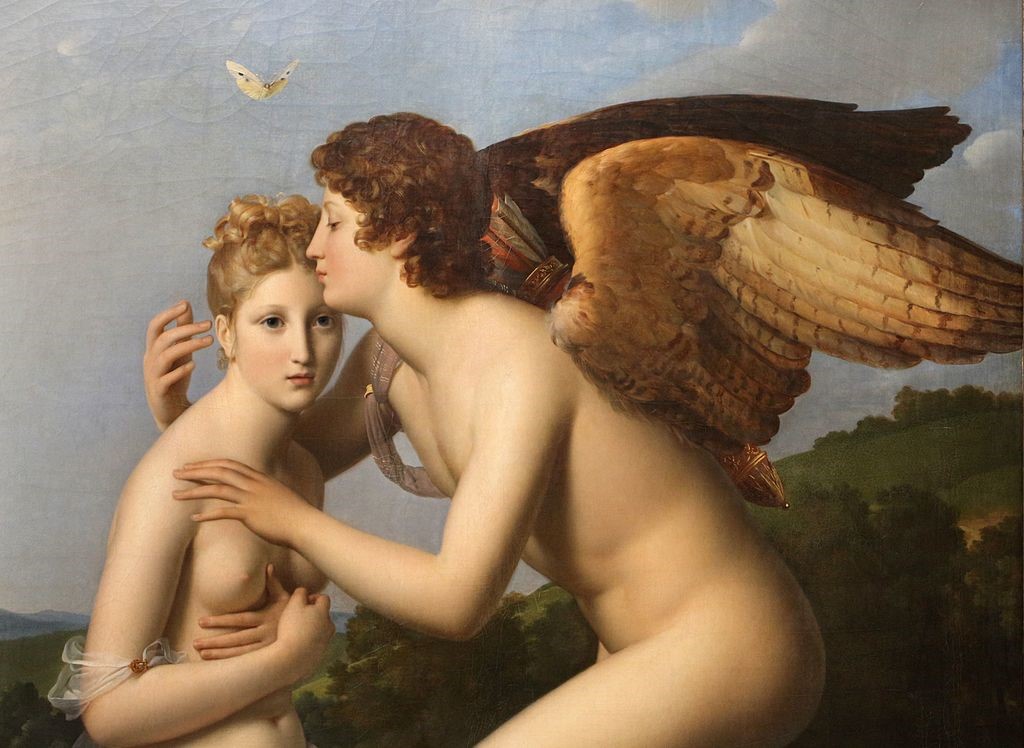
One of the largest sections of Apuleius’ Metamorphosis however, is dedicated to the narrative of Cupid and Psyche, begun in Book 4 Chapter 28. After Lucius’ affair with Photis cost him his human existence, and he is ultimately turned into an ass, he is stolen away by thieves in the night. Alongside himself, the thieves also abduct a young wealthy woman named Charite. Our narrator helpfully provides some background knowledge of this new character, centralising her story on her engagement, and proving once again how love is central to Metamorphosis’ plot. Lucius notes of how she had recently become engaged to a young local aristocrat, who was loved by the whole city like a son, and that their engagement had been celebrated by processions and sacrifices. Due to her visible and explainable distress, she begins to break down, but is stopped by another woman, who soothes her with the story of Cupid and Psyche. Fergus Millar remarks how this narration, by someone else met on Lucius’ way, is rather different to the ones told beforehand in Metamorphosis, as not only does it occupy a hefty number of pages in Apuleius’ novel, but the story itself is set in a completely “imaginary time and place”. In fact, Apuleius was the original creator of this now popular myth, serving as testament to perhaps what his initial intention with the novel was, yet nevertheless it is clear he desired to write about sex and love throughout it.
To conclude, there is no doubt as to what role sex and love play in Apuleius’ Metamorphosis, with it being central to Lucius’ storyline and arc as a narrator. Small snippets of relationships, whether heterosexual or homosexual, are included throughout the novel, allowing readers to understand more of what the standards of love and sex could have been under the Roman Empire. Moreover, the affair between our narrator Lucius and the slave Photis helps readers comprehend what casual sex was like in this period, as well as how it was perceived and described. Apuleius does not tone down the eroticism of the act, depicting a simple French kiss as “her tongue darting against mine with a touch like nectar”. Lastly, the inclusion of the myth of Cupid and Psyche ultimately proves what Metamorphosis’ main theme is, as how could the foundation of perhaps the most romantic and erotic myth not be based on the concepts of sex and love?
Bibliography:
Apuleius, Metamorphosis.
Martin G. Eisner and Marc D. Schachter, “Libido Sciendi”: Apuleius, Boccaccio, and the Study of the History of Sexuality”, Publications of the Modern Language Association of America, Vol 124, No. 3, (2009).
Fergus Millar, “The World of the Golden Ass”, Journal of Roman Studies 71 (1981).
Caroline Vout, “Sexuality” in A Cultural History of Western Empires: Antiquity, ed. Carols F. Noreña (London: Bloomsbury Academic, 2019).
Featured Image Credit: Cupid and Pysche, https://womeninantiquity.wordpress.com/2017/04/02/psyched-out-apuleius-psyche/.
 Retrospect Journal