
Written By Angelina Castrucci
17/11/2024
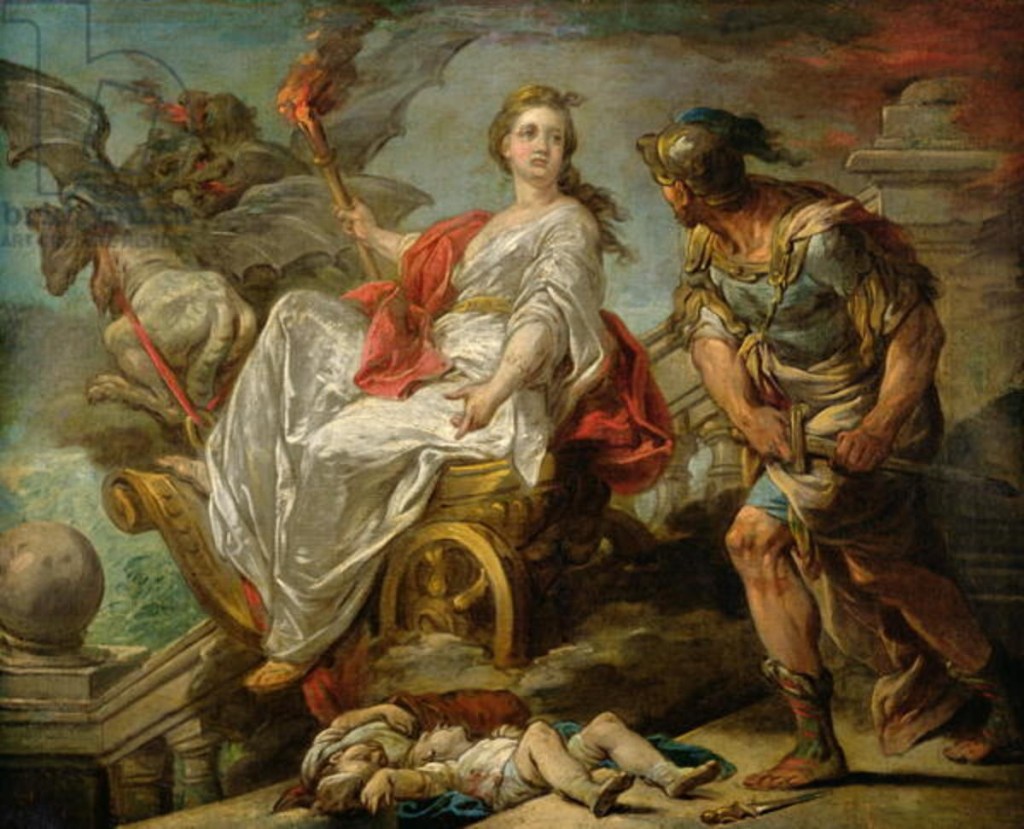
In Euripides’ play Medea, the eponymous heroine articulates a profound critique of the gendered burdens imposed upon women, contrasting their relegation to domestic spaces with the valorisation of male prowess: “They say we lead a life without danger at home, while they fight in war. Nonsense. I would rather stand in line three times with a shield at my side than give birth once”. This paradox reflects Classical Greek society’s conflicting views: women are valued for reproduction but limited by societal constraints, forcing them to internalise an identity as mere bearers of citizens. This paper argues that constraints imposed upon women in Classical Greece render the female body a site of subordination and yet, paradoxically, a means of exercising limited power within the public domain. To support this argument, it will first examine how Greek representations justify female inferiority, then explore motherhood as both societal validation and physical risk, and finally highlight other forms of agency women could claim over their bodies within this restrictive framework.
Representations of Women’s Bodies: A Means to Express and Dictate Their Inferiority and Subordination
Classical Greek society imposed a specific bodily and aesthetic norm on women, reinforcing an ideology that emphasised the inherent “otherness” between the sexes. The Greek word for “colour” (chrôma) derives from chrôs, meaning skin or complexion. This linguistic connection underscores the Greeks’ association between skin pigmentation and bodily appearance, with skin colour demarcating gendered distinctions. In artworks, a woman’s typically pale complexion contrasts sharply with the darker hue attributed to men, symbolising a societal division of roles: men occupied the public sphere, while women were relegated to the domestic space, the oikos. The Tomb of the Diver fresco illustrates this, showing a pale-skinned female musician among darker men, highlighting ideals of female delicacy and seclusion. This pale complexion became a “social skin,” symbolising female fragility, delicacy, and a socially idealised beauty exclusive to women. Achieving this ideal often required cosmetics, especially for lower-class women who worked outdoors. Indeed, women commonly used ceruse for whitening, blackened their eyes, and coloured their cheeks and lips red. This “artificial beauty” contrasted with the Greek ideal of “natural” male beauty, reinforcing a perceived female inferiority and notion of fabrication.
Beyond complexion, women’s clothing in ancient Greece reinforced social expectations. They wore long tunics, cloaks, and head coverings, symbolising societal demands for female modesty and invisibility, reinforcing women’s confinement to the domestic sphere. In public, women were expected to cover themselves extensively, contrasting with the masculine ideal of nudity, which embodied “naturalness” against female “artificiality.” The myth of Pandora reflects this ideology, portraying the first woman as a “beautiful evil”, the kalon kakaton, whose crafted beauty brings misfortune, symbolising female inferiority. Greek medical texts, such as those by Hippocrates, also reinforced these views, describing women’s bodies as deficient versions of men’s, with markers of “imperfection” like higher-pitched voices and softer bodies. Gynaecology (from gynai, meaning wives) treated the female body as fragile and problematic. Menstruation marked an “imperfection,” and puberty was seen as a medical issue for young girls. Marriage and pregnancy were prescribed as “cures,” underscoring the belief that reproduction was central to a woman’s purpose. Thus, Classical Greek discourse consistently contrasted the male body—nude, balanced, and virile—with the female body, characterised by softness, artifice, and concealment. This perceived inferiority framed women as unfit for public roles, confining their function to reproduction and the oikos.
Motherhood: The Paradox of Validation and Constraint
Motherhood in Classical Greece was fraught with peril, with childbirth embodying an ordeal both physically agonising and psychologically taxing. The process involved enduring strict regimens, from dietary restrictions to painful medical interventions—like pessaries, inhaling medicinal fumes, or enduring the violent “shaking from above” technique. Caught between the imperative to survive and fulfilling their sole socially valued role, women faced intense physical and societal constraints on their bodies. The profound stigma of infertility likely drove women to endure these trials. Furthermore, Classical Greek society aimed to erase women’s role in childbirth, a theme vividly illustrated in the myth of autochthony. According to this tale, Athenians are born not from human mothers but from the earth itself, symbolising a male-created, divine lineage. When Hephaestus’ semen mixed with soil after his failed attempt to rape Athena, it led to the birth of Erichthonius, the ancestor of Athens, removing maternal involvement. This myth reflects a broader Greek belief that minimised women’s role in procreation, framing the male as the primary creative force. Even in medical texts, such as Hippocrates’ On the Nature of the Child, women are largely absent from descriptions of childbirth, with the foetus portrayed as the primary agent, “bringing himself into the world.” This portrayal fits within the Greek phallocentric worldview, which often marginalised women’s contributions in favour of male-driven agency.
Yet, despite ideological attempts to erase women’s involvement, their essential role in civic reproduction was undeniable. Women’s bodies were integral to the continuity of the city-state, whether by producing future soldiers and public servants or daughters who would in turn produce heirs. The Greek analogy between childbirth and warfare further emphasises this role. Dying in childbirth was equated to a “beautiful death” on the battlefield, symbolising a sacrifice for the good of the city. Indeed, funeral stelae often commemorated women who died in childbirth, recognising their contributions to the polis. In Sparta, the societal importance of strong offspring led to physical education programs for women, aimed at preparing them for the rigours of motherhood and ensuring that they bore physically robust children. This acknowledgment of women’s role, however indirect, reveals a subtle but critical public function vested in the female body. Through motherhood, women attained a form of relative public power, essential to the survival and continuity of the city-state. Yet this power was paradoxically both essential and restricted, confined to the reproductive function. In this complex socio-cultural landscape, the female body became both a vessel of power and a site of constraint, channelling women’s lives toward roles dictated by the broader masculine ideology.
Desire and Power: Ambiguities of Female Agency in the Public Sphere
In Against Neaira, Demosthenes categorises women into three roles: courtesans for pleasure, concubines for daily care, and wives for bearing legitimate children and managing households. This hierarchy reflects the value placed on different types of female roles, defining a woman’s worth by how she could serve men’s needs. The text illuminates the lives of courtesans (hetairai) and lower-status prostitutes (pornai). These women operated within a hierarchy themselves, ranging from free, often celebrated hetairai to impoverished and enslaved women selling their bodies in brothels. Regardless of their status, women’s bodies were viewed as instruments, existing to satisfy male desires. Prostitution, though legally sanctioned, was socially stigmatised, casting a harsh light on women in the trade. Athenaeus’ The Deipnosophists recounts how Solon, credited with establishing legal brothels, was praised for making women available for men’s use, suggesting they were seen as disposable. Thus, society imposed strict, passive roles on women, confining their sexuality to satisfy men’s urges while denying them personal agency over their own bodies.
However, paradoxically, prostitutes held indirect public power by absorbing male aggression, which could otherwise destabilise social order. Given that men typically married later in life, young men risked forming relationships with marriageable or married women, which would destabilise family structures and social hierarchies. Prostitutes inadvertently maintained societal balance, channelling disruptive male impulses toward themselves. One hetaira, Phryne, achieved renown. Accused of impiety, her defender supposedly revealed her nude form to highlight her beauty as proof of innocence, reinforcing the Greek ideal of beauty equating to virtue. Around this time, Praxiteles sculpted the nude Aphrodite of Knidos, believed to be modelled on Phryne, signalling a shift in Greek art that celebrated feminine sensuality akin to the aesthetics of male athletes and diverged from the earlier androgynous portrayals of femininity. Within this framework, the female body became a gateway to public recognition, but only insofar as it conformed to ideals of beauty and sensuality defined by male tastes. This paradoxical visibility allowed women a fleeting form of public influence, one grounded in their objectification and restricted by control over their bodies. Thus, Classical Greece commodified female sexuality, both celebrating and confining women’s beauty, shaping a legacy of admiration and limitation that defined their social role.
At opposite ends of the social spectrum for women, Classical Greek society positioned some women as veiled, hidden within the household, while others were overly exposed. Thus, women’s bodies were bound by contradictions—excluded yet necessary, desired yet disdained, subordinate yet essential. Greek discourses converged to define the female body as inherently subordinate, requiring “cures” and confinement to the domestic sphere. However, by navigating the constrained roles imposed on their bodies, women were able to access limited forms of power. Thus, despite the subordination of women’s bodies, Classical Greece society paradoxically depended on them to maintain order. Indeed, by treating women’s bodies as civic resources, Greek society reduced their presence to utility, underscoring their marginalisation yet highlighting a dependency on their indispensable, if restricted, place within the polis.
Bibliography
Bonnard, André. Civilisation grecque, Volume 1. Guilde du livre, 1957
Brun, Patrice. Le monde grec à l’époque classique 500-323 av. J.-C. 2010
Chauvaud, Frédéric, Lydie Bodiou, Myriam Soria, Ludovic Gaussot, et Marie-José Grihom, éd. Le corps en lambeaux. Rennes: Presses universitaires de Rennes, 2016.
Cuchet, Violaine Sebillotte. “Représenter les sexes. Images et genres dans l’Antiquité grecque.” Perspective, 4. 2007
Frontisi-Ducroux, Françoise. “Idéaux féminins : le cas de la Grèce ancienne”. Topique, 2003/1 no 82, 2003. p.111-119. CAIRN.INFO
Gherchanoc, Florence. “Nudités athlétiques et identités en Grèce ancienne”. In Dossier : S’habiller, se déshabiller dans les mondes anciens. Paris: Éditions de l’École des hautes études en sciences sociales, 2008.
Gherchanoc, Florence. “ Des corps nus, athlétiques et féminins dans l’imagerie attique classique. Déconstruire le genre ou décliner des discours conventionnels grecs sur la vraie beauté ? » dans « Corps, normes, genre. Discours et représentations de l’Antiquité à nos jours.” Synthèses & Hypothèses, n° 2, 2022
Grand-Clément, Adeline. “Blancheur et altérité : le corps des femmes et des vieillards en Grèce ancienne”. Corps, 2007/2 n° 3, 2007. p.33-39. CAIRN.INFO
Paragone. Les femmes et leur représentation dans la Grèce classique (partie 1). PARAGONE. https://doi.org/10.58079/so17
Raepsaet, Georges. “Claude Mossé, La femme dans la Grèce antique.” L’Antiquité Classique. Vol. 54. PERSÉE : Université de Lyon, CNRS & ENS de Lyon, 1985.
Roubineau, Jean-Manuel. Les cités grecques. Essai d’histoire sociale. Paris, PUF, 2015.
Villard, Flavien. “La toilette d’Atalante. Érotiser le corps féminin sur la céramique du banquet (Athènes, époque classique)”. Clio. Femmes, Genre, Histoire, 2021/2 n° 54, 2021. p.23-46. CAIRN.INFO.
Featured Image Credit: Medea, https://owlcation.com/humanities/An-Analysis-Medea.
 Retrospect Journal