
Written by Ailsa Fraser
Then [the waterman] pointing to one house, “There they are all dead,” said he, “and the house stands open; nobody dares go into it. A poor thief,” says he, “ventured in to steal something, but he paid dear for his theft, for he was carried to the churchyard too last night.”
Daniel Defoe, A Journal of the Plague Year
August 1665. London.
The door to the house yawned open, but Nick went round to the servant’s entrance at the side. Thief or not, it felt wrong to just waltz in.
The street was dead empty, though, and the alleyway tight and close. Too many had fled London when the plague stormed in, even King Charles and his court, and the officers going around shutting people in their houses had been effective. People stayed inside, whether because their family members were sick or because they weren’t, and they wanted to keep it that way. It left the streets dirtier and emptier than usual. The cold walls threw his steps back at him as he walked here, echoing just enough to unsettle. It was a blistering summer, and the heat haze flickered over everything. In the silence and stillness, London felt…
…haunted.
But disaster meant opportunity, for the thieves brave enough to seize it. It wasn’t like the dead needed the money they left behind.
Gardens sprawled before him, shaggy though not yet unkempt, but he just seized the handle of the door set in the side of the house. It wasn’t locked. This was probably the way they’d brought the bodies out—prevent prying eyes on the main street from seeing what was left—and there was no one left to lock it again. The door swung open with a creak.
A stench billowed up his nose; he took a step back, grimacing. There was a large dog sleeping pressed up against the wall, fur matted and bloodied. Except it wasn’t, of course, sleeping.
Nick stepped right over it. Not much of a guard dog anymore.
This corridor was bare and barren, meant only for the servants or tradesmen to see, but when he rounded a corner the house revealed the full splendour promised by its attractive façade. It was an atrium of sorts, with several doors leading off into several more lovely rooms. Portraits, trinkets, and petty little things lined the walls. He wondered if the people—dark-haired men and women with pale, pinched faces—were the family who had died, or just distant ancestors none of them really cared about. But it didn’t matter. He couldn’t sell the portraits.
The candlesticks though… Those were solid silver.
These people had been rich. Their house was in the finer part of town, where it really was silent. They should have fled to their countryside estates like their neighbours. The father had been too dedicated to his duty as a civil servant of some sort, too involved in the city’s health response to the plague to leave it in the hands of his underlings. His pride had dragged his family down with him.
Nick inspected the nearest candlestick on the shelf. The candle it had once held had dripped wax down its sides and the once-polished surface was beginning to tarnish, but that was nothing he couldn’t fix. He reached up to lift it, feel its weight. It wasn’t too heavy, and it could fit in his bag. He wiped his thumb along one of the tarnished spots and rubbed it clean. The painted face of the man who might have been the patriarch gleamed back at him, twisted and bent, on its surface.
The head tilted and opened its mouth.
Nick dropped the candlestick and whirled around, his own mouth agape. But the wall of portraits hung there as neat as ever. The man stared into the distance, his jaw set.
The clatter of the candlestick on stone cut through him.
Suppressing a shiver, he glanced around. The candlesticks were valuable, but they would be too heavy. And who would buy them? The businesses he usually sold to were closed. Some rich areas of London were hardly touched by plague, and still went about their lives without fear, but he would raise a few eyebrows if he sauntered in there as he was…
Coins. Coins would be his best bet—he just needed to find the family’s coffers. And small bits of jewellery. Anything that would fit in his pouch.
After a few tried doors, he found the drawing room and rooted around in drawers. Lots of paper—lots of sewing supplies—other mundane things. Noises kept raising his hackles, and he froze every time he thought he heard something. But it was just the wind in the rafters. A door that took a while to slam. His own quick breathing…
Another ten minutes of searching unearthed a lady’s purse brimming with coins. He grinned and stuffed it into his bag. It was satisfyingly heavy. But when he turned to leave the room, something twitched in the corner of his eye.
He froze. Something was definitely moving.
Was there another dog? Was there someone else in this house?
Slowly, he turned.
His shoulders slumped. There was another dog, curled in a miserable ring on the sofa beneath the window—a stupid little lapdog. Over its head, the window was cracked open, and the white gauze curtain buffeted in the dismal breeze.
There were no living dogs here, he told himself. If there were, they would have yapped at him by now, or bitten him. And there were no people, either. Everyone in this house was dead.
Except for him.
All their money. All their fine things. Had they been able to take it with them, to Heaven? Nick had never been a devout churchgoer, but he was pretty sure there was no waterman; you couldn’t bribe your way in. That seemed too Catholic. The money would be useless to this stupid, dead family. But Nick was alive, and it would be very useful for him.
He moved onto the next room. And the next. He tore through bedrooms and dining rooms, closets and dressers. His bag bulged with jewellery, cufflinks, strange little ornaments that sat around the house. As the sun set, and orange light filtered through the windows, his haul glistened like fairy gold.
The coins floated to the top of his pile. Every time he moved, they clinked reassuringly.
He didn’t want to be moving through the streets after dark, so he hurried the last few rooms, until there was just the study left. There probably wouldn’t be much there but paperwork, but there was always the chance he had a safe in there. Nick crept down the corridor and cracked open the door.
The smell hit him immediately. He cringed and panicked, covering his mouth with cloth. Bad air was meant to spread the plague, wasn’t it? Why hadn’t he brought those flowers? It smelled like someone had died in here.
One glance at the desk told him that was true. A sheet of parchment sat there, naked. All that marred its surface was a few ink blots and a smear. It looked like the man had fallen over dead there and then. The thick red rug that covered most of the floor even seemed impressed with his cold corpse.
Nick didn’t really want to approach the seat the dead man had sat in, but the call of the coins pulled him forward. He crept there, two steps—and then a swarm of black filled his vision.
His legs went out from under him; his back hit the rug. Hands up and waving in front of his face, he cried out—then shut his mouth just as quickly, hoping no one was near enough to hear. The swarm was black was leaping, dancing, slicing from side to side. He felt something land in his hair. He felt a lot of things land in his hair and burrow, biting.
Ugh.
Fleas weren’t pleasant, but they weren’t the ghostly threat he’d been on edge about this whole time. When he shielded his hands and blinked his vision clear, he saw a third dog—another big brown one—lying dead just beside the desk. They must have been on the dog until it died and been hiding in the rug, waiting for someone else to bite. He’d seen it before in abandoned houses.
For the last time, he relaxed again and scrambled to his feet, brushing them off. His skin was already red with bites; his cheeks were hot and itchy. But he reached the desk and rummaged around, gaining a few more pouches of coins for his troubles.
That was enough, Nick decided.
There’d been rooms he hadn’t searched fully. Doors he hadn’t explored. But his bag was full, and his nerve had nearly run out. The shock of fleas had been his last straw. They were still swarming on the rug like a thundercloud.
He jostled his bag in his hand and glanced into it. The dusk light was just enough to see by, and what he saw made him smile.
He’d have enough to feed himself for the rest of his life.
Back through the house. Through the servant’s door. Into the quiet, empty streets. It was an easier walk back, though he had a heavier load; it was hard to keep from smiling when he could hear his fortune clink with every step.
The sun was almost down. As he walked, it bathed the beautiful white houses around him with bloody light. It wouldn’t be long before the night drew in.
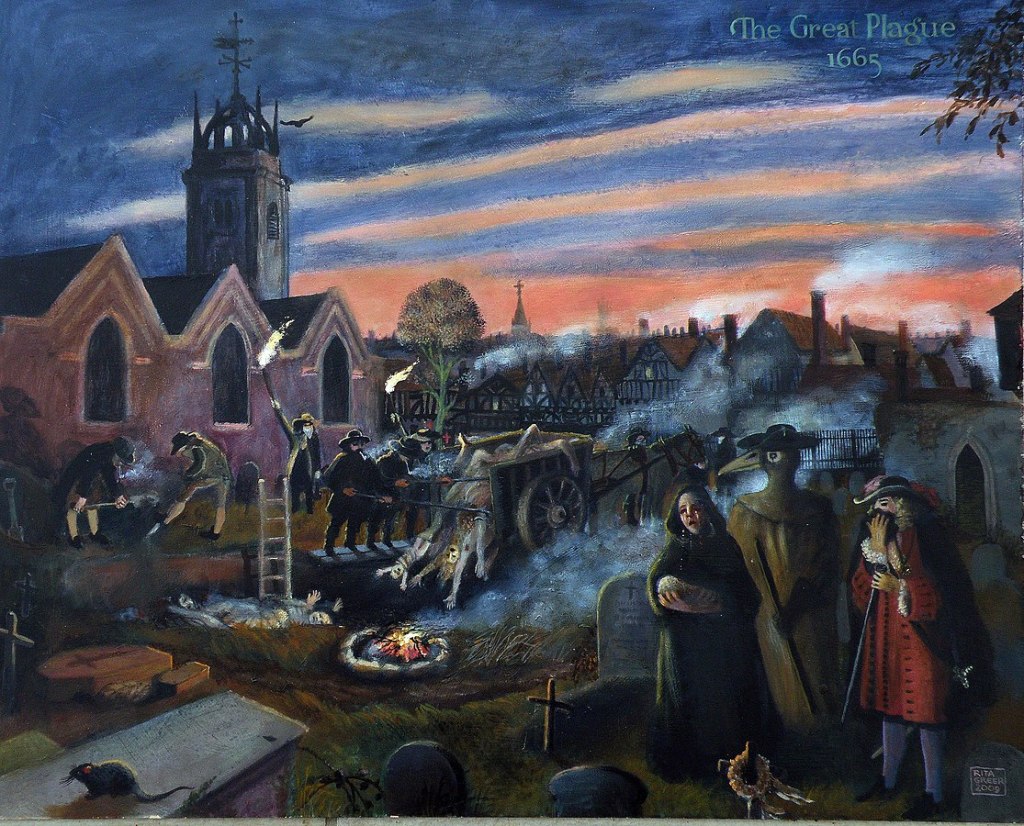
Featured image credit: The Great Plague 1665 by Rita Greer, 2009. Accessed via Wikimedia Commons: https://commons.wikimedia.org/wiki/File:20_The_Great_Plague.JPG
 Retrospect Journal
