

Written by Ami John
The word Iconoclasm derives from the Greek word eikonoklastēs, which translates to “image destroyer”. Recently, this concept has resurfaced in the context of the Black Lives Matter movement, which has called for the removal of colonialist statues representing figures such as Stonewall Jackson. Such monuments were viewed as symbols of racism and oppression, and incited drastic responses like the partial demolition of the 1901 statue of Confederate General Albert Pike in Washington, D.C., during the 2020 riots after the murder of George Floyd. However, this is not a recent phenomenon; throughout history, iconoclasm has been driven by a variety of factors, be it religious, political or sometimes even personal conflicts.
The most prominent mention of iconoclasm is from the second commandment in the Bible:
“You shall not make for yourself an image in the form of anything in heaven above or on the earth beneath or in the waters below”. (Exodus 20:4-6)
This scriptural directive laid the groundwork for many acts of iconoclasm, especially during the Protestant Reformation in the sixteenth century.
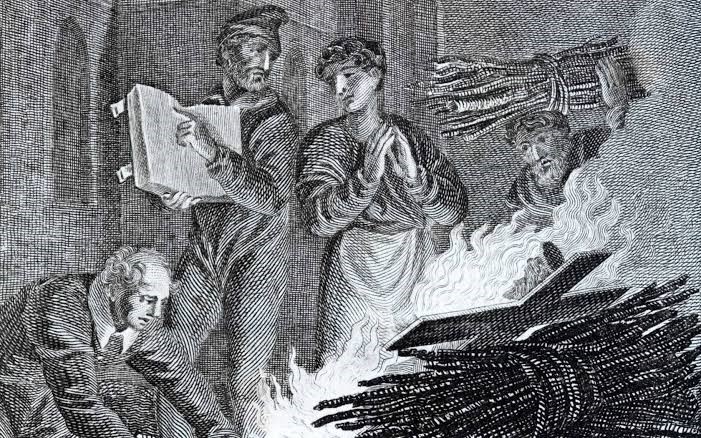
Puritan iconoclasts. (Photo by Michael Nicholson/Corbis via Getty Images)
A notable figure of this movement was William Dowsing, dubbed the “iconoclast general.” Active in the mid-seventeenth century, Dowsing was responsible for the destruction of 250 religious sites across Cambridgeshire and Suffolk. He targeted everything from crucifixes to stained glass, driven by the anti-Catholic sentiment of the period, fuelled by Martin Luther’s earlier critiques of the Church. The repercussions of Dowsing’s actions were far reaching, leading to the loss of traditional imagery and the redefinition of communal worship. This aligned with the Protestant model of an individualistic and direct relationship with faith, still found in many contemporary Christian denominations, where there is an emphasis on scripture and idolatry is completely abandoned.
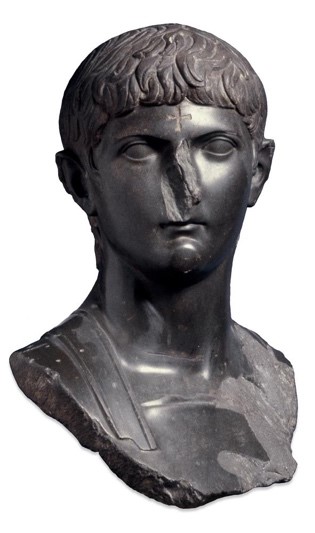
Basalt statue of Germanicus, 1st century CE, defaced at some point in Late Antiquity (British Museum)
Similarly, in antiquity, when Christianity became the official religion of the Roman Empire, a major shift took place under Emperor Constantine. This conversion came with the expectation that it was the emperor’s duty to enforce religious unity across the vast empire. As Christianity gained prominence, anything associated with paganism was met with fear and rejection. Constantine’s reign established a campaign against earlier emperors and the gods of the Roman pantheon. These statues faced destruction, reflecting the rapid assertion of the new religious order. One aspect of this iconoclastic wave was the marking of pagan statues with a cross or crucifix placed on their foreheads or noses. The act was meant to “baptise” these figures, symbolically cleansing them of their past associations, transforming them into symbols of the emerging Christian faith. The statue of Germanicus, who ruled in C.E. 19, serves as a prime example of this transformation. The defacement of subsequent statues like this depicts how iconoclasm served as a marker of change and a way to confront the involute religious landscape of the time.
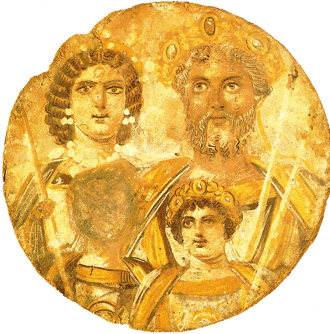
Severan Tondo, Late 2nd century CE (Altes Museum, Berlin)
But iconoclasm is not just about religion; it can also stem from personal motivations, as seen in the Severan tondo, a family portrait from around AD 200, now in the Altes Museum, Berlin. This piece shows Emperor Septimus Severus, his wife Julia Domna, and their two sons, Caracalla and Geta. In AD 209 Geta and Caracalla were made co-emperors by Severus, which resulted in a heated rivalry eventually leading to Geta’s murder. After the assassination, Caracalla ordered the erasure of his brother’s image, this is described as Damnatio Memoriae—the Latin phrase expresses the deliberate attempt to erase someone from history, “damnation of memory”. However, this is not an isolated incident as Damnatio Memoriae was a common theme during the rule of the Severan dynasty. Famous figures such as Elagabalus (Syrian cousin of Caracalla) and Pescennius Niger (a Roman usurper) were also subjected to this.
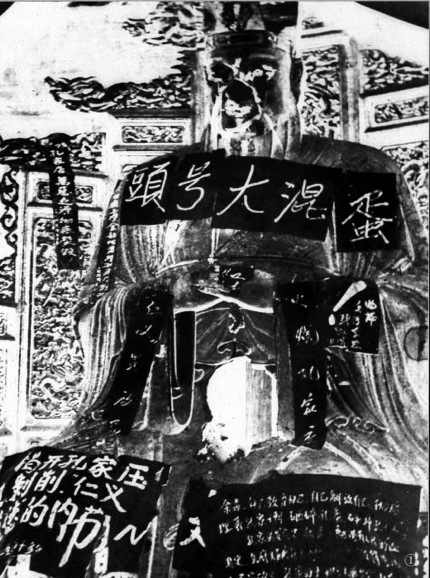
Sommer, 司馬黛蘭 Deborah A. “Images for Iconoclasts: Images of Confucius in the Cultural Revolution.” (2007).
However, iconoclasm isn’t limited to the West. A well-known example is Mao Zedong’s Cultural Revolution in China. The movement began in the mid-1960s and gained momentum around 1966. Its central aspect was the push to eliminate the “Four Olds”—old ideas, old culture, old customs, and old habits. The Maoists and the Red Guards led this charge on 8 August, focusing on attacking temples, churches, books, and anything they deemed evocative of the past. This wave of destruction purely represented a cultural transformation, free from economic or military ideals. Mao’s movement aimed to reshape society by erasing the remnants of the previous era. The most prominent case highlighting the extent of the mania during this period was the iconoclasm initiated in the temple Qufu. There were slurs labelled on the statue of Confucius, an attempt to violate the religious figure. It was then paraded through the streets of the town and burned. It is important to note that there is a traditional discourse of icons as living presences, and as such, the statue was treated as an embodiment of the human form. This line of reasoning is corroborated by the manner of its ruin. It was almost akin to human torture, with the gouging of eyes or the slitting of the throat and what could be dubbed the organs, i.e., the internal materials used to make the statue, being removed for display, just like human disembowelment. Due to the brutality and violence that swept the country during this time, the revolution was dubbed a ‘cultural genocide’. Mao’s rule brought about terror and unprecedented destruction, leading to a phase of unparalleled political iconoclasm in China that only really faded after his death in 1976, revealing the impact of one individual’s capabilities that led to the loss of religious and cultural heritage during such a short period.
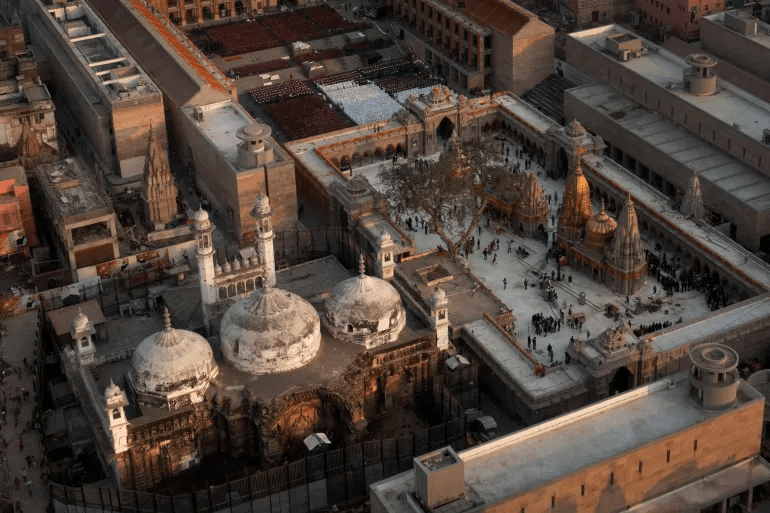
An aerial view of Gyanvapi Mosque, left, and Kashi Vishwanath Temple on the banks of the Ganges River in Varanasi, India [File: Rajesh Kumar Singh/AP]
Ultimately, the previous examples depict iconoclasm as a manifestation of danger to historical record. However, it is not a straightforward process and often presents contradictions, as illustrated by the ongoing controversy surrounding the Gyanvapi Mosque in contemporary India. This mosque, located in Varanasi, Uttar Pradesh, was originally the site of the Vishweshwar temple, dedicated to the Hindu deity Shiva. The mosque, referred to as the Alamgiri Mosque, was named after Aurangzeb, the sixth Mughal emperor, who ordered the temple’s partial destruction in 1669. Some ideologues equate this act of iconoclasm with physical violence, framing the calls for the mosque’s removal as an assault on cultural identity. Despite these accusations for the removal of the mosque, the Places of Worship Act of 1991 prevents the conversion of any place of worship and protects its religious character as it existed on August 15, 1947, the day India gained independence. Scholars argue that the ongoing disputes in Varanasi not only violate this law but also reflect a broader pattern of iconoclasm that seeks to erase or undermine the historical and cultural significance of certain religious sites. Thus, challenging the legal protections of places of worship that can act as a modern form of iconoclasm exacerbating the tensions within a society.
This case raises complex questions about restoration versus erasure of history and whether such actions themselves constitute iconoclasm. Therefore, be it in China, where iconoclasm transformed cultural history, Caracalla’s envy that prompted the erasure of his brother, or the Christians who believed they were saving souls by destroying images, iconoclasm has penetrated the depths of history.
So, I will leave you with this question: is iconoclasm the destruction of history, or the definition of it?
Bibliography
“Smashing churches to save souls: who was the ‘Iconoclast General’?” https://earlofmanchesters.co.uk/smashing-churches-to-save-souls-who-was-the-iconoclast-general/.
“Graduiertenkolleg Identität und Erbe – identitaet-und-erbe.org.” https://www.identitaet-und-erbe.org/?post_type=veranstaltungen&p=6231.
Taussig, Michael. “Iconoclasm Dictionary.” TDR (1988-), vol. 56, no. 1, 2012, pp. 10–17. JSTOR, http://www.jstor.org/stable/41407126. Accessed 29 Oct. 2024.
Reinders, E. (2004). Monkey kings make havoc: Iconoclasm and murder in the Chinese cultural revolution. Religion, 34(3), 191–209. https://doi.org/10.1016/j.religion.2004.01.003
Wilson, Thomas A., editor. On Sacred Grounds: Culture, Society, Politics, and the Formation of the Cult of Confucius. 1st ed., vol. 217, Harvard University Asia Centre, 2002. JSTOR, https://doi.org/10.2307/j.ctt1tg5jtj. Accessed 30 Oct. 2024.
“Gyanvapi masjid: India dispute could become a religious flashpoint – BBC.” 17 May. 2022, https://www.bbc.com/news/world-asia-india-61476741.
“Icons and Iconoclasm in Byzantium | Essay | The Metropolitan Museum of ….” https://www.metmuseum.org/toah/hd/icon/hd_icon.htm.
“Caracalla Erased Hated Brother’s Memory Using Damnatio Memoriae.” 07 Feb. 2023, https://www.ancient-origins.net/weird-facts/damnatio-memoriae-0017900.
“Iconoclasm: From Post-Socialist Yugoslavia to Black Lives Matter.” 13 Oct. 2020, https://blog.degruyter.com/iconoclasm-from-post-socialist-yugoslavia-to-black-lives-matter/.
Featured image credit: “Calvinist iconoclasm on 20 August 1566” by Nick in exsilio is licensed under CC BY-NC-SA 2.0.
 Retrospect Journal