
Written by Fleur O’Reilly
We often think of the Native American experience as isolated to North America, and only in relation to the colonial powers of Europe and their oppression. We do not consider the reverse, how if the Europeans travelled to America, did the native population of America make the return journey to Europe?
It is hard to reconcile our ideas of Native Americans as people tied to the land with the reality of them as influential players in Early Modern Europe themselves. Little evidence is left behind as their identities are often erased, meaning scholars are left to delve deep into the archives and read into sources. The earliest proof of indigenous populations in the UK dates to the late-sixteenth century, over four hundred years ago. One of the first known native Americans to live a successful life in England was a man who went by the name of Thomas Rolfe.
Although born in Virginia to an indigenous family, Thomas grew up in Norfolk from the age of two, where he was adopted by an aristocratic family. Another example is Arnaq and her son Nutaaq who were brought to England, along with another man, in 1577 after being captured in Canada. They performed tricks in Bristol and toured London and the captain who had captured them, Captain York, aimed to teach them English and introduce them to the Queen. Unfortunately, all three died within the year, but not without four portraits being made, two of which were given to the Queen and hung on display at Hampton Court Palace. What’s particularly interesting about this is that we have contemporary accounts writing back to Europe describing the indigenous population as monsters, certainly not human-looking. One of these accounts, titled ‘The Discovery of the Large, Rich, and Beautiful Empire of Guiana’ was written by the English explorer Sir Walter Raleigh in 1596. In this account, he describes the people as having eyes and mouths on their chests, their “heades appeare not aboue their shoulders”. And yet, twenty years before, London and the court had seen indigenous people in the flesh. These people who are described were never seen by the Europeans but by locals who relayed the tales to Raleigh who readily believed them.
Before British exploration had even dived deep into the Americas there was already a presence in the royal court of these expositions, the court of Henry VIII was home for a brief period to a Brazilian king. Brought over in 1532 by the explorer William Hawkins during his exploration of Brazilian land. Although it’s hard to find evidence of his activity in England we have a source written by Richard Hakluyt in The Tudor Venturers’ where he writes: “In his second voyage one of the savage kings of the country of Brazil was contented to take ship with him, and to be transported hither into England” the British left behind one of their own men to guarantee the King’s safe return. ‘This Brazilian King, being arrived, was brought up to London and presented to King Henry VIII’ he stayed there a year until the king dismissed him back to Brazil”.
Some of these Americans entered the continent as diplomats, who came to petition their rights with European counsels, others as offspring of important figures of court, and some as a form of ambassadors, representing their nation. One example of this is the Four Kings who spent seven weeks in London in 1710. These kings presented a view of indigenous populations of America as knowledgeable and active members of politics, even if historians now believe they were simply pawns for Queen Anne. The chiefs were from the Haudenosaunee (Iroquois) Confederacy, the Chiefs’ names were Sa Ga Yeath Qua Pieth Tow, Ho Nee Yeath Taw No Row, Tee Yee Ho Ga Row and Etow Oh Koam. The goal of their visit was an alliance with the British as they sought to keep the Dutch and the French away. The English crown needed the support of these Kings in America and so they were treated as representatives of a sovereign nation. The British did not control the region these Kings were from, the Iroquois. As Ed Simons sees it the diplomats walk through London there is “a potent demonstration of Indian power and an elusive glimpse of an alternative history which did not result in genocide.” They were a sensation in London. Crowds flocked to see them, and much was said about their visit. During their visit Queen Anne even commissioned the royal artist, Jan Verelst, to paint their portraits. On one occasion the Kings went to view a play where the audience’s attitudes betray a dehumanising fascination, with demands for the kings to go on stage and perform. Although apparently many visiting foreign dignitaries would have been treated the same.
Some men were brought back to Europe in order to act as future translators whilst others joined European militaries. Alden Vaughan traces the lives of some of these characters in his ‘Transatlantic Encounters’. The general trend is that those travelling to Europe were young and male, the most popular period for travel was between 1584 and 1616 when 50 people sailed to Britain, then forty in 1760 to 1770, thirty between 1670 and 1690 and twenty in the 1730s. By denying the existence of these men and their attempts to navigate European politics we rid them of their agency, instead resigning their fate as inevitable and making them passive in their fate, or their downfall as preordained.
The stories also have their sadder side, many Native Americans were stolen back to Europe as slaves. This started in 1495 with Christopher Columbus who sent five ships containing 550 Indigenous Americans as slaves back to Spain in order to pay for the expenses of his expeditions. Although the Spanish crown outlawed ‘Indian slavery’ in 1542, the practice continued through loopholes. It’s much harder to find records of those brought back to Europe as slaves as many were unrecorded or illegal.
At the start the English claimed indigenous populations as allies against the Spanish in claims for American land; however, the 1622 Powhatan uprising, where around 350 English were killed, led to a change in attitude leading to many enslaved uprisers being sent as slaves to Nicaragua. Equally, it is difficult to find records of the children of native Americans who were brought back to Europe, either as children to be raised as European children or treated as slaves, their history was often erased. The main notable example we have is Martin Cortes, the illegitimate son of the explorer Hernan Cortes, he was brought to Spain and raised as a noble, alongside Cortes’ legitimate sons. He became a commander of the Order of Santiago and fought in many battles. Although his portraits depict him as white, he is known to have travelled back to Mexico and stayed with his mother.
There is so much more to this topic to be discovered, this was merely a snapshot of three hundred years of history. Linked at the bottom of this article is a fascinating map with more information on the lives and locations of Native Americans within the United Kingdom. I would recommend playing around with it, some of the people may surprise you. Other common reasons for coming to the UK included theatre or performance tours in the nineteenth century, touring missionaries or sports teams such as lacrosse.
This narrative of American discovery and presence in Europe contradicts the common view of Native Americans as helpless and passive to the incoming Europeans and instead presents a narrative of politically active people or people who wanted to explore their equally newfound world. However, we must correspondingly consider those who travelled to Europe not by choice and have been left forgotten. It also informs how we view Europe at this time, it’s a new perspective on how Europeans viewed the Americas and interacted with foreigners that has been long neglected in history. By questioning the flow of ideas that we view as one directionally, we instead highlight the reciprocal relationship. It’s important to remember to take historical groups out of their context and view them outside of how we normally view them and the boxes we place them in.
Bibliography
Maps
Simon, Ed, Indigenous Kings in Londontown. Jstor daily, 2023. https://daily.jstor.org/indigenous-kings-in-londontown/
Vaughan, Alden T. Transatlantic Encounters: American Indians in Britain, 1500–1776. Cambridge, UK: Cambridge University Press, 2006.
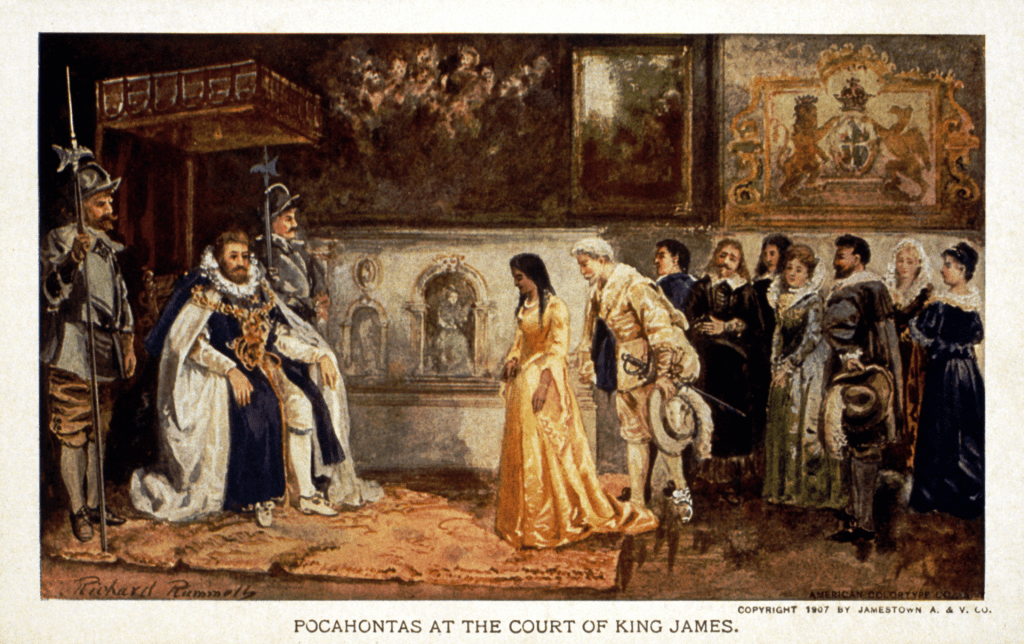
Featured Image Credit: Pocahontas in the court of James I of England. Postcard published by the Concessionaire, The Jamestown Amusement & Vending Co., Inc via Wiki Commons.
 Retrospect Journal