
Written by Emilio Luppino
“And there, upon its granite height,
Above the Neva’s darkened course,
Its hand outstretched towards the night,
The great bronze idol on its horse”.
Father of the ‘window to the West’, an acme of an everlasting dualism, was ascribed by Pushkin in these verses to Peter the Great; written during a time when Russia considered Europe the archetype.
No longer just Tsar of Russia, the emperor wanted raise all of Russia to a new level: the European one. The Oriental, driven by passions, and pagan Russia should have not only followed new rules, but it should also have adopted a new mindset, becoming rationalised, and enlightened.
His main creation, the city of Saint Petersburg, soon became the beacon of his policies and the Capital of the empire. With the grandeur of the palaces, the frenzy in the streets, the growing demographic, and the unique blend of Western and traditional Russian architecture, it aimed to match the grandeur of Moscow and aligned with Russia’s ambition to establish itself as a European superpower. Poets and authors began writing about the city, making it the main setting for literary works during that period.
However, Peter the Great’s ideas of turning Russia into a northern Rome were not shared by the whole of the Russian intelligentsia. When he died, the funeral was carried out to resemble the one of a British royal, but that was the last thing to be westernized by him.
Russian elites soon found themselves torn apart, divided like two parents fighting over the future of their child. An intellectual civil war started between his supporters and those who considered him the Antichrist. The debate lasted decades, and suddenly the modern ideas they were fighting over became outdated as well.
At the start of the nineteenth century, while the debate between the Westernizers and the Slavophiles was infuriating, literature took the lead and deepened the grey area left uninhabited by the two factions.
Europe was still considered a model by many in Russia. Like a novice sees a professional athlete when looking in the mirror after a few months of training, so many Russians used to view Europe while talking about their Motherland. However, its eternal and ethereal aura soon began to vanish, and like the Old Continent, the goal to become like it became Old too.
In this cultural milieu, Pushkin’s The Bronze Horseman unfolds, beginning with the founding of a glorious city meant to showcase Russia’s ambition. The poem shifts to a tragic story of a young man who, after a devastating flood takes everything he loves, he spirals into madness. Confronting the statue of the city’s founder, Peter the Great, he is pursued by the looming figure, symbolizing the tension between personal suffering and the overpowering ambitions of the state.
The personal identity was at stake. Useless were the ideas if madly pursued by a blind ruler. In the West-East discourse, the individual dimension had been neglected, and now had to be explored.
In 1859, Ivan Goncharov published his famous Oblomov. Lazy, petulant, stubborn but still deeply benign, Oblomov struggles to get out of bed. He spends his time thinking about his youth, and his past dreams, delaying his current goals, affected by an almost clinical tendency to get bored, somatising his inability to feel any spark of interest toward anything. Like the Slavophiles, who were trying to create a Russian Sonderweg, he preferred thinking about the idyllic, bucolic and pastoral life of Russian villages. In contrast, his friend Stoltz, is a dynamic, brave, frenetic and entrepreneurial man, travelling between France and Germany. Europe, once again, is used as a basis for comparison, seen as a successful man able to take over the reins of his life.
It was not a case that just a few months later the literary critic Nikolay Dobrolyubov wrote What is Oblomovitis?. What he wrote was almost a medical essay, thinking about Oblomov not just like a lazy slothful amoeba, but like the personification of a weak, dysfunctional, and identity-less country. A country corrupted by ancient practices such as serfdom and authoritarian rulers imposing their visions, whether more Western or Eastern-oriented.
The split between ideologies appeared as detrimental as the worst of ideologies, stuck in a continuous struggle, delaying any reform regardless of its colour.
Just five years later Feodor Dostoevsky wrote Notes from Underground. Dostoevsky’s work captures Russia’s identity crisis. Isolated and at odds with both him and society, the narrator’s chaotic monologue reveals the profound discontent, scepticism, and existential despair of individuals unable to reconcile themselves with the duality between traditions and progressive views. More rebellious than the so-called revolutionaries, who are preoccupied with politicising every aspect of life, the main character seems unable to adapt to society’s relentless changes. A society that appears to embody the worst elements of both Western and Eastern influences.
What comes out of some of the most astonishing Russian literacy pieces of the eighteenth and nineteenth centuries is a drive for a pause between East and West. A pause to analyse the need to shift the dissection of Russian culture from the state level to the individual level. The idea of a rational, prosperous, methodical and enlightened Europe seemed incompatible with the main characters of those books. When experienced, that dream society turned out to be materialistic, opportunistic, and sharp.
On the other hand, the conservation of the archaic rules, dogmas, and the desperate trying to make a decayed society work, justified by its mere Slavic past, struggling to find a spot in the caravan travelling toward the future.
Amid the disquieting battle of imperatives and propositions, literature stood as the only shield.
Bibliography
Leonid Alekseyevich Nikiforov. 2019. “Peter I | Biography, Accomplishments, Facts, & Significance.” In Encyclopædia Britannica. https://www.britannica.com/biography/Peter-the-Great.
Malia, Martin E. “Frontmatter” In Russia under Western Eyes: From the Bronze Horseman to the Lenin Mausoleum, i-vi. Cambridge, MA and London, England: Harvard University Press, 1999. https://doi-org.eux.idm.oclc.org/10.4159/9780674040489-fm
Pesonen, Pekka. 1991. “The Image of Europe in Russian Literature and Culture.” History of European Ideas, January. https://doi.org/10.1016/0191-6599(91)90007-l.
Pushkin, Aleksandr Sergeevich, Aleksandr Sergeevich Pushkin, and D. M Thomas. The Bronze Horseman : And Other Poems. Harmondsworth, [U.K: Penguin Books, 1982.
Williams, Robert C. “The Russian Soul: A Study in European Thought and Non-European Nationalism.” Journal of the History of Ideas 31, no. 4 (1970): 573–88. https://doi.org/10.2307/2708261.
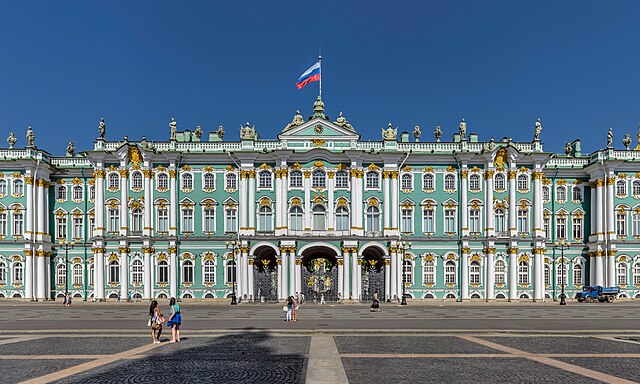
Featured Image Credit: Winter Palace in Saint Petersburg, the Central Part of the South Facade via Wiki Commons
 Retrospect Journal
