
Written by Abbie Teal
‘Up the close and down the stair, in the house with Burke and Hare. Burke’s the butcher, Hare’s the thief, Knox the man who buys the beef.’
The year is 1827 in the UK’s leading centre of anatomical research; the city of Edinburgh. The corpse of an army pensioner is sold to Dr Robert Knox, the distinguished lecturer of anatomy, by Messrs Burke and Hare, for the price of three pounds and ten shillings.
In a boarding house somewhere in West Port, encouraged by the outcome of their cunning exploits, landlord Hare and his comrade Burke, embark upon their notorious money-making scheme as a murdering double act.
To set the scene, we must step back around seventy years prior to the year 1752, when the crown legalised the dissection of bodies killed by the death penalty, with the aim of furthering anatomical awareness and aiding Britain’s medical advancement.
An issue became apparent, however, when medical schools across the country were competing for access to fewer than one hundred legally authorised cadavers. In Edinburgh, lecturer Dr Knox instructed over 5,000 students between 1828-9 but received an allotment of under twenty-five cadavers.
If, like myself, you enjoy observing the unfolding of history, you may begin to notice a pattern which can be applied aptly to this scenario – when legislature insists on one thing, but necessity demands another, human beings will devise cunning and curious ways to obtain their needs, regardless of the law.
Thus, the formation of the infamous resurrection men; resurrecting, or in realistic terms stealing, bodies from freshly dug graves to sell to the surgeons of Edinburgh’s illustrious anatomical schools.
The government shut its eyes to the actions and endeavours of many resurrectionists. Perhaps because they knew a surgeon’s access to cadavers was a necessary step in catching up to the anatomical knowledge being developed on the continent. Therefore, ever the competitive nation, the government chose to ‘shut their eyes to the transactions of the Resurrectionists’ wrote one surgeon in the nineteenth century, ‘for, without their passive permission… England in a short time would have stood lowest among European nations as to the conditions of her Medical science’.
Nevertheless, whilst authorities turned a blind eye to the happenings, the general public did not.
As a highly Christian society, the concept of dissection faced a great deal of religious and public opposition. Through mutilating a corpse, many believed this would interfere with the ‘Great Resurrection’. Therefore, whilst legally the bodies of executed prisoners could be dissected, and authorities ignored those being stolen from their graves, the public morally condemned it and actively prevented it.
It was not uncommon in the 1800’s for cemeteries in Edinburgh and around the country to become festooned with mort-safes and iron grills; for protection groups to form with the intention of watching over freshly dug graves.
It was therefore under these circumstances, with legislature restricting the number of legal cadavers and public opposition making it progressively harder for resurrection men to procure stolen ones, that our protagonists Burke and Hare enter the narrative.
In November of 1827, in the West Port lodgings of William Hare’s wife Margaret, an old army pensioner dies whilst still indebted to Hare. Enlisting his friend William Burke, the two schemers devise a plot to sell the body to an anatomist and are promptly directed to the office of Dr Robert Knox, a lecturer in Surgeon’s Square. Under the cover of darkness, the exchange is made and the two depart from the scene three pounds and ten shillings richer.
You can almost imagine the conversation that ensued after the deal was made; the lightbulb that went off in both of their heads.
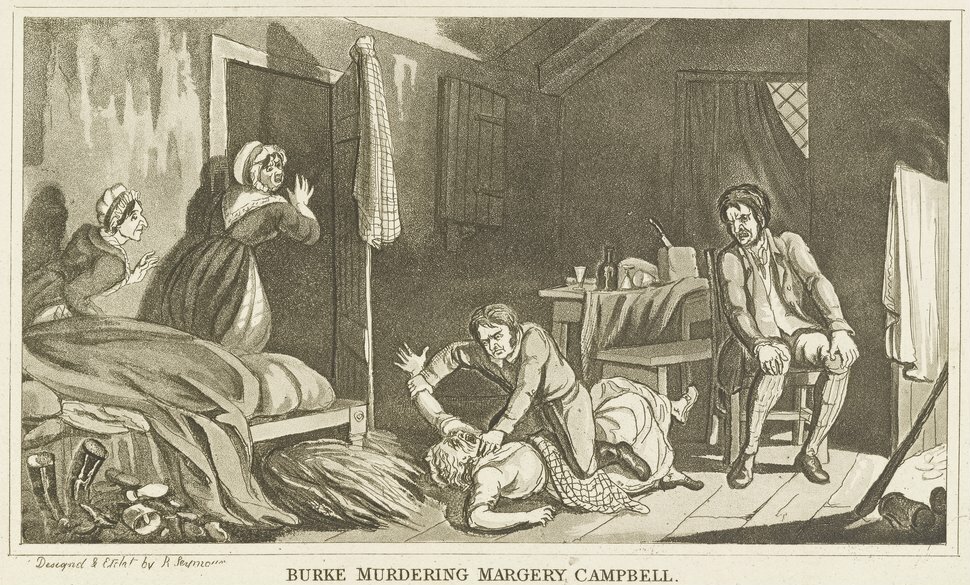
Taking advantage of their circumstances, Burke and Hare, along with their wives Margaret and Helen, used the cover of these lodgings to lure unsuspecting victims into their conniving scheme. Between November 1827 and October 1828, the two murdered sixteen lodgers by supplying them with strong alcohol and smothering them in their sleep, a method of killing which eventually came to be known as ‘Burking’ amongst the general public. Each body was sold to the same Dr Knox in Surgeon’s Square.
Whether he truly knew how his suppliers obtained these bodies was a question of which the answer was never disclosed, but with over 5,000 students eager to pay for his lecture on dissection, perhaps the more intriguing question would be as to whether he would care.
Feverish with their success, however, the murdering double act got careless when it came to their final kill the following October on the night of Halloween. After hiding the body of Mary Docherty under the bed, it was found by a member of the public before Burke and Hare had a chance to sell it. Authorities were alerted and promptly arrived at the lodgings only to discover that the body had disappeared. Whilst the two men were quickly arrested, without a corpse the murder would’ve been difficult to prove.
The popular phrase “no honour amongst thieves” sums up the conclusion to this story, with Hare, a schemer until the end, turning King’s evidence in return for a complete pardon, and disclosing the story behind the murders which had been committed. Following his confession and release, Hare swiftly made himself scarce and disappeared from historical records, whilst Burke was tried, found guilty of murder and sentenced to be hung.
In a rather ironic turn of events, his body was to be dissected by Edinburgh’s anatomists, and tickets were sold to a fervid crowd eager to watch the dissection of the disreputable notorious character, William Burke.
With a gruesome conclusion to this chapter of history, Burke met his end.
His skeleton was left on display and is now kept in the University of Edinburgh’s Anatomical Museum, perhaps as a reminder of the grisly exploits and characters that make up the cities dark medical history.
Bibliography
ELLIS, BRENDAN. “BURKE AND HARE.” History Ireland 19, no. 2 (2011): 13–13. http://www.jstor.org/stable/41202757.
Montgomery, Horace. “Resurrection Times.” The Georgia Review 43, no. 3 (1989): 531–44. http://www.jstor.org/stable/41399936.
Ronan O’Connell ‘Take a grisly tour of Edinburgh in the footsteps of its two famous body snatchers’, National Geographic, October 2023 https://www.nationalgeographic.com/travel/article/walking-tours-museums-edinburgh-william-burke [accessed 21st October 2024]
Ross, Ian, and Carol Urquhart Ross. “Body Snatching in Nineteenth Century Britain: From Exhumation to Murder.” British Journal of Law and Society 6, no. 1 (1979): 108–18. https://doi.org/10.2307/1409709.
Featured image credit: William Burke murdering Margery Campbell by Robert Seymour (1829). Accessed via Wikimedia Commons: https://commons.wikimedia.org/wiki/File:Burke_Murdering_Margery_Campbell.jpg
 Retrospect Journal
