
Written By Darcy Gresham
Greenland comprises a staggering 98% of the landmass of the Danish Realm, but only a miniscule 0.95% of its population. The establishment of Danish settlements in Greenland began in 1721 and the island was operated as a colony until Home Rule was introduced in 1979. As the largest contingent of the Danish Kingdom, Greenland has endured colonial ownership and the consequent dissolution of this into self-governance, creating a legacy that survives into the present-day.
Historically, the only inhabitants of Greenland were the Inuit, with foreign settlement from the tenth century by Erik the Red. Norse settlements did not persist, and prior to Danish monopolisation, only Indigenous Inuit populations inhabited the island. Six different Inuit cultures emigrated to Greenland across several migrations with the modern population’s ancestors, the Thule culture, arriving in the ninth century. In 1721, Danes settled on Greenland, near the modern capital Nuuk, with consequent trading under their control and the beginning of Greenland as a Danish colony. Only in 1953, following the Second World War, did Greenland gain any parliamentary presentation in Denmark. The Referendum of 1970 granted Home Rule, allowing control over internal affairs; however, Denmark retain ownership of all decisions on defence, foreign policy, and the constitution.
The colonial control of Greenland was categorised by Danish rulers attempting to exert power over their imperial territory. Some historiographies have noted the way Danish colonialism has been viewed more “humanely” than others of the time such as the Dutch, Spanish, and British. However, Danish practices were, in reality, equally as brutal and inhumane as other nations’, even if they did not look identical or take place in the same geo-temporal sphere. Søren Rud demonstrates the idea that “Denmark was every bit as invested as other western nations in the production of hierarchised notions of culture, race, and society” illustrating that imperialism was present in the same form across Scandinavia. In these ways, colonial control was exerted upon Greenland from the outset.
The efforts and motivations for the ways in which colonial control was carried out lie in the civilising mission of Danish rule, compounded by perceptions of Greenlanders. Richard Jenkins portrays these goals as an empirical desire to make ‘Danishness’ the overriding ideology that was present in daily life. In Denmark there was a perpetuated idea that Greenlanders were secondary citizens, lacking key traits which enforced superiority and a need for the imposing of the colonial notion of civilisation. It is evident that the aim was to make Greenlanders as civilised as possible, which in this case meant as Danish as possible.
Danification, the colonial process of assimilation into Danish thought and behaviour, was clearly a policy of the state. In contrast to other civilising missions of colonial enterprises across the globe, the Greenlandic model sought to find a balance between identities. It was necessary that Greenlanders maintained some cultural characteristics, such as hunting skills and specifically Arctic survival methods. However, this should be alongside supplementations of “European morality, reliability, work ethic and energy”. The multifaceted nature of this identity shows how both Greenlandic and Danish connections were enforced to manipulate people into the best fit for the empire. By maintaining Greenlandic traits, traditions could be kept alive, conserving the Arctic, and keeping the economy afloat in unique environmental conditions. Nonetheless, it is clear that this could not operate solely by itself, with Danish infiltrations of colonial culture.
The portrayal of Denmark has been vital to the colonial image in creating a perception of a utopian coloniser, as well as inspiring migration and friendship between the nations. Some roots of truth indeed fuel this narrative, with high standards of healthcare and welfare, yet there were also some exaggerations. During the heights of colonial control, Denmark was perceived as a place with ““education and travel possibilities” which were in comparison, “much more limited in Greenland”. In this case, it is important to note how Denmark was portrayed in juxtaposition to Greenland. In creating a hierarchy between the two nations, colonial supremacy could be exerted through another lens. This was important as it allowed Denmark to become a place associated with promise and opportunity, thereby promoting voluntary migration in conjunction with the following of the Danish model both societally and culturally.
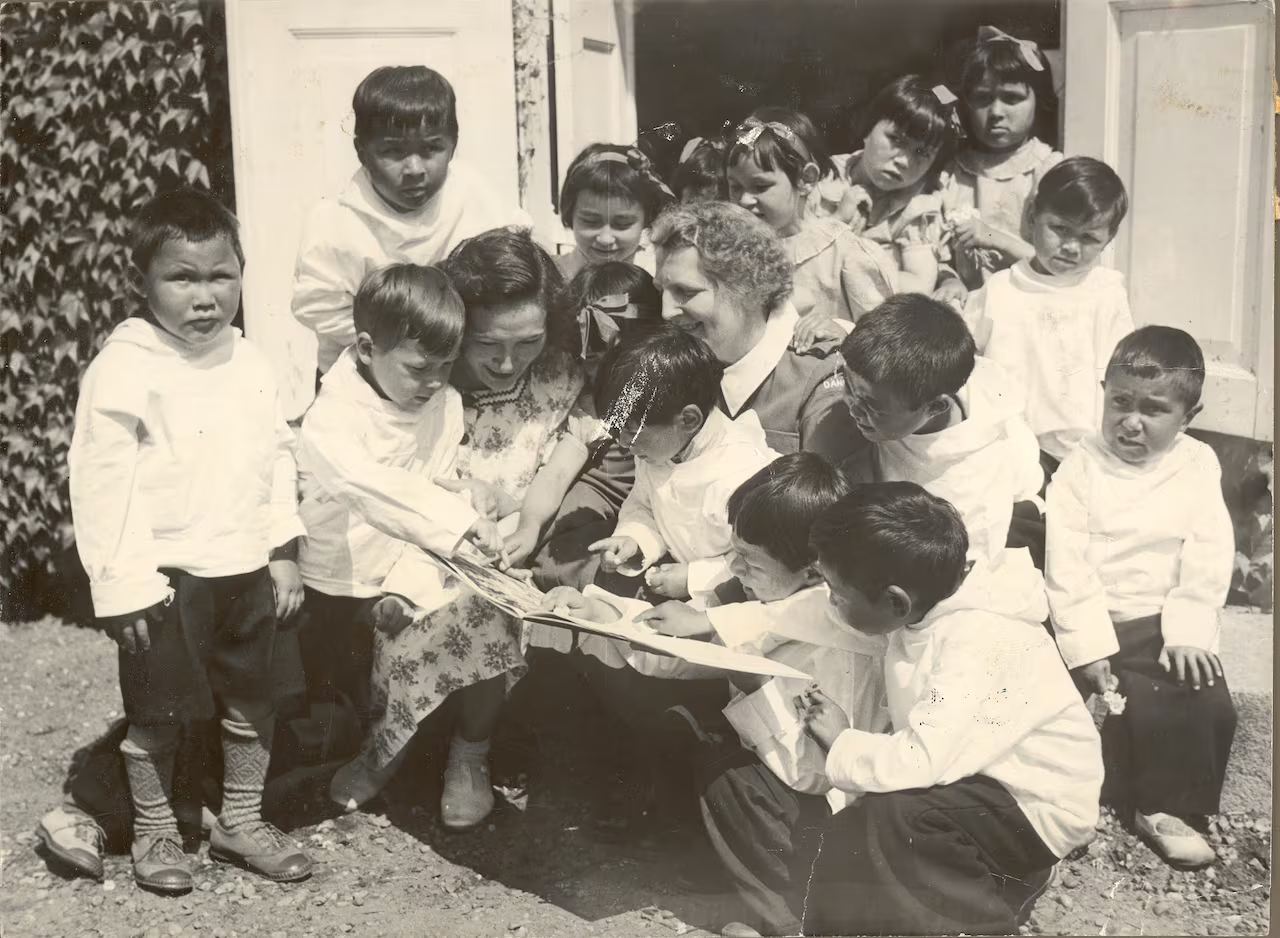
The removal of Inuit children and educational policies have been key methods of colonial influence in Greenland. They demonstrate the continuous Danish presence in order to mould children into citizens of the Danish Realm. The long-term repercussions of such practices will be examined further in section three. It is evident that the ‘Little Danes’ experiment unjustly stole children from their familiar environments and placed them in Danish families to future the colonial mission and promote so-called integration, through force. This occurred under the guise of rescuing the children from their fates of Inuit upbringings, giving moral justification to the actions. Forced migration through education was a crucial policy in colonial Denmark to spread civilisation, ideas, and education to as many Greenlanders as possible.
Assimilation processes were target through language, and the creation of a Greenlandic elite, and continued through additional educational policies of catechist colleges. Language was a key feature of tension between Denmark and Greenland and has categorised much of the interaction between the powers. The conservation of Greenlandic has been vital for the continuation of many cultures and traditions; whilst the widespread nature of Danish influences demonstrates the colonial influences and the infiltration of a greater power into everyday life. The formation of a Greenlandic elite demonstrates that Danish officials wanted to transfer some leadership roles to Greenlanders; however, they dictated the ways in which this was achieved. Greenlanders had very little agency in who could form a part of this elite, or the ways in which their education was conducted. These models asserted Danish influence whilst maintaining the background of life in Greenland. Whilst there are some similarities between catechist colleges and the boarding house in operation in Copenhagen, the fact that they kept pupils in Greenland was a new development that supported ties to the homeland. The protection and promotion of the hunting customs could be seen as in opposition to these assimilationist policies, however in reality they were important for colonial economic success. Therefore, by controlling some of the environments in which special skills were taught, Denmark was able to make sure that they were entwined with a colonial education, while still supporting the vital trade of blubber and fur.
Education is an area of investigation that has proven revealing through this essay as it probes the questions of how learning became a tool of the state. Educational policies can help to target younger and more susceptible members of the population through indoctrination at an impressionable age. Within the case of Greenland, education has been a vital tool of colonial imposition through examples such as the Little Danes experiment, the Copenhagen boarding house, folkeskoles, and catechist colleges. In terms of education, it can be determined that colonial policy took a harsh stance towards its imposition, clearly driving it forward as a method of dominance. The forceful imposition and residential nature of some of these programmes intensified their impacts. These features made the legislation more successful from the colonial point of view as; by controlling the extracurricular activities and spare time of pupils, the state was able to monitor exactly what they were exposed to.
Migration and its roots within educational policies forced pupils into Denmark; forced migration clearly illustrates the brutality of colonial control, whilst elective migration shines a light on the portrayal of the superior power through the lens of colonised peoples. The relative ease of migration within the same realm displays the success of the assimilation policies. Policies of particular success were linguistic influences, with Danish taught in the majority of institutions. Tensions arose from this; however, the continuation of the language’s prevalence into present-day illustrates that, despite it being a colonial technique, it did have applicable uses that allowed it to become a tool for the future of Greenlanders. The formulation of a Greenlandic elite through social engineering was another policy supported by migration, as it allowed an education outside of Greenland, in the metropole. Additionally, to this, colleges were constructed within Greenland that strengthened traditional ties more than had been previously possible. Overall, migratory experiences display the overarching omnipotency of the coloniser.
Denmark was able to successfully exert their colonial control over Greenland through education and migration. This occurred in a way that secured long-term power and the creation of a state that upheld their ideological principles. Forced Inuit child removal aided the permeation of the Danish language whilst crafting an elite with the prospect of governing Greenland by Indigenous peoples in a way that suited the rest of the Kingdom. Further educational policies continued these ideas, by upholding Danish values alongside the cultivation of traditionally Arctic skills. Voluntary migration uncovers the attractions of the idealised colonial nation, whilst highlighting the lack of resources in Greenland that fuelled these migratory patterns. The preexisting connections to the colonising nation and reduced bureaucratic process, coupled with the idea of greater opportunity increased the potential for such migratory journeys to take place. Therefore, in conclusion, Denmark asserted their colonial control through the tools of educational policies and institutions, alongside migration to the metropole.
Bibliography
University of Alaska Museum of the North, Archaeology: Thule Culture
Simon Molholm Olesen, “A Sacred Course: Decolonisation of Greenland, 1945-54,” Tidsskrift for Historie 7, no.13 (2017)
Magdalena Naum and Jonas Nordin, “Introduction: Situating Scandinavian Colonialism,” in Scandinavian colonialism and the rise of modernity, ed. Magdalena Naum and Jonas Nordin (New York: Springer, 2013)
Søren Rud, Colonialism in Greenland: tradition, governance, and legacy (New York: Springer, 2017)
Richard Jenkins, Being Danish: Paradoxes of identity in everyday life. (Copenhagen: Museum Tusculanums Press, 2011)
Tekke Klaas Terpstra, Inuit Outside the Arctic: Migration, Identity and Perceptions, (Arctic Centric of the University of Groningen: Barkhuis, 2015)
 Retrospect Journal