
Written by Kilan Duan
31/10/2024
While present Chinese leaders may reject the idea of a diverse spectrum of sexuality, homosexuality was a customary practice among the supreme leaders of the Han Dynasty around 2,000 years ago. The emperor, regarded as the son of heaven, often had male companions. This aspect of history is rarely mentioned, yet reflecting on these relationships offers an essential lens for understanding ancient Chinese views on homosexuality and the underlying power dynamics within such relationships.
It is believed that affection towards boys, which was practiced by 10 emperors out of 12 in the Western Han Dynasty, all started from the very first one: Liu Bang, who was honoured as Gaozu (an honorific title given to emperors after their death and to those emperors who created dynasties in Ancient China). According to Shih Chi, when Ying Bu was revolting, all generals and officials were anxiously waiting for Gaozu’s decision, but he shunned all of them out of his chamber and spent ten days with his favourite eunuch, Ji Ru. When one infuriated general broke into his room, Gaozu was found to be lying on Ji Ru’s laps. Sima Qian, the author of Shih Chi, commented that Ji Ru was imbecile, but he climbed to the top of the power only because of Gaozu’s affection.
A similar story was repeated by Gaozu’s heir: Liu Ying, the emperor Hui. His favourite boy was called Hong Ru, and this affection even stirred a wave of imitation of Hong’s speech, dress, and manner. “During Emperor Hui’s reign, the court attendants and chamberlains all wore Zhuyi hats and jade belts, applied makeup, and emulated figures like Hong and Ji”, one anecdote demonstrates more vividly. Liu Ying discovered that his mother, Empress Lü, had been having an affair with the Marquis of Piyang. Liu Ying was furious and planned to execute Shen Yiji. As Empress Lü was unable to intervene directly, she sent a man named Zhu Jian to speak with Hong Ru, using the latter’s influence over the emperor. Zhu Jian threatened Hong Ru, saying, “You are favoured by the emperor, while Shen Yiji is favoured by the empress dowager. If the emperor kills Shen Yiji, the empress dowager will seek revenge and kill you in turn.” Hearing this, Hong Ru found the argument convincing and hurriedly went to plead with Liu Ying on Shen Yiji’s behalf. Although the exact words Hong used are not recorded in history, the result was that Liu Ying relented and spared Shen Yiji’s life.
Even the greatest emperors of Han Dynasty were not immune from such stories. Emperor Wen of Han, Liu Heng, was a wise ruler who, along with his son Emperor Jing, Liu Qi, ushered in the prosperous era known as the “Rule of Wen and Jing.” Emperor Wen was known for his filial piety, and one of the “Twenty-Four Filial Exemplars” — the story of him personally tasting his mother’s medicinal soup — refers to his devotion to his mother, the Dowager Empress Bo. He was also known for his frugality, often wearing simple clothes made from coarse black silk. However, even such a virtuous emperor had three favourite boys.
Liu Heng’s first two male companions were both eunuchs — one named Zhao Tong, the other Beigong Bozi. Zhao Tong was skilled in astrology and divination, while Beigong Bozi was known for his simple, altruistic nature. Both were eunuchs and served as Emperor Wen’s drivers and secretaries. However, the male companion whom Emperor Wen cherished the most was his third one, a man named Deng Tong.
Emperor Wen’s affection for Deng Tong began with a dream. One day, he dreamed of ascending to the heavens but struggled to rise until a “yellow-headed man” helped him achieve his goal. The defining feature of this man in the dream was that his belt was tied at the back. Emperor Wen, eager to find the man from his dream, launched a search across the country. Eventually, he found someone matching the description — a man named Deng Tong. The name “Deng Tong” sounded alike to “ascending smoothly”, symbolizing his meteoric rise to favour.
Emperor Wen adored Deng Tong, showering him with immense wealth, including an estate worth billions and even granting him a copper mountain, along with the exclusive right to mint coins. As a result, Deng Tong became one of the wealthiest men in the empire. His loyalty to Emperor Wen was extreme. When the emperor developed a painful abscess, Deng Tong would personally suck out the pus without any sign of disgust — something even the crown prince, Liu Qi, could not bring himself to do.
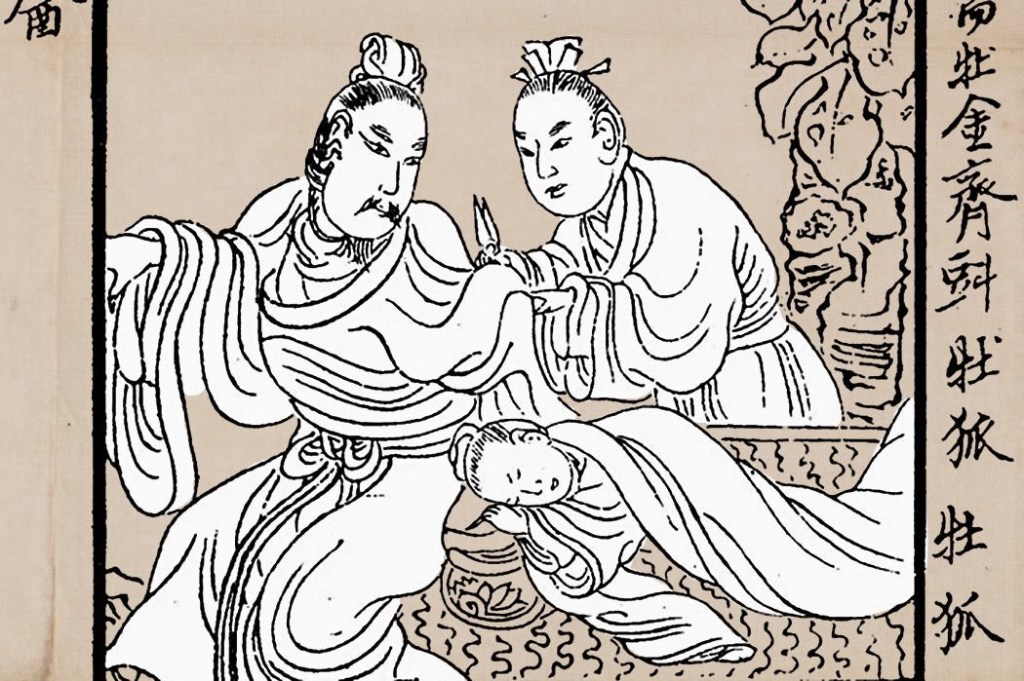
The love stories between Han Emperors and their boys peaked in Emperor Ai’s rule. His story with Dong Xian even formed a symbolic idiom in Chinese; “cut sleeve”. One time, Emperor Ai of Han was sleeping with Dong Xian. The emperor woke up first, while Dong Xian was still asleep. Dong Xian was lying on the emperor’s sleeve, and Emperor Ai, not wanting to wake him, drew his knife and cut off the sleeve, quietly slipping away. Such deep affection was unparalleled throughout history.
We could talk endlessly about the romantic relationships between emperors and their male companions. But let’s take a moment—whether as historians or modern citizens—to step back and think critically about these romances.
The first question we have to ask is whether such overt homosexuality was accepted in ancient Chinese. Perhaps since emperors were involved in such relationships ancient Chinese people seldom discussed them. Still, some people may draw a negative conclusion here because Sima Qian wrote the stories of these male companions in the chapter of Falsely Blessed People which conveyed negative implications. Others used Confucianism’s opinions to attack them, blaming them for their promiscuous.
However, they miss the focus of the criticisms of these relationships, misinterpret the messages, and take advantage of them in their favour. We should clarify what exactly the ancients were criticizing when it came to homosexuality. Homosexuality itself does not seem to have been the core issue, as the ancients did not view same-sex attraction as sinful, shameful, or deviant. An old saying goes: “There is no distinction between inside and outside, no difference between male and female.” In this sense, both male and female companions of emperors were subject to the same condemnation. What Sima and Confucianists criticised is not the sex of the relationship but the ensuing detrimental impacts, such as making emperors, such as Gaozu, indecisive.
Moreover, as the dominating thought in Han and almost all following Dynasties of China, Confucianism does not regard homosexuality as an inherently extreme or essential problem. This is because it lacks a supernatural deity that condemns homosexuality or enforces moral edicts based on divine will. Confucianism’s understanding of the pursuit and fulfilment of natural desires suggests that homosexuality was, in fact, met with sympathetic understanding. The Confucian Golden Rule of “shu” (reciprocity or empathy) also allows space for the existence of homosexuality. Again, what Confucianists detested was the potential disorder of social hierarchy brought by the romance of emperors regardless of their companions’ sex.
We should then think about if there was really love in their romantic relationships. It is observed that almost all the male companions had a miserable end of their life. Deng Tong of emperor Wen was deprived of all property and starved to death; Zhang Pengzu of emperor Xuan was poisoned by another official; Zhang Fang of emperor Cheng was expelled; Dong Xian of emperor Ai was impeached and executed right after the emperor’s death… Vice never comes from nowhere. To understand the source of such vice, we must consider that the emperors’ male companions were either eunuchs or officials at a critical position in Han Dynasty within a special political regime called the “Inner and outer court” or the “central and peripheral court.” The Inner court was occupied the emperors’ and eunuch’s intimate officials while the outer court was dominated by members of other powerful families. Such a political regime was designed to favour the emperor, as the divergent balance the power between these two courts helped to consolidate his own status as the absolute authority. Therefore, Han emperors’ male companions were often regarded as a critical figure of inner court at that time. It is no wonder they often suffered misfortune after the emperor’s death as a result of their revenge seeking opponents from the outer court. Thus, we can say while love of the relationships between emperors and their boys cannot be denied, there must be more considerations of politics.
In conclusion, while romantic relationships between Han Dynasty emperors and their male companions were marked by affection, they were also deeply intertwined with the political power struggles of the time. Ancient Chinese views on homosexuality were less focused on condemning same-sex attraction and more concerned with the potential disruption of social and political order. These relationships provide valuable insights into both the personal lives of the emperors and the broader dynamics of power in Ancient China.
Bibliography
Chen, Sin-Yee. “Two Men Sharing a Peach, Can Confucianism Tolerate It? — On the Compatibility of Classical Confucianism and Homosexuality.” Progressive Confucianism Site, 3 Mar. 2023, jinburuxue.com/blog/2023/03/03/%E4%BA%8C%E7%94%B7%E5%88%86%E6%A1%83%EF%BC%8C%E5%84%92%E5%AE%B6%E5%A0%AA%E5%BF%8D%EF%BC%9F-%E8%AE%BA%E5%8F%A4%E5%85%B8%E5%84%92%E5%AE%B6%E4%B8%8E%E5%90%8C%E6%80%A7%E6%81%8B%E7%9A%84/. Accessed 25 Oct. 2024. (陈欣怡. “二男分桃,儒家堪忍?——论古典儒家与同性恋的相容性.” 进步儒学网. 3 Mar. 2023.)
Li, Wei. “An Analysis of Emperor Wen of Han’s Grant to Deng Tong to Mint Coins.” Lantai World, vol. 14, 2016, pp. 123-124. doi:10.16565/j.cnki.1006-7744.2016.14.49. (李伟.”汉文帝赐邓通铸钱辨析.” 兰台世界, 14(2016): 123-124. doi:10.16565/j.cnki.1006-7744.2016.14.49.)
Qian, Sima. “Records of the Grand Historian: The Biographies of Favorite Courtiers – Chinese Text Project.” Ctext.org, ctext.org/shiji/ning-xing-lie-zhuan/zh. Accessed 25 Oct. 2024. (司马迁. “史记 : 列传 : 佞幸列传 – 中国哲学书电子化计划.” Ctext.org.)
Yang, Changjun. “Were the Terms ‘Remaining Peach’ and ‘Cut Sleeve’ Both Derived from the Han Dynasty?” Bite the Word, vol. 7, 2012, p. 9. doi:CNKI:SUN .0.2012-07-008. (杨昌俊.”“余桃”“断袖”都出自汉代吗.” 咬文嚼字, 07(2012): 9. doi:CNKI:SUN .0.2012-07-008.)
Image Credit: Jstor Daily, In Han Dynasty China, Bisexuality Was the Norm, https://daily.jstor.org/in-han-dynasty-china-bisexuality-was-the-norm/.
 Retrospect Journal