
Written by Sarah Zhou
31/10/2024
Introduction
With the recent release of the Chinese TV series ‘She and Her Girls’, based on true stories, the pioneering work in women’s education by Zhang Guimei has once again captured public attention. This timely resurgence of interest in Zhang’s contributions offers an opportunity to explore the broader history of women’s education in China – a history marked by significant figures and evolving attitudes. From traditional teachings that confined women to domestic roles to modern efforts aimed at empowering them through education, this journey has been shaped by women pioneers. Their efforts have gradually transformed educational access and inspired generations, paving the way for greater gender equality and opportunity in China.
Historical Foundations of Women’s Education in China
Historically, women’s education in China was narrowly confined to moral and domestic instruction, with a primary focus on shaping girls into virtuous wives and capable mothers. This tradition dates as far back as the West Zhou Dynasty (770 BC), when a patriarchal social order established strict roles for women. Teachings such as ‘Husband as Guidance’ and the doctrines of the ‘Three Obediences and Four Virtues’ defined a woman’s duties to her father, husband, and sons, reinforcing subservience and domesticity. The infamous saying, ‘a woman’s virtue is to have no talent,’ epitomised these values, discouraging academic pursuit and independent thought for women. These deeply ingrained principles significantly shaped Chinese women’s lives for centuries, setting the backdrop against which reformers and educators such as Aldersey and Zhang would later advocate for change.
Mary Ann Aldersey: The First Female Missionary Educator in China
Mary Ann Aldersey (1797–1868) was the first British female missionary to mainland China and is recognised for her groundbreaking contributions to girls’ education in the region. Born in Hackney, London, Aldersey displayed a strong dedication to her faith and education from an early age. Between 1824 and 1826, she studied Chinese under the guidance of Robert Morrison, a notable Protestant missionary to China, and developed a passion for it, despite her father’s initial disapproval. In 1837, she began her mission in Batavia (modern-day Jakarta), establishing a school specifically for Chinese girls; a rare initiative at the time.
Following the opening of China’s treaty ports, Aldersey moved to Ningbo, Zhejiang, in 1843, and established one of the earliest girls’ schools in China the following year. Her impact extended well beyond the classroom; her students included notable figures such as Ruth Ati and Christina A-Kit, who became some of China’s first female schoolteachers. Aldersey’s educational approach was also innovative for her time, as she introduced the use of Romanised Chinese in her teachings: a method which helped bridge linguistic gaps and expanded the reach of her influence.
Aldersey’s work, however, was not solely focused on education. She established the school in part as a platform for Christian missionary work. Parents who wished to enrol their daughters had to sign contracts agreeing not to withdraw them from the school once they converted to Christianity. Aldersey also employed and trained local Chinese women as evangelists, spreading her teachings more widely through the community. Aldersey’s legacy is multifaceted, encompassing her dedication to education, faith, and community building. She is remembered not only as a pioneering educator but also as a figure whose work inspired generations of female educators and leaders in China.
Zhang Guimei: A Pioneer for Girls’ Education in Rural China
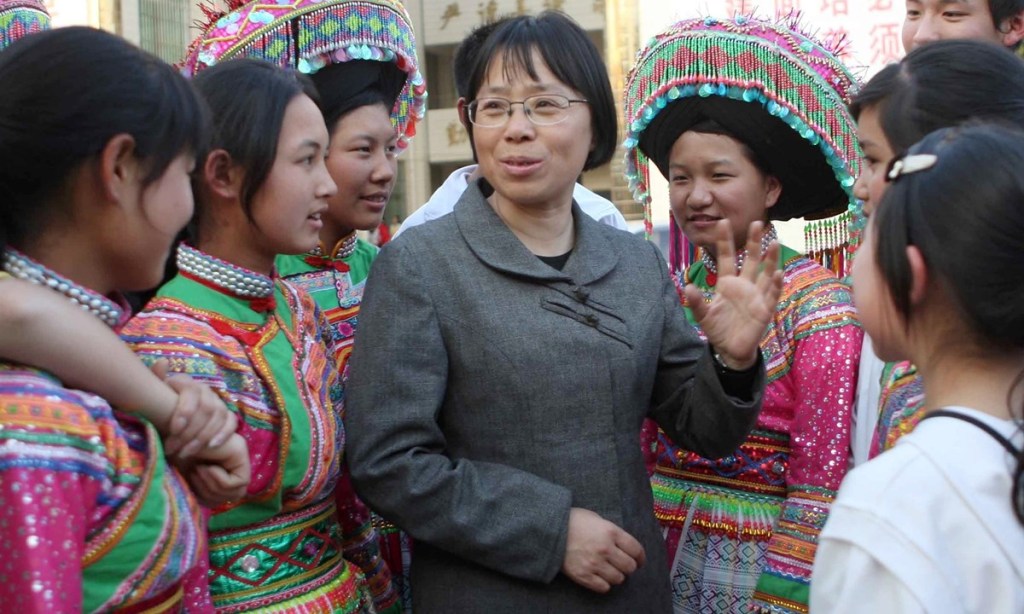
Present-day attention has turned to Zhang Guimei, often referred to as ‘the female headmaster in the mountains.’ Zhang, born in 1957, is a remarkable educator and the founder of Huaping High School for Girls in Yunnan, China. Established in 2008, Huaping High School is China’s first and only free public high school exclusively for girls, aimed at providing educational opportunities to young women from impoverished backgrounds. Zhang’s mission was grounded in her firm belief that education is essential to empowering women and breaking cycles of poverty.
Zhang faced numerous challenges in establishing and maintaining the school. Deep-rooted gender stereotypes in China often discourage girls from pursuing education, especially in impoverished areas. Zhang had to work tirelessly in persuading families to allow their daughters to attend school and secure funding and resources maintaining the school’s running. Despite these obstacles, her dedication has paid off remarkably; over the past 16 years, Huaping High School has seen more than 1,800 of its students go on to receive university education. The school’s success is evident in its achievements: by 2020, it boasted a college admissions rate of 94%. This success story has had a ripple effect, with the high school enrolment rate in Huaping County rising from below 50% before the school’s founding to nearly 90% by 2020.
Zhang’s journey to becoming a pioneering educator began decades earlier. After graduating in the 1970s, she moved to Yunnan’s rural counties to support frontier construction efforts and worked at a forestry bureau. When the bureau’s school faced a severe teacher shortage, she transferred there and began her teaching career, meeting her future husband in the process. Zhang’s personal life took a tragic turn in 1995 when her husband died of cancer. Despite this loss, she continued teaching and remained dedicated to her students, even when she herself was diagnosed with cancer in 1997, in addition to facing other health issues, including osteoma and uterine fibroids. Nevertheless, she continued teaching, determined to support her students.
Zhang’s resilience and unwavering dedication did not only change the lives of thousands of girls but also influenced social attitudes toward gender equity in education. Her work has profoundly impacted her community, challenging long-standing norms and creating opportunities for young women where few previously existed. Zhang Guimei stands as a symbol of determination, sacrifice, and the transformative power of education in breaking down barriers.
Literature as a Catalyst for Women’s Education and Social Reform
Chinese literature has long served as a powerful tool in the advocacy for women’s education and gender equality, providing both critique and inspiration. In the Qing Dynasty, Li Ruzhen’s novel ‘Jing Hua Yuan’ (Flowers in the Mirror) used satire and a utopian narrative to expose the deeply entrenched societal constraints on women’s education and critique Confucian doctrines that reinforced patriarchal values. Through her storytelling, Li questioned the validity of these limitations and inspired figures like Yuan Mei and Chen Bicheng to establish private schools exclusively for girls. These institutions challenged prevailing norms and provided girls with unprecedented educational opportunities, laying important groundwork for future reforms.
Literature continued to play a crucial role in sparking social change in the 20th century. ‘The Women’s Bell’, published in 1903 by Jin Yi, became an influential voice calling for gender equality and revolution. Jin Yi’s work passionately urged women to participate in revolutionary activities and argued that education was essential for women’s empowerment and societal advancement. Through such influential works, literature in China not only reflected the evolving perspectives on women’s roles in society but also actively shaped them, using the written word as a vehicle for lasting social transformation.
Conclusion
Today, we honor the pioneers who have championed women’s education in China by acknowledging their enduring contributions to a more equitable society. From Mary Ann Aldersey’s early missionary schools to Zhang Guimei’s transformative work in rural education, and from the literary voices of Li Ruzhen and Jin Yi to the progressive reforms supported by many more, such as Sun Zhongshan and Cai Yuanpei, each of these figures have helped shape a path towards opportunity and empowerment for Chinese women. Their legacies continue to inspire, reminding us of the power of education to break barriers and uplift communities.
Bibliography
Hu, E.T. (2022). Aldersey, Mary Ann. In: Scholl, L., Morris, E. (eds) The Palgrave Encyclopedia of Victorian Women’s Writing. Palgrave Macmillan, Cham. https://doi-org.eux.idm.oclc.org/10.1007/978-3-030-78318-1_415.
Lu, Yujing, and Wei Du. “Women’s Education in China: Past and Present.” SHS Web of Conferences 152 (January 1, 2023): 02001. https://doi.org/10.1051/shsconf/202315202001.
Pointon, Pip. “Mary Ann Aldersey and ‘first School for Girls’ in China | Pip’s Patch.” Pip’s Patch | Pip Pointon’s Website … For All Things Pip!, December 29, 2012. Accessed October 25, 2024. https://www.pipspatch.com/2012/12/29/mary-ann-aldersey-and-the-first-girls-school-in-china/.
Tian, Fen, Yaqian Zheng, and Taheri Ray. “A Historical Review of the Development of Women’s Higher Education in China (1908-2020): Stages, Explanations, and Trends.” Sociology Study 14, no. 1 (February 2024): 39–53. https://doi.org/10.17265/2159-5526/2024.01.004.
Valerie Griffiths (2008) Biblewomen from London to China: the transnational appropriation of a female mission idea, Women’s History Review, 17:4, 521-541, DOI: 10.1080/09612020802200377.
Wong Yin Lee (1995) women’s education in traditional and modern China, Women’s History Review, 4:3, 345-367, doi: 10.1080/09612029500200092.
© 2024 Boston University. “Aldersey, Mary Ann (1797-1868) | History of Missiology,” August 16, 2017. https://www.bu.edu/missiology/2017/08/16/aldersey-mary-ann-1797-1868/.
Image Credit: Global Time, Woman devoted to rural girls’ education written into book of PRC’s history, captures hearts, By Zhang Han and Fan Anqi. Published: Oct 21, 2021 09:38 PM. https://www.globaltimes.cn/page/202110/1236975.shtml.
 Retrospect Journal