

Written by Harry Fry
When discussing the representation of gender in cinema, Gurkan proposes that “masculinity does not exist on its own”. This suggests that male characters are manufactured to shape their identity and that their body is insufficient without adaptation, company, or accessorisation. More recently, Smelik, Neale, and Lang have argued for unique frameworks in locating how men are perceived, often reinterpreting feminist theory – such as Mulvey on cinema and Butler on society – to consider how masculinity is characterised. Answering the debate, this investigation will consider the 2023 film Saltburn, where filmmaker Emerald Fennell explores two contrasting male leads in proximity to one another. Felix Catton embodies a desirable, hypermasculine image, opposing the unenviable Oliver. However, this paradoxical connection is eventually unravelled as darker and more complex: Oliver is the mastermind who ties a cord around the Catton family only to manipulate and betray them. Moreover, their relationship has increasingly sexual undertones as Felix is aestheticised and idealised through Oliver’s eyes. While Oliver’s desire towards Felix’s image could rationalise his obsession, this essay will argue that Oliver holds a deeper attachment to Felix which substantiates his queer identity. With varying degrees of dependency on one another, Fennell interplays Oliver’s infatuation towards Felix through Oliver’s separation from the upper classes and his resulting inability to transform into Felix himself. Inasmuch as male characters may be presented in isolation, Fennell evidences how constructing a format of masculinity relies on comparable versions.
When Fennell conveys the power dynamic between Felix and Oliver, it initially favours Felix, as he is made the glamorised ideal of masculinity. Oliver is not only constructed to differ in personality and appearance from Felix, but he is largely situated as the spectator through which the audience views Felix. Oliver initially lacks friendships and is isolated at Oxford, only gaining social status upon forming a relationship with Felix. (Fig. 1) Neale argues that female filmmakers present aestheticised heterosexual masculinity as a “spectacle”, as their attributes are idealised through the lens of an onlooker. In expanding Mulvey’s thesis on female selfhoods being narcissistic, Neale applies this to men: Felix’s aestheticism, being wealthy, tall, charming, and popular, make him “the gleaming centre of the universe […] it’s just always been that way”. Mulvey extends her perspective, finding that characters on screen are perceived through one’s narcissistic lens, where our desires are presented through replicas in art. By integrating Butler’s concept of how the body is styled to emphasise Felix’s hypermasculine status, Lang proposes that male audiences locate potential ‘conditions’ for ‘happiness’ in Felix’s life through his gendered acts. This aligns with how Oliver observes Felix through fascination and desire, watching him engage in sexual relations with girls (Fig. 3). However, Felix is unaware of his stalker and instead views Oliver as his quest, fuelling his saviour complex. Venetia, Felix’s sister, describes Oliver as advancing ‘last year’s one’ and ‘[Felix’s] toys’, referencing Felix’s previous friend, Eddie, who also stayed with him the summer before. Smelik states that female filmmakers subvert patriarchal constraints, which Fennell could be acting on through limiting Felix’s power, as Oliver violates his privacy. However, Felix appears to covertly use Oliver for his own benefit, implying that patriarchy and a heterosexual identity emerge as superior.
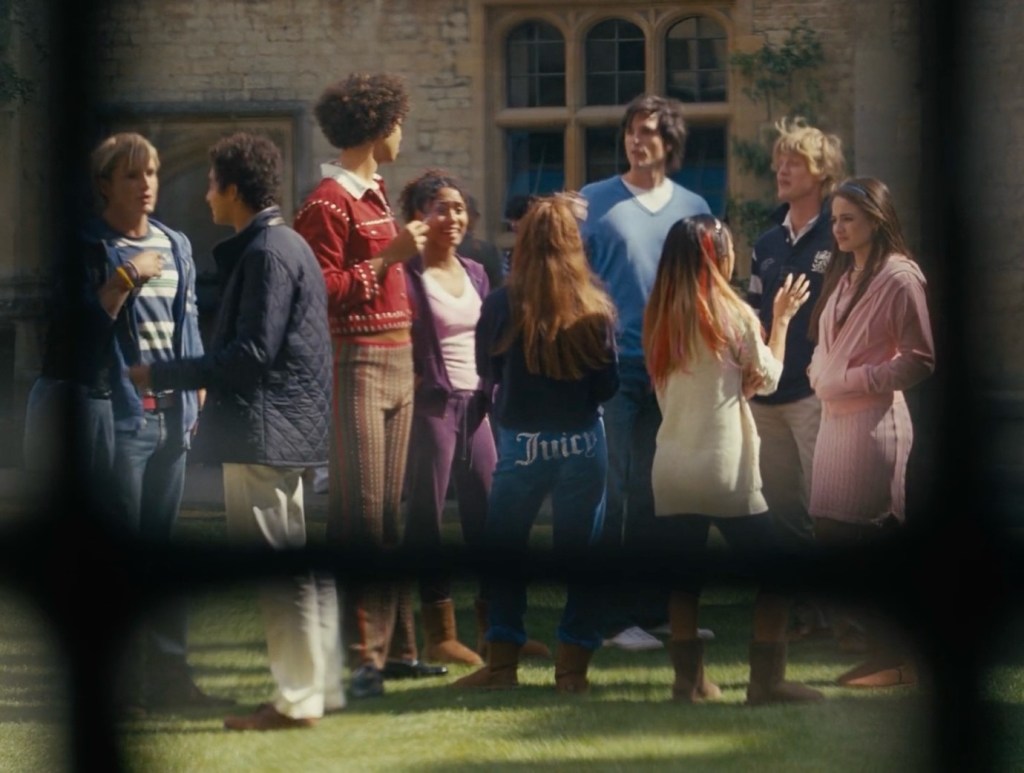
Fig. 1: (Saltburn, 2023, 00:04:13).

Fig 2: (Saltburn, 2023, 00:20:17).
Alternatively, through Oliver’s covert, manipulative scheme, he destroys Felix’s hegemony and reverses this previously established power dynamic. (Fig. 2) As Saltburn ends, Oliver is revealed as murdering Felix, Venetia, and Elspeth to conquer the Catton family, slowly revealing inconsistencies in Felix’s hegemonic masculinity. Oliver’s persistent intrusiveness toward Felix becomes sexually and uncomfortably obsessive when he drinks Felix’s semen after watching him bathe. This establishes an unorthodox, quasi-physical interaction between the two propelled by Oliver. Horrocks views institutional masculine behaviours in society as worrying and amplifies Mulvey’s framework on scopophilia towards male characters – to him, they represent male obsessions with watching and, therefore, a hysterical and lawless patriarchy. Fennell channels Horrocks’ perspective of seeing the dangers of the patriarchy and in construing men as untrustworthy beings. Oliver, being a homosexual, masculine character, means Powrie’s suggestion that queer men are damaged in patriarchal environments holds validity. Nevertheless, Oliver threatens Felix’s heterosexual, overtly masculine power, further supporting Mulvey’s insistence that the viewer gains power by observing. Being presented through a 4:3 ratio aspect, Fennell allows us to visualise Oliver’s intrusive observations, yet, consequently, what is visible is restricted to his point of view (Fig. 3). In hyper-fixating on Oliver’s lens and how he overrides Felix’s private, elite world, Oliver weakens the perception of Felix as an untouchable male archetype. As such, Fennell inversely re-establishes patriarchal supremacy: Oliver is a second example of the predominance of masculine behaviour on screen, conveying a duality in the issues of a patriarchal world. While Fennell has Felix possess hegemony in his idolised appearance, Oliver’s character suggests that exclusively men can challenge this kind of autonomy, limiting the spectrum of social power to merely different forms of masculinity.
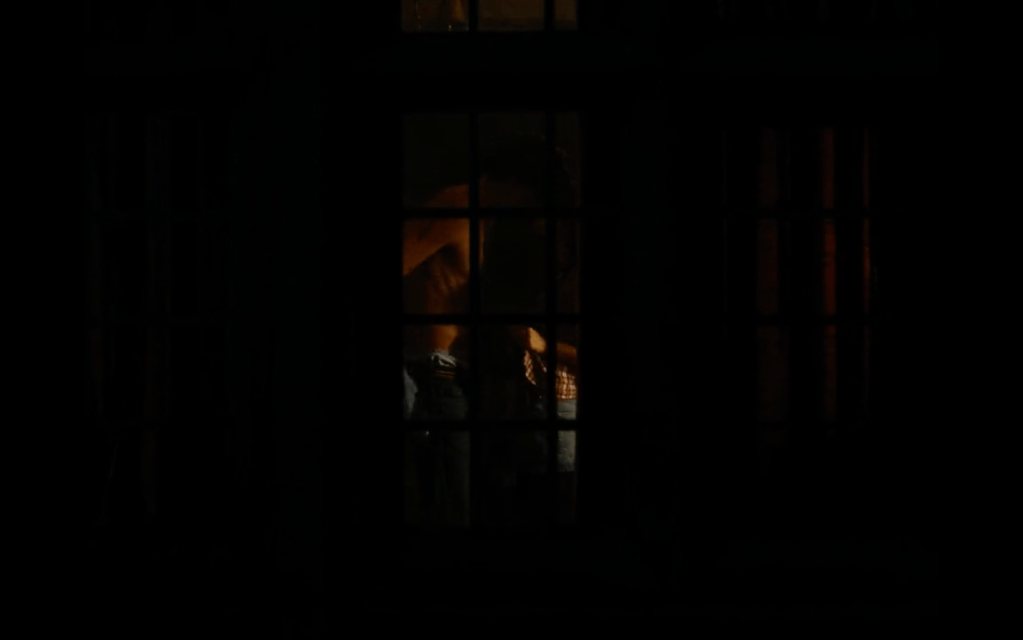
Fig 3: (Saltburn, 2023, 00:20:04).
Fennell crafts Felix and Oliver with opposing financial backgrounds yet adds complexity to how Oliver is perceived by other characters and the audience. Farleigh, Felix’s cousin who also lives at the Catton family manor, Saltburn, describes Oliver as ‘almost passing’ for a ‘real human boy’. Oliver is loaned a suit for his graduation, emphasising his separation from the elite Oxford populace that Felix and Farleigh embody. Upon staying with Felix in Saltburn, Oliver is attached to wealth, eventually driving out the Catton family by making Elspeth, on her deathbed, transfer ownership of Saltburn to him. However, upon the film’s end, Oliver dances around Saltburn naked in a haughty celebration of his success rather than activating it (Fig. 4). Given that his body appears stripped of any luxury, Fennell could be displaying his status through his naked, blank canvas. This indicates that Oliver aimed to crush the Catton family’s prestige out of jealousy but remains unable to legitimately harness it. Ultimately, Fennell implies that the masculine ideal runs parallel to wealth, but notably that it must be secured and correctly held. While multiple characteristics making Felix’s image desired are grounded in wealth, when Oliver absorbs the entirety of the Catton family’s power, he remains alone and unseen. This supports what Butler posits as gender being vitally performed, as the audience perceives Oliver as inauthentically elite. Therefore, desired masculine images, notably financial prosperity and its benefits, must be presented convincingly. Felix displays his wealth assuredly, performing a tour of Saltburn to Oliver nonchalantly, as well as pouring champagne into Oliver’s mouth as if Oliver must be taught to behave aristocratically. In contrast, Oliver, having inauthentically stolen his way into the upper classes, is unable to replicate this appearance, even after gaining what Felix economically possesses.

Fig 4: (Saltburn, 2023, 02:04:44).
Fennell substantiates the claims of Wood’s study The Gay Male Gaze by depicting Oliver’s reaction to murdering Felix as bipolar: shifting between a humorous and controlled response while maintaining obsession through sexualised acts of grieving. When visiting Felix’s grave, Oliver strips naked to masturbate and weep above Felix’s corpse (Fig. 5). This visceral and disturbing act of necrophilia positions Oliver as representative of Horrocks’ view that within patriarchy queer masculinity is disordered. One could widen this framework to explore Woods’ theory of intimate masculine relationships’ lacking coherent boundaries, or even to suggest that masculine hegemony exists in all forms, and that all men have the capacity for unsanctioned behaviour. While Oliver shows intense grief over murdering his idol, he also exploits Felix’s dead body, suggesting men who observe their desired masculine formats will more likely act irrationally and mistreat them. Wood finds queer men as uniquely volatile in desiring other men, as they frequently remould their bodies and their movements to fit society. In a similar vein, the Catton family either breaks down or vomits over hearing Felix’s corpse being transported, whereas Oliver attempts to eat and appease the family. Similarly, Oliver asks and approves what font Elspeth chose for Felix’s tombstone. Although substantiating Wood on queer, masculine behaviour as emotionally unsettled, Oliver’s addition of humour and small talk equally contradicts this thesis. It implies Oliver has unconventional assurance in this environment, to an extent mirroring Felix’s hypermasculine confidence. In evaluating the tendency for queer male spectators to objectify masculine forms they idealise and desire, Fennell overturns Butler’s concept of desires and actions being constrained to match societal expectations. Fennell makes Oliver act monstrously by overtly displaying his unattractive desires in handling Felix.
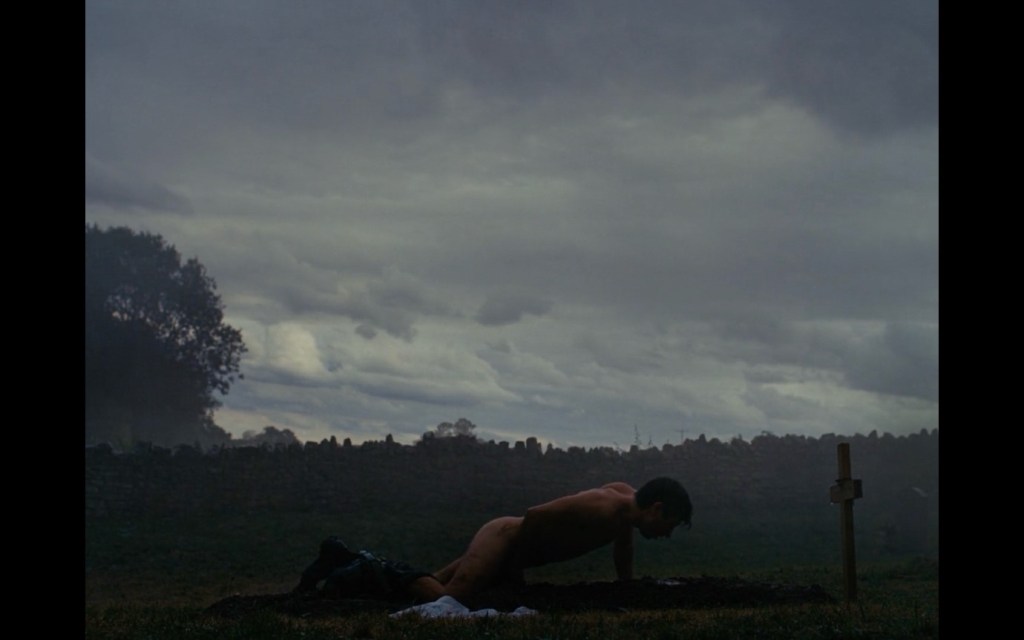
Fig. 5: (Saltburn, 2023, 01:45:12).
While Lang focuses on masculine identification on screen, namely men seeking out how to “be masculine” in locating a “role model”, it should be argued that Oliver’s obsession with his idol, Felix, reaches greater depths. Lauzen’s concept of female filmmakers’ using novel approaches in depicting the male gender, such as silence and parasocial relationships, on one level, mirrors the reality of Oliver’s obsession. Oliver applies a variety of emotional forms towards his unknowing idol: knowing Felix for only six months but proclaiming ‘[he] loved him’ and ‘hated him’. Alternatively, Felix is presented as genuinely wanting and needing Oliver when he says Oliver will ‘save’ him by coming to Saltburn, indicating a sense of co-dependency. The explicit physical intimacy between the two is seen upon their final interaction in the maze, where their faces grow closer, and they hold each other. Given that Felix’s sexuality is undefined, and Oliver watches Felix as a mission, there are signs of requited closeness between them. Certainly, Gurkan posits that recent films depict male-to-male communication as relying on unique “codes”. However, Fennell connects heterosexual aestheticism to wealth as well as power over even other men, less speculatively making Felix appear to use Oliver as a ‘toy’ or project. Being born into and maintaining an elite lifestyle, Felix could care for Oliver to absolve his guilt and compensate for his privilege. In contrast, Fennell remarks on constructing Oliver as loving but detesting the aesthetic ideal Felix represented in a deeper, jealous desire for it. By murdering him, Oliver’s less masculine image proves able to destroy an elite, idealised male image. This illustrates that the wrath or envy of queer masculinity can overpower heterosexual normativity.
Smelik and Gurkan find that scholarship on masculinity in films conceptualised through feminist theory is insufficient. This scholarship is revised by Horrocks, Powrie, and Wood, who have birthed novel considerations of queer men and their unique struggles under patriarchal and heteronormative constraints. Fennell investigates heterosexual and queer formats of masculinity in conjunction with effect, probing whether the patriarchy is consistently superior, especially when wealthy and therefore powerful. The final interaction during the grave scene between Felix and Oliver shows the physical contrast in their bodies and the subversion of their stature. Felix’s dead body is silent and abused, whereas Oliver’s naked body towering over Felix plays on how queer masculinity can expose their actual movements and emotions to override heterosexual normativity (Fig. 5). While fin de siècle queer film studies mirror feminist scholarship, Smelik and Gurkan see perceptions of heterosexual masculinity as instinctively straightforward and thus overlooked as invalid. Felix’s character diverges from normativity with undefined sexuality and death under a less masculine, unidolised male, Oliver. Fennell explores how heterosexual and homosexual masculinity can be dissected in comparison to one another through Felix and Oliver. In opposition to Oliver’s uncomplicated conquering of Felix, how heterosexual masculinity, its distinct identity and difference from queer masculinity, are presented in cinema requires greater attention.
Bibliography
Primary Sources
Fennell, Emerald, Saltburn, 2023, https://amazonmgmstudiosguilds.com/app/uploads/2023/11/Saltburn_Script.pdf.
Saltburn, 2023, [Film], Emerald Fennell, Shepherd’s Pie UK Limited.
Ford. Rebecca, Welcome to Saltburn’s Twisted Gothic Tale, (Interviewing Emerald Fennell), Vanity Fair, 2023, https://www.vanityfair.com/hollywood/2023/08/saltburn-first-look-emerald-fennell-interview-awards-insider.
Secondary Sources
Butler. Judith, Undoing Gender, 2004, Routledge.
Gurkan. Hasan, The Representation of Masculinity in Cinema and on Television: An Analysis of Fictional Male Characters, Volume 7, Number 1, 2022, https://revistia.com/index.php/ejms/article/view/5844.
Horrocks. Roger, Masculinity in Crisis, Self and Society, Volume 22, Number 4, 1994, https://www.tandfonline.com/doi/pdf/10.1080/03060497.1994.11085458.
Lang. Robert, Masculine Interests: Homoerotics in Hollywood Film, 2002, Columbia University Press.
Lauzen. Martha, The Role of Women on Screen and behind the Scenes in the Television and Film Industries: Review of a Program of Research, Volume 23, Issue 4, 1999, https://journals.sagepub.com/doi/10.1177/0196859999023004004.
Mulvey. Laura, Visual Pleasure and Narrative Cinema, Screen, Volume 16, Issue 3, 1975, https://academic.oup.com/screen/article-abstract/16/3/6/1603296?redirectedFrom=fulltext.
Neale. Steve, Masculinity as Spectacle, Screen, Volume 24, Issue 6, 1983, https://academic.oup.com/screen/article-abstract/24/6/2/1653405?redirectedFrom=fulltext.
Powrie. Phil, The Trouble with Men, 2005, Wallflower Press.
Smelik. Anneke, Feminist Film Theory, 2016, Radboud University Nijmegen, https://www.researchgate.net/publication/316228058_Feminist_Film_Theory.
Wood. Mitchell, The Gay Male Gaze, Journal of Gay and Lesbian Social Services, Volume 17, Issue 2, 2004, https://www.researchgate.net/publication/254363245_The_Gay_Male_Gaze.
 Retrospect Journal