
Written by Louisa Steijger
27/10/2024
Content Warning: This post contains discussions of violence and death.
Augusto Pinochet Ugarte came to power through a violent coup on 11 September 1973, overthrowing the democratically elected government of Salvador Allende, Chile’s first Marxist president and the first Marxist to be democratically elected in Latin America. The coup marked the start of a reign of authoritarian terror, lasting from 1973–1990, which sought to eliminate all political opposition who posed an ideological threat to the regime’s stability. Furthermore, Pinochet pursued harsh economic policies restructuring the nation along neoliberal lines. The justification for the brutal military regime was framed as a defence against the internal threat of communism within Chile and the need to restore ‘order’ to the nation. Arguably, this rationality aligned with the broader Cold War geopolitical strategy of the United States which sought to contain the spread of Communism in the US’ backyard. Thus, once in power, Pinochet swiftly consolidated his authority by dissolving the Chilean Congress, banning political parties, suspending civil liberties, and declaring a state of emergency. The ensuing repression was marked by extreme violence, in which 3,065 Chileans were murdered, 40,018 tortured and a further thousand forcibly ‘disappeared’. The word ‘disappeared’ refers to the military tactic employed to deal with enemies of the state, in which individuals were held in secret, tortured and disappeared into Chile’s prison systems and detention centres. Furthermore, Pinochet’s regime included stringent censorship imposed on the press and media. Which, to some extent, shielded the full scale of Pinochet’s atrocities from international scrutiny. Consequently, in this climate of silence and repression, a unique form of protest emerged from Chilean women, many of whom had been left behind after their husbands, brothers, or sons had been abducted by the state. These women weaved vibrant colourful tapestries known as arpilleras, depicting scenes of everyday life in Chile.
Arpilleras, were a traditional folk-art form from the Chilean countryside, made from cheap materials such as burlap, a common sackcloth fabric. Under the dictatorship, women used arts and crafts to transform traditionally feminine practices into powerful forms of resistance against the oppressive regime. Therefore, arpilleras became a medium to document the everyday horrors of life in Chile in the 1970s and 80s. These tapestries granted women autonomy and agency to speak out against authoritarianism in a nation where all other avenues of ‘free expression’ were silenced. Depicting scenes of soldiers rounding up men, women illegally siphoning electricity, and empty homes left behind by those who had been disappeared, these tapestries became potent symbols of defiance and survival.
It is important to note, that the majority of arpilleras remain anonymous, crafted by women whose names are deliberately obscured. Given that Pinochet’s government had recognised the power of this medium labelling the tapestries as a form of ‘defamation’ against the state, the anonymity of the female creators safeguarded the women from potential persecution. In this context, the Catholic church played an instrumental role in the production and dissemination of these tapestries. Once a month, arpilleras were collected from grassroot workshops and taken to the Vicaria de la Solidaridad (Vicarate of Solidarity), a Catholic human rights group based in Santiago who were responsible for the international distribution of the tapestries. Given that the regime had banned these tapestries from being shown or sold in the country, distributing these artworks posed a difficult task. Consequently, the Vicaria often relied upon diplomatic channels to smuggle arpilleras out of Chile. While the Catholic Church assumed the responsibility of distributing, it ensured that all funds generated from the sales, often a modest $10 per piece, went directly to the women who created the arpilleras. For many women this income had become their only means of survival.
An exploration of these radical art forms is vital as it reveals the profound emotional and social realities of women living under Pinochet’s regime, providing a powerful visual testimony of their lives that transcended censorships and amplified their voices amidst the silence of repression.

Fig. 1: Aprilleras A.P.A ‘Arrests and Raids’. (1976). Embroidered Textile, 15 x 19.5 inches, Courtesy of Margaret Beemer
In one arpillera titled Arrests and Raids (1976), soldiers dressed in green uniforms are shown moving between houses in a Chilean neighbourhood, rounding up suspected dissidents—usually men—who are depicted with their hands raised in surrender. The women and children left behind in these scenes convey the profound impact of the regime’s repression on families and communities. The men taken away would often never return, ‘disappeared’, never to be seen again. For many of the women who turned to arpillera workshops, this image was a stark reflection of their own lives—left behind in an oppressive system where their only means of socioeconomic survival and resistance was through the production of art.
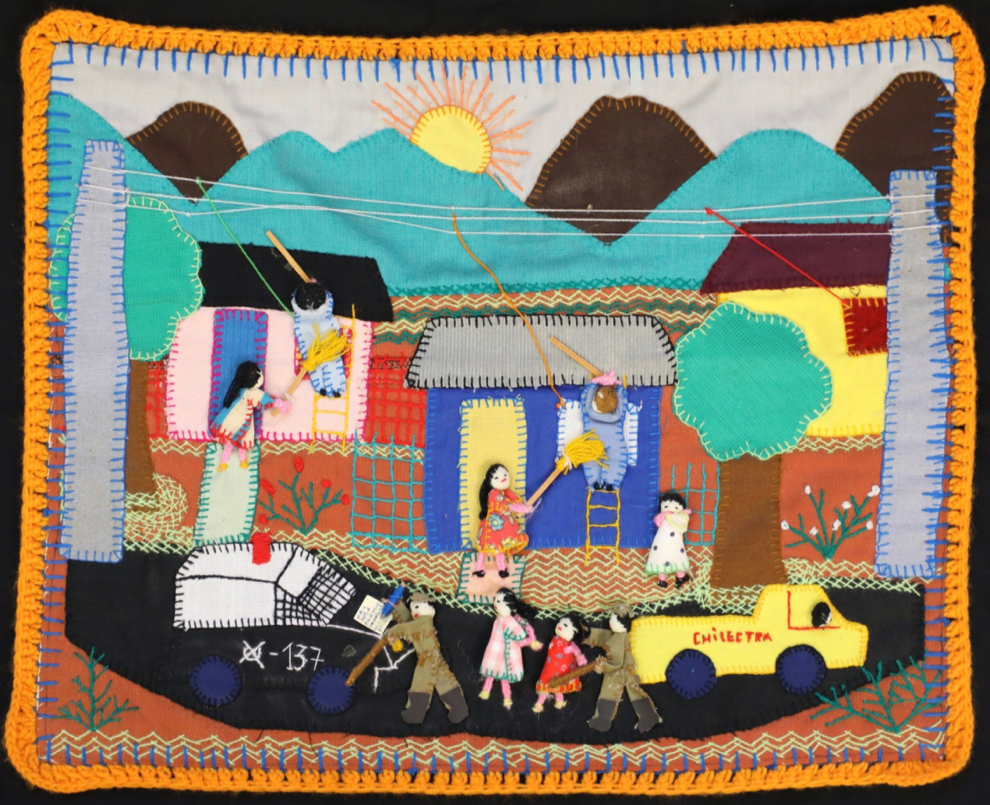
Fig. 2: Arpilleras A.P.A ‘Chilectra Disconnecting Power Lines’, 1976. Embroidered Textile, 15 x 19 inches. Courtesy of Rosalind Bresnahan.
In another striking work, Chilectra Disconnecting Power Lines (1976), women are shown hooking cables to power lines, illegally siphoning electricity from Chilectra, the national power company. This image captures the desperate conditions under which the poorest Chileans were forced to live, where basic utilities like electricity were unaffordable luxuries. Raids on neighbourhoods, such as those depicted in this tapestry, were common as authorities sought to punish those who rebelled against the regime in even the smallest of ways, for example by tapping into electricity. For many, power pilfering was the only means of survival, and the depiction of this act in Chilectra Disconnecting Power Lines reveals the extent of economic inequality under Pinochet. The image serves as a stark reminder of how the dictatorship’s policies deepened the divide between rich and poor, forcing citizens into illegal and ultimately dangerous activities to meet their basic needs.
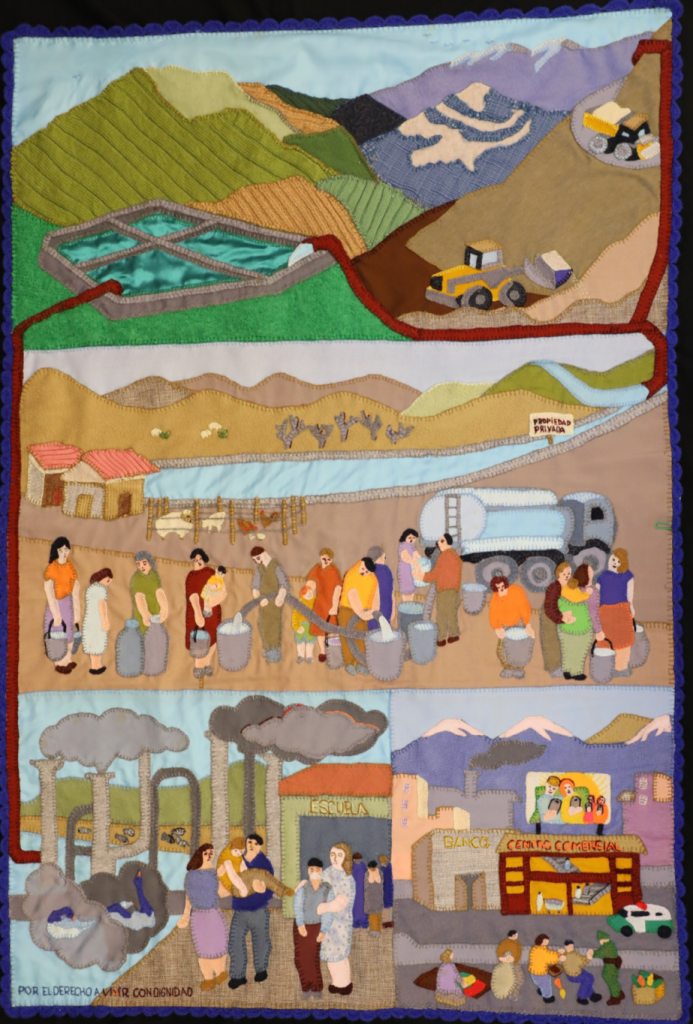
Fig. 3: Victoria Diaz. For the Right to Live With Dignity, 2019, Embroidered textile, 67 x 39 inches, Courtesy of Marisol Quintana.
While the arpilleras originated as a response to Pinochet’s repression, their legacy continues to resonate in modern Chile. Contemporary artists, such as Victoria Diaz, use the same medium today to address ongoing social and political issues. In her work For the Right to Live with Dignity, Diaz tackles global concerns such as climate change, water shortages, and pollution, linking them to ongoing struggles for human rights and economic equality in Chile. Indeed, Diaz’s arpillera emerged against the backdrop of growing protests in Chile in 2019, which were triggered by a spike in the price of metro fares in October but quickly expanded to address broader issues regarding education, healthcare, pensions, and environmental concerns. These anti-government protests led to a short-term suspension of the freedom to assemble and protest in Chile. Thus, Diaz’s piece demonstrates the enduring power of arpilleras as tools of protest and social commentary, highlighting how the art form has evolved to reflect contemporary society in Chile while remaining rooted in its tradition of resistance.
Beyond their immediate context of resistance, the arpilleras also serve as lasting visual testaments to the lived experiences of Chileans under dictatorship. Exhibited in museums and collections around the world, such as the Californian Museum of Latin American Art, these tapestries provide a profound testimony to the brutality of Pinochet’s regime. Ultimately, the arpilleras did more than just critique Pinochet’s regime—they made visible the invisible suffering of ordinary Chilean women and preserved their stories for future generations.
Bibliography
Adams, Jacqueline. Art Against Dictatorship: Making and Exporting Arpilleras Under Pinochet. (2021) Austin: University of Texas Press. https://doi.org/10.7560/743823.
Agosin, Majorie. Tapestries of Hope, Threads of Love: The Arpillera Movement in Chile 1974-1994. (2008) USA: 2nd Edition, Rowman & Littlefield Publishers.
Amnesty International. ‘Public Document the Case against Augusto Pinochet’. (2008) [online] https://www.amnesty.org/en/wp-content/uploads/2021/06/amr220042008en.pdf. [accessed 12.10.24]
Doolan, Elizabeth. “Arpilleras and Archives: Textiles as Records of Conflict.” Curator (New York, N.Y.) 63, no. 4 (2020): 547–54. https://doi.org/10.1111/cura.12386.
Farias, Mariela Rojas. “Arpilleras of Migration: An a/r/Tography about Female Latin American Resilience.” Canadian Art Teacher 19, no. 1 (2023): 34
Maryuri Grisales. “CHILEAN ARPILLERAS: WOMEN WHO WEAVE TOGETHER MEMORIES AND RESISTANCE.” Sur: International Journal on Human Rights 17, no. 30 (2020): 151–54.
O’Toole, Rick. ‘What is an Arpillera?’, The William Benton Museum of Art. (2014) [online] https://benton.uconn.edu/web-exhibitions-2/arpillera/what-is-an-arpillera/. [accessed 08.10.24]
Sepúlveda, Emma. We, Chile Personal Testimonies of the Chilean Arpilleristas. (1996) USA: Azul Editions.
Watson, Katy. ‘Chile Crisis: Fearlessness and Anger Drive Protesters.’ BBC News, October 23, 2019, sec. Latin America & Caribbean. [online] https://www.bbc.co.uk/news/world-latin-america-50151323. [accessed 08.10.24]
Appendix
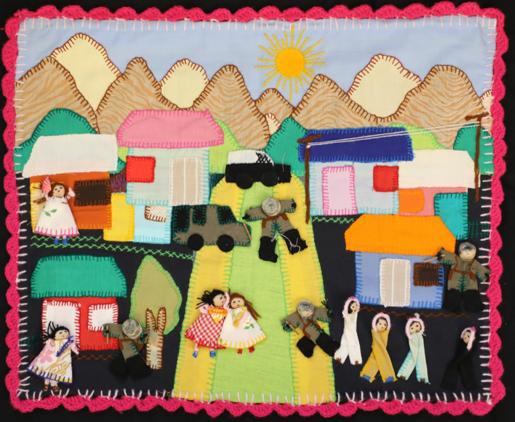
Figure 1. Arpilleras A.P.A, ‘Arrests and Raids;. 1976. Embroidered Textile, 15 x 19.5 inches, Courtsey of Margaret Beemer. In Museum of Latin American Art. ‘Arte, Mujer, Y Memoria: Arpilleras From Chile’, MOLAA Exhibition, 24th November 2019 – 6th September 2020. [online] https://molaa.org/arpilleras-online [accessed 05.10.24]

Figure 2: Arpilleras A.P.A, ‘Chilectra Discconecting Power Lines’. 1976. Embroidered Textile, 15 x 19 inches. Courtsey of Rosalind Brenshaw. In Museum of Latin American Art. ‘Arte, Mujer, Y Memoria: Arpilleras From Chile’, MOLAA Exhibition, 24th November 2019 – 6th September 2020. [online] https://molaa.org/arpilleras-online [accessed 05.10.24]

Figure 3: Victoria Diaz. For the Right to Live With Dignity. 2019. Embroidered Textile, 67 x 39 inches, Courtesy of Marisol Quintana. In Museum of Latin American Art. ‘Arte, Mujer, Y Memoria: Arpilleras From Chile’, MOLAA Exhibition, 24th November 2019 – 6th September 2020. [online] https://molaa.org/arpilleras-online [accessed 05.10.24]
 Retrospect Journal