
Written by Jazmine Chambers
20/10/2024
Greek sources only start referencing ’the Celts’ at the start of the sixth Century BC – mainly for ethnographic purposes. Herodotus (484 – 425 BC), an ancient Greek historian, wrote his famous work History to give a background to the Persian war; already this implies that his writing about Celts is probably incidental, rather than an outright effort to research and describe these peoples. Within his very simplistic description of the Celts, Herodotus is wrong in his placement of the river Danube. This suggests that he never ventured anywhere near the ‘land of the Celts’. The most probable reason for this mistake was that he compared it to the river Nile in Egypt, to exaggerate its exoticness to his readership. Herodotus’ main motivation for writing History was to explain and defend the reasons behind the Greco-Persian war. Whilst his details are not accurate, this text does tell us that the Greeks had labelled those living around the region of the Danube ‘Celts’, and that they were worth mentioning. We are told by Herodotus that these people referred to themselves as ‘Celtae’, and he probably only referred to the Gauls that were known to be left of the Danube. Even then, it is highly improbable that these peoples acknowledged themselves all under one name.
Plato (427 – 347 BC), one of the most prominent Greek philosophers of all time, also mentions the Celts in his work Republic, in which he described his ideal city. His writing tells us that the Celts were drunkards (a recurring theme in much of Classical writing, that could suggest Plato was leaning towards stereotypes of the time rather than first-hand experience) and he uses “broad characterisation” to describe the Celts along with several other identities, including the Persians. He shows undoubted bias towards the Greco-Persian war of the time and contributes to the Ancient Grecian idea of the Other. Furthermore, he uses the idea of Celts enjoying alcohol too much to assert his own ideas of right and wrong. As he describes, the Spartans apparently did not drink, and therefore the portrayal of drunkenness associates the Celts with a barbaric violent image. His work, as a source to determine Celtic culture and society, is therefore unreliable. The people themselves left no evidence of their supposed heavy drinking, leaving it up to speculation on whether their drinking was as excessive as Plato and others claim. Therefore, Plato’s work can be said only to allow us a glimpse of Greek bias towards the Other, rather than an account of Celtic custom.
Classic authors were lax at defining what someone who was ‘Celtic’ looked like. Xenophon’s (430 – 354 BC) account Hellenica is an example of this. Writing as a Greek military leader who fought Persia frequently, Xenophon claims that Dionysius (432 – 367 BC) employed troops, including Celts, to fight the Thebans. This infers that Celtic warriors were valued for their fighting qualities and their supposed legendary ferocious nature in battle had become well known at this point. However, where these Celts came from, or who he saw fit to define as Celtic is not mentioned. Since the image of the Celts in Greece at this time was a warrior stereotype, it can be assumed that any soldier from Western Europe could have been labelled as Celtic by those who had never interacted with Celtic peoples before. It can also be assumed that many, in part at least, admired these warriors, even if most of the time they were the enemy. The text was used as propaganda for Greek purposes, lacking specificity and associating Celts with anything Northern European. Although it is an uncommon example of a first-hand observation, it is simply a description that is quite dismissive of Celtic troops, giving us limited information on Celtic societies and cultures outside of their use as soldiers.
Diodorus Siculus (90 – 30 BC), who was an Ancient Greek historian, provides a much more detailed account on who he labels Gauls, which seemingly shows a greater understanding of the different Celtic peoples. It is not clear whether Diodorus uses Gaul and Celtic as interchangeable, or whether he genuinely knew the difference (Gaul now refers to the Celtic peoples who occupied what is modern-day France, northern Germany and parts of the Alps). Recurrently, he claims that the ideology of Celtic ‘drinking culture’ was fierce and that Gauls were drunk all the time with no self-control. He impounds this idea of a passionate, disorganised people: this is also shown by the fact that he compares undiluted wine to the Grecian tradition of mixing wine with water. Diodorus’ reliability as an author is questionable as he was known to mix fact with fiction and rely on second hand information rather than do his own research. In this particular example, he borrowed from Poseidonius (135 – 51 BC), who did personally go to Gaul. None of Poseidonius’ original works survive. We can only assume that his descriptions of the Celts’ drinking habits resemble Diodorus’, however, this uncertainty makes his work less likely to reflect actual Celtic customs. Diodorus also wrote his findings because he was compiling a ‘great work of history’, suggesting that he would exaggerate and exotify the Celts in a way that was entertaining and a source of fearmongering. He tells us that the Celts drank wine, and that trade happened between Celtic peoples and the Romans (implying some sort of economy) but in reality, there is still the constant stereotype of the passionate Celt firmly weaved between his lines.
One of the most prominent examples of first-hand observational accounts of the Celts is from Caesar (100 – 44 BC), a Roman General at the time, in his Commentarii de Bello Gallico; Caesar fought against Celtic peoples in the first Century BC. Although his writings were underlined by the fact that he wanted to justify his actions in battle to his Roman political opponents, his details of the Celts are greater than most other Classical authors. His account was written as he was fighting – and winning – against them. As the conqueror, we can infer that he would have made no attempts to truly understand the Celtic peoples he intended to tax and enslave. For example, he describes the morbid scene of the Gaul sacrifice using the wickerman, which paints a gory picture of the Druids burning people alive in giant wooden replicas of people. Although we have this very detailed, story-inspiring account, we have no evidence of this ritual ever taking place, or ever existing. Caesar’s account of the wickerman is proof of his political agenda to prove that these barbaric peoples were worth conquering and subduing.
We have archaeological evidence that Celtic societies may have practiced ritual sacrifice. This is shown in sites such as Gordion (dating suggests it is a Hellenistic site), which show bodies of multiple humans thrown hazardously into deep pits; this, contrasting the more careful burials of, for example, La Tene and Hallstatt, suggest an act of sacrifice. However, the evidence does not imply anything other than that they died brutally and cannot be solidly connected to ritual sacrifice. Although it is unclear of how they were deposed, it is not evidence of a mass sacrificial wickerman. That being said, although Caesar’s account is exaggerative, it does show us that sacrifice was associated with, and might have occurred, in Celtic society (just perhaps not as fantastical as he claimed).
Another aspect of Celtic culture to which both Caesar and Polybius (200 – 118 BC), a Greek historian, refer to, is the fact that Celtic warriors were not clothed on the battlefield. In Polybius’ account, he claims this is to showcase young Celts at their fittest, and that garments impeded fighting. However, this was probably an estimation on his account, and not a direct inclination from the naked persons in question. Although it might be a firsthand account, Polybius’ main motive for his work was for the Roman army’s actions to receive a good reception back home, which presumably would mean he tried to portray the Celts as powerful but as vincible as possible: he used their nakedness as a contrast to animalistic imagery, portraying to those reading his work that the Celts were formidable foes (and therefore a threat). But Polybius dehumanised the Celtic warriors enough for the fight against them to continue without question from Greece. Although Polybius’ work may have been an exaggeration, Celtic nakedness has often been attributed to the Celts throughout Classic arts as early as the fifth Century BC, implying that they did fight naked at least some of the time. The jewellery he mentions such as the torcs are also present in the La Tene and Hallstatt burials, as they held great divine significance for many Celtic tribes. So, although Polybius’ account may have been motivated by the continued violence against them, he does seem to describe Celts on the battlefield accurately.
In this brief overview of what Classical Authors wrote about the Celts, it can be concluded that many of the Classical texts claiming to describe the Celts are limited, due to the political and self-gratifying motives behind them, and we have no clear picture of the Celtic peoples from how they have painted them. We are almost always strictly narrowed to how Celtic peoples would have acted militarily, because it is clear that most at the time had never visited Gaul, or other places occupied by the Celts, themselves. There is no defined idea of who the different Celtic peoples were, and most references to them are generic and broad. Our information on the Celtic peoples from Classical sources is limited to where the Greco-Romans thought they resided, their military tactics, and what may or may not have been propaganda about a few of their rites of life. Most tell us much more of the attitudes and cultures within Greco-Roman society than they do of Celtic societies, at the time.
Bibliography
Barry Cunliffe, ‘The ancient Celts’ / Barry Cunliffe. (Second edition.). (Oxford: Oxford University Press, 2018). Print.
Bernhard Maier, ‘The Celts: a History from Earliest Times to the Present’ / Bernhard Maier; Translated from the German by Kevin Windle. (Edinburgh: Edinburgh University Press, 2003). Print
David Rankin. ‘Celts and the Classical World’. Taylor and Francis. (2002) <https://doi.org/10.4324/9780203441985>
Dench Emma, “Ethnography and History.” in ‘A Companion to Greek and Roman Historiography’. (Oxford, UK: Blackwell Publishing Ltd, 2007). Print.
H.J. Edwards (trans.), Caesar: ‘The Gallic War’ (Cambridge, MA, 1917). Print.
Jane Webster. “At the End of the World: Druidic and Other Revitalization Movements in Post-Conquest Gaul and Britain.” Britannia (Society for the Promotion of Roman Studies) 30 (1999): <https://www.jstor.org/stable/526671?seq=1#metadata_info_tab_contents> 24/22/2021
Jane Webster, ‘Ethnographic barbarity: Colonial discourse and “Celtic warrior societies”’, in ‘Roman Imperialism: Post-Colonial Perspectives’ (eds) Jane Webster & Nick Cooper, (Leicester, 1994). Print.
Jeremiah R Dandoy, Page Selinsky, and Mary M Voigt. “Celtic Sacrifice.” Archaeology 55.1 (2002) <https://www.jstor.org/stable/41778956?refreqid=excelsior%3Adf37b43c1d5581dc2afc3e9c4caafd49&seq=1#metadata_info_tab_contents> 24/22/2021
John Collis, ‘The Celts: Origins, Myths & Inventions’ / John Collis. (Stroud Tempus, Gloucestershire, 2003) Print.
John T. Koch, ‘Celtic Culture: A Historical Encyclopedia’ / John T. Koch, Editor. (Santa Barbara, Calif: ABC-CLIO, 2006). Print.
John T Koch, John Carey, ‘The Celtic Heroic Age: Literary Sources for Ancient Celtic Europe & Early Ireland & Wales’ / Edited by John T. Koch in Collaboration with John Carey. Fourth edition. (Aberystwyth: Celtic Studies Publications, 2003). Print.
Patrick Sims-Williams, “An Alternative to ‘Celtic from the East’ and ‘Celtic from the West.’” Cambridge archaeological journal 30.3 (2020) <https://pure.aber.ac.uk/portal/files/42499087/an_alternative_to_celtic_from_the_east_and_celtic_from_the_west.pdf> 24/11/2021
Philip Freeman, ‘Greek and Roman accounts of the ancient Celts’, Koch, J. T. ed. Celtic Culture: A Historical Encyclopedia, 5 vols, (Santa Barbara, California, 2006), (vol. 3). Print.
Polybius (trans) Evelyn s Shuckburgh, ‘The Histories’. (New York: Macmillan, 1889). Print.
Sean B Dunham, ’Caesar’s Perception of Gallic Social Structures’, in Celtic Chiefdom, Celtic State: The Evolution of Complex Social Systems in Prehistoric Europe’. Arnold, Bettina., and D. Blair. Gibson / Edited by Bettina Arnold and D. Blair Gibson. (Cambridge: Cambridge University Press, 1995.) Print.
Xenophon, Henry Graham Dakyns. ‘Hellenica’ / by Zenophon; Translated by H.G. Dakyns. (Place of publication not identified: Neeland Media LLC, 2011).
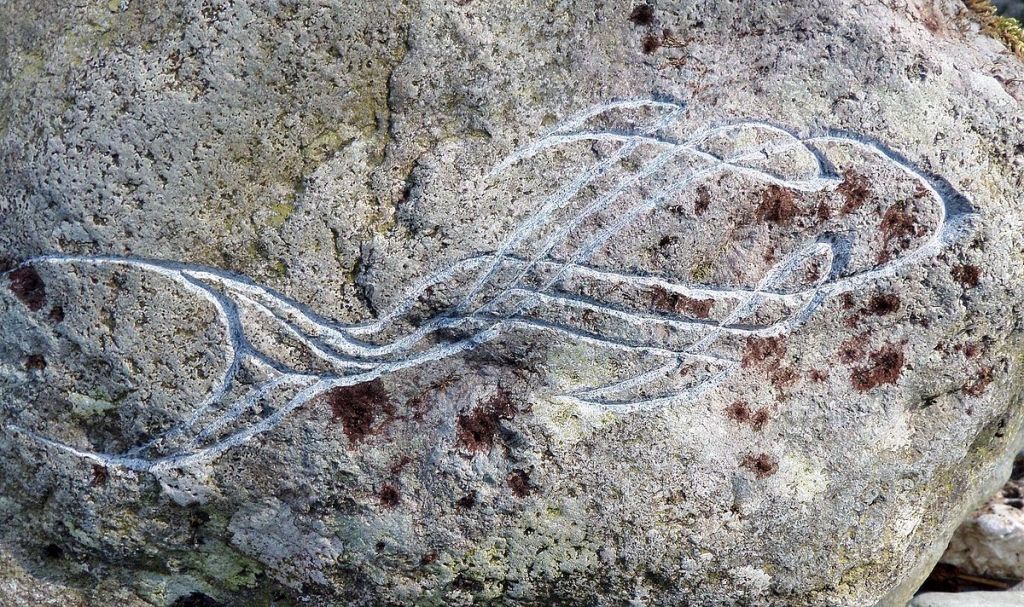
Featured Image Credit: Celtic Fish boulder carving by Rosser1954. Accessed via Wikimedia Commons: https://commons.wikimedia.org/wiki/File:Celtic_Fish_boulder_carving_-_Glencoynedale,_Cumbria.JPG
 Retrospect Journal
