
Written by Ailsa Fraser
We think of ourselves as living in an information age—something post-industrial, divorced from the physicality of the former industrial period. The increasing digital turn, accelerated by the pandemic, only emphasises this. We can meet across time and space without even needing to leave our desks—or, in some cases, our beds. This idea of the intangible information age is false. If, like me, you were one of the many students who moved into a new home this semester, you may have experienced the classic wait for your Wi-Fi to be connected, and been confronted with a much-ignored fact: we depend entirely on a physical, unseen infrastructure. The cloud is a physical thing.
It took three weeks after moving in to get functioning Wi-Fi. Internet connection in particular is something we view as ethereal and intangible, a piece of the information age—the ‘cloud’ was given that name for a reason. But it is a misleading name. The cloud is actually another computer, far away, that stores your information ready for you to retrieve it when, and only when, you have a functioning internet connection. I did not for a while—truly tragic, mostly because I could not watch videos of my dogs—and when the Wi-Fi engineer finally arrived to connect me, what he did was baffling. Plug in some wires? Replace some cables? I had thought that surely the house could be connected remotely, but this was not true. When I booked the appointment, I was even told that the process might involve some digging—what for, I do not know. Not being the owner of the garden, this made me nervous. Thankfully, no digging was necessary.
My own ignorance about how home Wi-Fi functions is a prime example of how little many of us know about the physical infrastructure we depend on. Constellations of satellites connect our phones. Internet cables under the sea connect us internationally. Even the most visible examples of infrastructure, like roads, go unnoticed until the potholes appear. Or, more seriously, until something stops working altogether. Again, much like my Wi-Fi, these structures that enable our lives are meant to be larger than us, systematic, and reliable—but more often than not, they are eternal works in progress. They break down.
Jennifer Gabrys writes about the physicality of the information age, specifically investigating electronic waste. Up to 90 per cent of computer consumer devices in the United States go to landfill. She studies these sites as an archaeology of technology: in the past few decades, technology has evolved so fast that it is possible to date and identify ‘fossilised’ digital waste. She and other garbologists show that such fossils hold enormous amounts of information about the culture that disposed of them, but for this article, their main revelation is a disconnect between consumer and product. The vast majority of us cannot trace the supply chain that produced the items we use every day or what happens to them after disposal—I certainly could not for this very computer I am typing on—and that abstraction from physicality is the defining feature of the information age, not a lack of physicality altogether.
The environmental history of computing is still nascent, but Nathan Ensmenger set it into motion with his article of the same name, pointing out that although it seems the cyberspace we occupy is less resource-intensive and better for the environment, this is not necessarily true. We still consume enormous resources to maintain this lifestyle. Many email signatures nowadays will include a note such as, “Please consider the environment before printing this email.” But research suggests having an email signature at all, especially one with an image in it, increases the carbon footprint of your email—perhaps not as much as the printer paper would, but worth noticing if you send hundreds of emails per day. The resources consumed by computing are much harder to analyse and offset. Ensmenger looks at the environmental history of Bitcoin to demonstrate this. It had such a high energy requirement that if you map prominent areas of Bitcoin mining in America onto a map of the United States energy grid, there is a startlingly clear correlation, as mines farther from the grid could not function as well. This, like everything else, is a holdover from the industrial age: the United States energy grid was built based on the patterns of the railway. Places of traditional, material power still wield that power in the information age; it is just more difficult to see.
Furthermore, the physicality of the information age can be just as harmful as the industrial, to humans and environment alike. To use the example of Bitcoin again, earlier this year Time reported the story of Granbury, Texas, a town where the background noise of the nearby Bitcoin mine caused health issues for over forty people, including hearing loss, migraines, nausea, hypertension, and panic attacks. The noise came from the fans used to cool the facility’s computers. Artificial intelligence is even worse for this, known to consume enormous amounts of energy and water alike. AI does promise to be enormously useful in the fight against climate change, but its own emissions are difficult to ignore. Nor does it affect all countries equally: in 2022, Google’s data centre in Finland ran on 97 per cent green energy, while for its Asian data centres, green energy was between 4 and 18 per cent of their energy consumption. Fossil fuels step in to fill the gap—and the local environment is what suffers for it.
Our perception that today’s world is disconnected from the material one, abstract and intangible, and thus above it, is only true to a certain extent. We still rely on the physical products of the industrial age to operate. As easy as it is today to access information, to communicate with others, to entertain ourselves at the touch of a button, that ease depends on the invisible infrastructures around us. Those infrastructures are older—and less sustainable—than we give them credit for. It was only recently that Britain shut down its last coal power plant after 142 years of operation. We will mostly interact with those infrastructures in moments of failure and frustration—when the road wears thin, when the power cuts, and, in my case, when the Wi-Fi wavers again. But they are situated in a physical realm, whether that be in the ground, in geostationary orbit, or right next to a town in Texas. The cloud itself is a physical thing. It is only the narrative around it that is smoke and mirrors.
Bibliography
Adamson, Glenn. “Do You Know Your Stuff? The Ethics of the Material World.” Aeon Essays. 28 November, 2018. Available at: https://aeon.co/essays/do-you-know-your-stuff-the-ethics-of-the-material-world [Accessed 07/10/2024]
Chow, Andrew R. “‘We’re Living in a Nightmare’: Inside the Health Crisis of a Texas Bitcoin Town.” Time. July 8, 2024. Available at: https://time.com/6982015/bitcoin-mining-texas-health/ [Accessed 07/10/2024]
Dhar, Payal. “The carbon impact of artificial intelligence.” Nature Machine Intelligence. 12 August, 2020. Available at: https://www.nature.com/articles/s42256-020-0219-9 [Accessed 07/10/2024]
Edwards, Paul N., Steven J. Jackson, Geoffrey C. Bowker, and Robin Williams. “Introduction: An Agenda for Infrastructure Studies.” Journal of the Association for Information Systems 10, no. 5 (2009): 364–374.
Ensmenger, Nathan. “The Environmental History of Computing.” Technology and Culture 59, no. 4 (2018): 7–33.
Gabrys, Jennifer. Digital Rubbish: A Natural History of Electronics. Ann Arbor: University of Michigan Press, 2011.
Ren, Shaolei, and Adam Wierman. “The Uneven Distribution of AI’s Environmental Impacts.” Harvard Business Review, July 15, 2024. Available at: https://hbr.org/2024/07/the-uneven-distribution-of-ais-environmental-impacts [Accessed 07/10/2024]
Ward, Jacob. “Oceanscapes and spacescapes in North Atlantic communications.” In Histories of Technology, the Environment, and Modern Britain, edited by Jon Agar and Jacob Ward, 186–205. London: UCL Press, 2018.
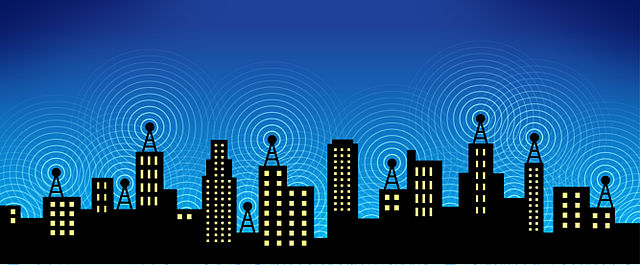
Image credit: D’Andrade, Hugh. Electronic Frontier Foundation (eff.org) graphic created by EFF Senior Designer Hugh D’Andrade to illustrate EFF’s work for open wi-fi. 5 September 2014. https://commons.wikimedia.org/wiki/File:Wifi-BIG.jpg
 Retrospect Journal
