
Written by Jake Beecroft
On the morning of 26 February 1986, two US Air Force planes prepared to land on the Hickam air base in Hawaii. As the first plane touched down, the deposed President of the Philippines, Ferdinand Marcos and First Lady Imelda Macros stepped off after being evacuated from the Philippines on the advice of US President Ronald Reagan. Alongside the couple came an 88-person family entourage, 22 boxes of freshly minted pesos and 278 crates of jewellery, 24 gold bricks and various invaluable artworks, and the deeds to a vast array of real estate assets, in total running up 23 pages on United States customs records.
The legacy of the regime under Ferdinand Marcos in the Philippines can be linked with political repression, corruption, and human rights abuses for over 20 years, including martial law for almost a decade and an increasingly dire domestic economy heading towards collapse under crony capitalist management. Against these conditions, the opulent and extravagant lifestyle of the Presidential couple, particularly First Lady Imelda Marcos, is almost unfathomable to imagine in a nation where, by 1986, 50% of the nation lived in poverty.
The excesses of the Marcos Regime soon began to unravel. Protesters overwhelmed security and stormed the Malacañang Palace in Manila on the 25 of February as the last part of the People’s Power Revolution. Inside the former official residence, the true extent of the couple’s, and in particular Imelda’s, lavish lifestyle was revealed to the people of the Philippines as protesters witnessed the grandeur and opulence of the residence in a manner fitting more to that of royalty or the mega-rich than the residence of elected officials. Imelda’s wardrobe stood out infamously to the press for her collection of nearly 900 handbags, 508 gowns, and the most infamous, a shoe collection suspected of numbering around 3000 pairs. That same day, the couple had fled the country.
Despite her husband holding the office of President since 1965, Imelda took just a controlling role in the government during his tenure in the position. Imelda herself was appointed to control roles within the government, including the roles of Metro mayor of Manila from 1975 and minister of human settlements and colony from 1979, the latter tying her to the human rights abuses committed in defence of her husband. Despite lacking an elected mandate for the positions she held, Imelda was also in control of around 50% of the state budget of the Philippines, a factor many have attributed to the ease of embezzlement committed by the pair.
Imelda Marcos often found herself under constant press coverage for her glamorous lifestyle with jet-setting trips across the globe. Political contemporaries had noted her charming personality and glamour as part of her strong stateswoman image, which contributed to a period that strengthened Filipino relations internationally. Imelda embraced many famous world leaders, such as Muammar Gadafii, Josip Broz Tito, and Fidel Castro. For her diplomatic efforts abroad, Imelda would indulge in extravagant spending abroad, including a three million dollar holiday to Rome, a five million dollar spending spree on jewellery and clothing in New York, a 150-karat Burmese Ruby, a 30-karat Bulgari diamond bracelet that was valued at one million in 1986, and various paintings, including works by Van Gogh, Rembrandt, Rafael, and Michelangelo. Purchases of which were largely shielded from the domestic crowds of the Philippines during their time in power.
During the two decades of power the Marcos family ruled, it is estimated that the couple embezzled between $5 and $10 billion in public funds, according to the Philippines Supreme Court; this is believed to have been largely hidden in foreign bank accounts and investments. As discovered in the immediate days after the couple had fled, records found in the President’s bedroom safe began to quickly unravel the Marcos regime’s credibility on public spending, as records of funds being syphoned off to elite cronies within the Philippines, foreign bank accounts, and overseas property deeds were revealed. The President’s successor in 1986 established the Presidential Commission on Good Governance (PCGG) in an effort to recover the lost assets and provide financial retribution to victims persecuted by torture under the regime. The value of the plundered wealth taken by the Macros family has infamously placed the couple within the Guinness Book of World Records for the largest government robbery, which still holds into the present day.
Though Ferdinand died just a few years later in 1989, the PCGG continued to spend the next four decades tracking down the couple’s ill-gotten gains through many legal battles against Imelda Marcos. One of the most notable discoveries that emerged included a bank account estimated at $356 million at its time of discovery. The Swiss account had been opened under the fake names of William Saunders and Jane Ryan, only adding to the secrecy, to which the total was returned to the new Filipino government in 2005 after years of legal battles. Other significant purchases made with Filipino state funds included properties across the United States, including four Manhattan skyscrapers, the most famous being 40 Wall Street, now owned by former President Donald Trump. The federal courts eventually ordered the skyscraper and many other properties to be auctioned off, and the money was returned to the people of the Philippines alongside American banks, which the couple had defrauded in their foreign ventures.
While the PCGG has been successful in returning almost $4 billion of the syphoned-off assets back to the Filipino people, it is believed much of the family’s wealth may remain hidden by Imelda Marcos, her family, and political allies in the Philippines. This includes some of the 200-piece art collections of some of the world’s greatest artists, of which many, such as Botticelli’s Madonna and Child, remain unaccounted for.
With the election of Bongbong Marcos in 2020, the son of the ousted couple, questions have been raised as to whether the state will ever recover the remaining potentially billions of dollars stashed away in foreign accounts, businesses, and properties, and with Imelda Marcos, now 95, and still never facing more than failed jail sentences. Will she ever be held accountable for the crimes of her and her husband’s regime?
Bibliography
Bareng, Eriza Ong. 2018. “Steeling the Butterfly: The Imperial Constructions of Imelda Marcos, 1966-1990 – ProQuest.” Proquest.com. 2018.
Daragahi, Borzou . 2022. “Remembering More than the Shoes: The Real Legacy of the Philippines’ Marcos Family.” The Independent, May 10, 2022.
https://www.independent.co.uk/independentpremium/editors-letters/ferdinand-marcos philippines-elections-bongbong-b2075660.html.
Davies, Nick. 2016. “The $10bn Question: What Happened to the Marcos Millions?” The Guardian. The Guardian. May 7, 2016.
https://www.theguardian.com/world/2016/may/07/10bn-dollar-question-marcos-millions-nick davies.
From Reuters. 1989. “Marcos Skyscraper on Wall Street Auctioned for a Paltry $77 Million : Real Estate: New York City Building Sec.” Los Angeles Times. November 13, 1989. https://www.latimes.com/archives/la-xpm-1989-11-13-mn-1117-story.html.
H. Overholt, William. 2024. “The Rise and Fall of Ferdinand Marcos on JSTOR.” Jstor.org. 2024.
“Philippines Government Gets Marcos Millions, Swissinfo.” 2003. July 15, 2003. https://www.swissinfo.ch/eng/life-aging/philippines-government-gets-marcos millions/3410412.
Tifft, Susan. 1986. “The Philippines Digging for Treasure.” TIME. nextgen. March 17, 1986. https://time.com/archive/6705775/the-philippines-digging-for-treasure/.
Van Erven, Eugene. 2024. “Philippine Political Theatre and the Fall of Ferdinand Marcos on JSTOR.” Jstor.org. 2024.
Image credit: Trikosko, Marion S. Derivative Imelda Marcos during a state visit at the White House in 1966. 1966
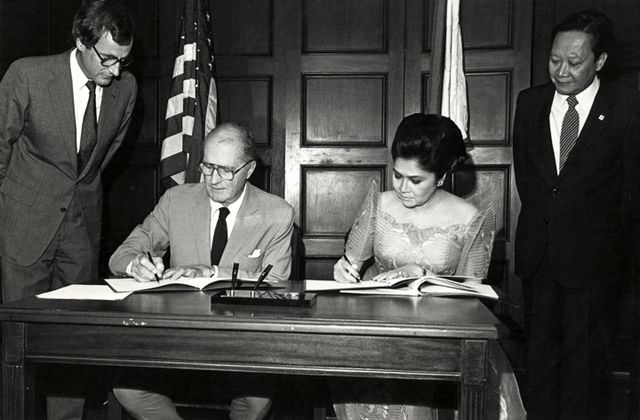
Howard Malcolm Baldridge, U.S. Secretary of Commerce, with Imelda Marcos, Department of Commerce Photographic Services, 12 February 2017, https://commons.wikimedia.org/wiki/File:HowardMalcolmBaldridgeWithImeldaMarcos.jpg.
 Retrospect Journal
