
Written by Logan McKinnon
Content Warning: Homophobia, Transphobia, Holocaust References
“I must paint you! I simply must! … You are representative of an entire epoch!”
“So, you want to paint my lacklustre eyes, my ornate ears, my long ears, my thin lips; you want to paint my long hands, my short legs, my big feet – things which can only scare people off and delight no-one?”
“You have brilliantly characterized yourself, and all that will lead to a portrait representative of an epoch concerned not with the outward beauty of a woman but with her psychological condition.”
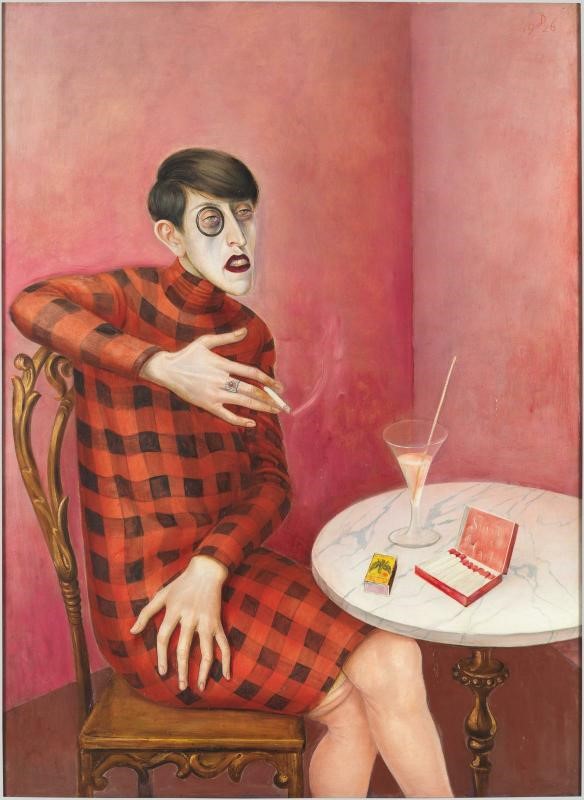
Otto Dix’s portrait of Sylvia von Harden captures the essence of views of queer people in Weimar Germany and is closely tied to New Objectivity’s core ideas in its distinct rejection of expression to represent post-war trauma in a curt and critical manner, which queer identities embodied.
The portrait’s notable unsympathetic tone is distinctly fearful towards broader societal androgynisation; Von Harden is presented in a burlesque manner, representing the duality between new society and all wrong with this society. Dix’s remark illustrates blurred lines between queer identity and wider society, where androgynisation had been broadly embraced by new ‘modern’ women but was widely perceived by Germans as morally dangerous to their people and nation’s character. It leaves us with a clear message – German society now had an ugly face, stripped of its pre-war beauty.
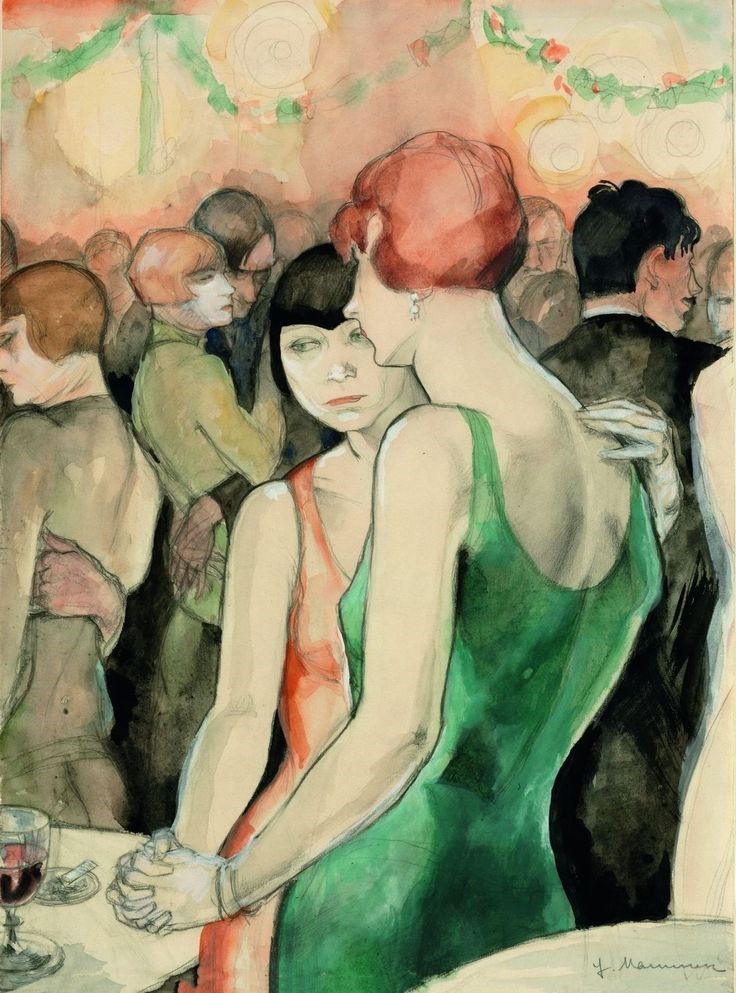
Turning our lens in, towards the queer community, we see a hidden beauty beyond the surface with warm and empathetic depictions of Mammen’s subjects and their relationships. Her observational nature shows the pure love and vibrancy clouding much of 1920s Berlin and presents a particular purity that we can find in the ordinality of queerness. Two Women Dancing reflects this in its sombre and comforting tone, showing an innocence behind queer love, which Mammen so prominently expresses to counter the queerness as it stands presented by Dix: a queerness with a vile and ugly character. Sykora nonetheless argues that Mammen’s pieces were caught in the time’s debates through her presentation of a ‘Bubi’ style, where it is argued this boyish appearance was almost as popular as the ‘radiant appearances of the femmes’. This however ignores the prevalence of the ‘Garconne’ look through the twenties associated with practical and working women. It is indeed Mammen’s work that captures this best – the ordinary and the normal – in the sense of people expressing a tenderness to love naturally supplanting the element of threat.
The dichotomy here brings great insight to casting our gaze upon the underbelly of Weimar society. Consequently, to examine queer lives through the Golden Era of the Republic against a brutal struggle for recognition that brings up a genuine beauty tragically overshadowed by the crushing weight of an oppressive society. It is through a failure to conform, through casting aside the beauty of individuality, that we find a threat in queerness, which puts queerness itself under threat.
The complications surrounding the presentations of queerness in the Republic extend beyond this into the realm of cinema too, for Weimar cinema was indeed social cinema in drawing from the sociopolitical instability of the time; playing on people’s greatest fears. Here we find Weimar cinema offers us a crucial black swan in providing critical pre-1950s queer representations. These are depictions of a fine beauty and very particular notions of fear, offering strikingly different visions of queer identity – and it is within we begin to further understand the underlying inherent beauty in queerness and queer love.
Richard Oswald’s Anders als die Andern was almost lost to the Nazis and exists only as fragments today as the first film to explicitly portray homosexuality. The film is part of a line of Aufklärungsfilme; in educating on homosexuality, we see a pioneering representation of a loving and natural homosexual relationship. We see in the destruction of Paul through blackmail, a by-product of §175 which eventually results in Paul’s suicide, thus killing queer expression and showing the reality of §175 as a brutal weapon of state oppression stripping homosexuals of their very humanity. The symbolic erasure of §175 is overtly political and homosexuality becomes anti-authoritarian in its manner of challenging conformity and the failure to conform. Anders as an Aufklärungsfilme creates a universality through right-angle front camera shots which Dyer suggests “reveal the reality beyond the characters.” This alongside Hirschfeld’s interwoven speeches throughout the film creates a strong scientific defence of homosexuality. An oppositional reading may be found, however, by focusing on Paul picking up Franz – a moment of pure lust setting into motion Paul’s downfall – gay desire can be read as degenerate. When Paul gently caresses Franz’s chest this deeply shocking scene, to a contemporary audience, frames homosexuality as an innately debaucherous orientation. Homosexuality was an infectious threat to many, with Sutton arguing that the “hint of queerness” was “sexy and fascinating, but also a bit scary and potentially off-putting.” Anders faced significant opposition with soldiers walking out of its screening and the Prussian Assembly pushing to ban the film under §184, with additional legislation eventually passed to ban the film alongside other Aufklärungsfilme, often viewed as purely pornographic.
Manuela’s ennobling declaration of love in ‘Mädchen in Uniform’ further emphasises the relationship between queerness and anti-authoritarianism through breaking society’s strict conformity. The school embodies patriarchal authority through its rigid straight edges inhibiting feminine expression. The defence of unadulterated love unites the girls in challenging militaristic conformity, with Von Bernburg boldly stating, “What you call sins I call the great spirit of love which has a thousand forms.” Suppressing love is suppressing human nature, and queer identity thus becomes tied to tackling authoritarianism by challenging and redistributing power. The defeated principal in the end walks into the distance at the close, which Scholar argues serves as a “rallying call for anti-authoritarian forces in Germany and elsewhere.” The brand of lesbian in Mädchen is crucially near indistinguishable from female solidarity – building a noble idea of the systematic oppression of the patriarchy – thus queer expression frees women as a whole.
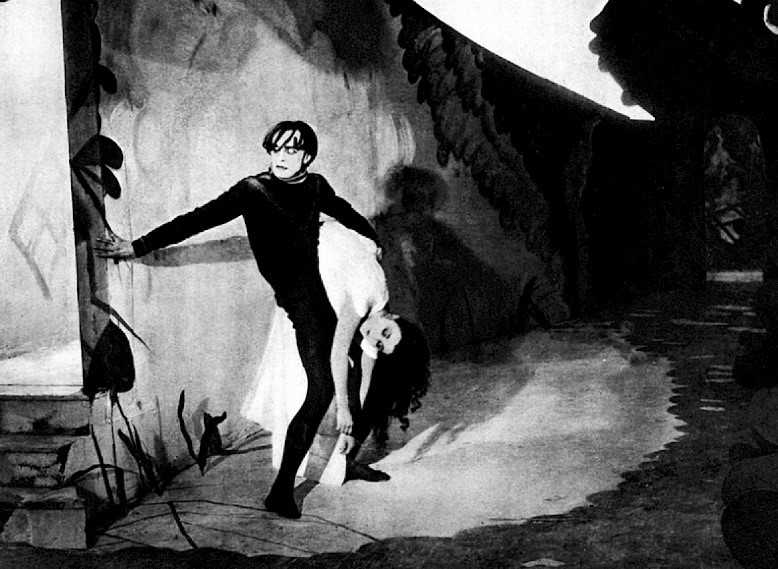
Deviance from conformity establishes queerness as innately anti-authoritarian, as apparent in queer-coding in early German expressionist horror cinema, including The Cabinet of Dr. Caligari. The lead Cesare becomes part of shadowy insubstantial landscapes through his dark androgynous appearance and fluid movements, which signal him as a threat to the idealistic fantasy town, with Corcoran arguing that “little and lean also spectral and gaunt, Cesare embodies the allure and anxiety of the Weimar fantasy.” Cesare embodies the social disruption of the Republic, where social deviance was deeply threatening. Moreover, Cesare symbolically kills the heterosexual unit in murdering Alan and kidnapping, placing queerness as a threat to ‘traditional relationships.’ The ambiguous plot-twist ending with Cesare institutionalised has symbolic undertones of the innate unnaturalness and seemingly pushes for its eradication.
Dyer’s description of Conrad Veidt is particularly poignant when considering queerness in the Republic, “attractive yet repulsive, tragic yet sinister.” It is remarkable to consider these remarkably warm presentations of queer relationships in the Republic, yet we find our fairytale ending will not arrive and crushing oppression looms large. Paul must die in Anders for this reason, through queerness’ a-conformity, and why Cesare embodies an ugly heart of German society in a manner that brings out our own natural fears. It is crucial then to remember Richard Evans’ words:
“If the experience of the Third Reich teaches us anything it is that a love of great music, great art, and great literature does not provide people with any kind of moral or political immunisation against violence, atrocity, or subservience or dictatorship.”
We are not immune to propaganda, as Evans illustrates; we like Cesare can find ourselves frozen out of society but led to commit unforgivable sins herded by those above us. The fortitude of attitudes held through Weimar Germany led to its heartless evisceration in Nazi Germany. Our story here is evidently a tragedy of a misconceived threat, only making it so important to highlight today.
The queer movement was hampered by various mountains too large to ever scale for 1920s Germany. However, the beauty of the movement, of the people who brought queerness mainstream, pushing for recognition against societal opposition in search of love is so deeply pure. Romantically, we can consider the movement to have flourished through enabling this, to any extent, and more-so than anywhere else globally, to enable human nature to flourish to come together is so precious. Indeed, to consider the movement to have failed devalues the individual experiences of so many within the movement; queer freedom is occasionally exaggerated in relation to the Republic, but shared sense alone makes it so deeply precious against a climate of such great hatred. Evidently, we can see queer culture today owes so much to the cultural developments of queerness in the twenties that paved the road for ourselves today, to a point where Mammen would have admired – where queer love remains precious but is nothing more than ordinary.
Bibliography
Primary Sources:
Official Publications:
§175 StGB (Germany)
§184 StGB (Germany)
Deutscher Reichstag, Geset zur Bewahrung der Jugend vor Schund – under Schmutzchriften: Vom 18. Dezember 1926.
Motion Pictures:
Anders als die Andern. Germany: Richard-Oswald Film Berlin, 1919.
Das Cabinet des Dr. Caligari. Germany: Decla-Film, 1920.
Die Büsche der Pandora, Germany: Nero-Film A.G., 1929.
Mädchen in Uniform. Germany: Deutsche Film-Gemeinschaft, 1931.
Artwork:
Dix, Otto. “Blidnis Der Journalistin Sylvia von Harden,” 1926. Germany.
Mammen, Jeanne. “Two Women Dancing,” c.1928 Germany.
Mammen, Jeanne. “She Represents (Carnival Scene),” c.1928. Germany.
Novels:
Döblin, Alfred, and Michael Hofmann. “Berlin Alexanderplatz.” London: Penguin Classics, 2019.
Magazines and Periodicals:
“Die Freundin.” Digitales Archiv des Forum Queeres Archiv München. https://archiv.forummuenchen.org./zeitschrift/die-freundin/.
Secondary Sources:
Books:
Beachy, Robert. “Gay Berlin: Birthplace of a Modern Identity.” New York, New York: Knopf, 2015.
Evans, Richard John. “The Coming of the Third Reich.” London, United Kingdom: Penguin, 2005.
Michalski, Serguisz. “New Objectivity: Painting, Graphic Art, and Photography in Weimar Germany 1919-1933.” Koln: Benedikt Taschen, 1994.
Whisnant, Clayon John. “Queer Identities and Politics in Germany: A History 1880-1945.” New York, New York: Harrington Park, 2016.
Articles:
Harvard Film Archive. “Decadent Shadows. The Cinema of Weimar Germany.” Harvard Film Archive. https://harvardfilmarchive.org/programs/decadent-shadows-the-cinema-of-weimar-germany/
McNay, Anna. “Jeanne Mammen: The Observer. Retrospective (1910-75).” Studio International: Visual Arts, Design, and Architecture.”
Steinkopf-Frank, Hannah. “Publishing Queer Berlin – Jstor Daily.” June 7, 2023. https://daily.jstor.org/publishing-queer-berlin.
Journal Articles:
Dyer, Richard. “Less and More than Women and Men: Lesbian and Gay Cinema in Weimar Germany.” New German Critique, no.51 (1990).
YouTube Videos:
Rowe, Kaz. “The Queer History of Weimar Germany.” YouTube, November 12, 2021. https://www.youtube.com/watch?v=oNGvga0QKZg&t=2018s
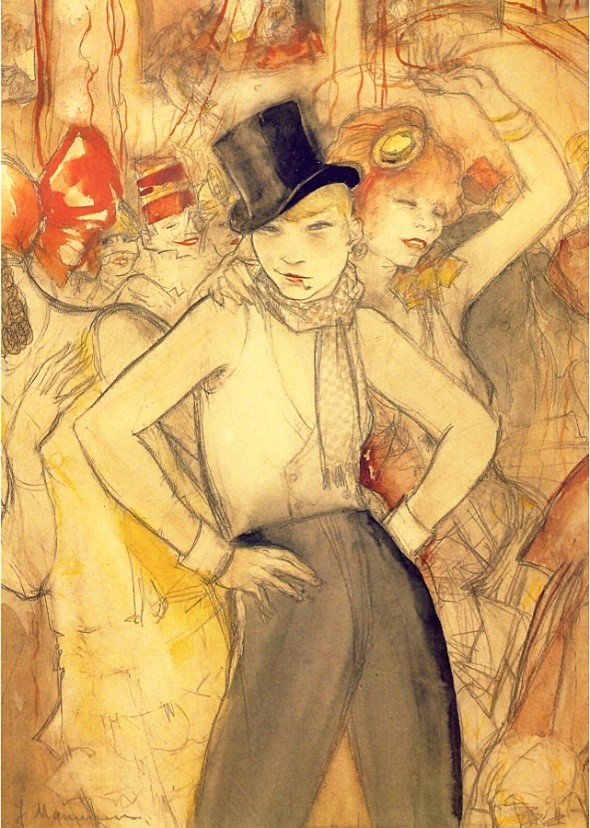
Featured Image Credit: Jeanne Mammen, She Represents (Carnival Scene), c.1928, https://www.flickr.com/photos/hen-magonza/32008868566.
 Retrospect Journal