
Written by Sam Marks
Of all the developments since the 20th century, media is the area that has seen the most amount of change. From printed newspapers, evolving into radios, into television, then pre-recorded broadcasts, calling, faxing, emailing, texting, then to social media, and now potentially on to artificial intelligence, the way people have consumed media has changed rapidly over the past era. Since the mid-20th century, scholars have considered us to be in the “Information Age”, where the global economy has largely focused on information technology. One technology that has been historically overlooked in the evolution (or devolution, depending on your optimism towards contemporary media) is the development of teletext.
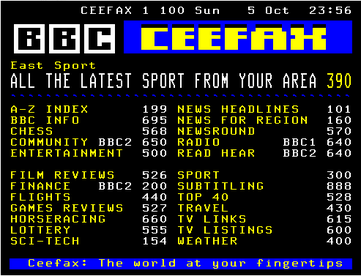
Teletext is an analogue method of sending text-based information over television screens. The first teletext service, Ceefax (meaning “see facts”), was developed and popularised by the BBC. It was initially tested by editor Colin McIntyre, but by the time of his retirement in 1982, he had a team of more than 20 journalists operating and updating the system. Brevity was key, as the system was designed to be short and to the point as news broke frequently.
In operation from September 23, 1974, Ceefax allowed viewers to toggle the display of subtitles on screen, the world’s first. Built into television decoders, the channel was easily accessible for most TV sets at the time and even compatible with continentaly European sets. The BBC wanted to become more accessible to deaf viewers, and Teletext became an early method of allowing user control over subtitles. The service was so good that the technology it used became standard for European teletext systems. At its peak, Beyond subtitles, Ceefax was an ingenuous system for communicating news without using much data.
Ceefax displayed a variety of pages that could be toggled using three-digit numbers entered on a remote. News, business, sport, weather, entertainment, TV, and subtitles were the main sections standardised after a 1996 relaunch of the service. The graphics displayed by Ceefax were versatile and allowed for a map of the UK to display the weather in all parts of the country. It was particularly useful for farmers and those in areas where television service was not particularly strong to still be able to receive news information. Beyond informational news, Teletext was also used to make video games like Channel 4’ “Bamboozle!” quiz-style game. Ceefax received 20 million views daily. However, despite the versatility of the technology, it did not last.
On October 23 2012, Ceefax was switched off the BBC during their analogue switch-off to digital technology. After 38 years in operation, the BBC paid homage to its closure but little was discussed about its implications afterwards. Competition to teletext came from social media forms like Twitter and Instagram, making the service a more outdated method of receiving news in the eyes of the industry. Despite it largely being forgotten, a small but committed campaign to bring back Ceefax has been underway.
The most prominent mentions of Ceefax today come from Count Binface, the novelty candidate whose slogan is “Down with fascism, up with Ceefax”. Binface has been a leading figure in drawing attention to the technology and turning nostalgia into action. While the BBC has yet to fulfil this manifesto point, in 2022, a Northern Irish programmer named Nathan Dane recreated Ceefax with some updated news pages. The BBC has even begun recently publishing a series of articles reminiscing about the benefits of having Ceefax and how it could be beneficial to the world of media today.
In the world of sensationalised “click-bait” media, Ceefax is reminiscent of a less anxiety-generated form of media. Though unlikely to change the trajectory of social media, it’s a fascinating example of how a simple technology was built to last longer than most online trends do. To see what Ceefax looked like, check out Nathan Dane’s recreation.
Bibliography
Featured Image credit: “Ceefax.Png.” 2021. In Wikipedia. https://en.wikipedia.org/w/index.php?title=File:Ceefax.png&oldid=1025625190.
BBC News. 2012. Review of Ceefax: Your Memories, by Priya Shah, October 22, 2012, sec. UK. https://www.bbc.com/news/uk-20035713.
“Count Binface.” n.d. Count Binface. Accessed September 23, 2024. https://www.countbinface.com.
Engel, Matthew. 2012. “Ceefax: A Love Letter.” BBC News, April 17, 2012, sec. Magazine. https://www.bbc.com/news/magazine-17745100.
Goodhart, Benjie. 2022. “Ceefax Is Dead, Long Live Ceefax! Meet the Fans Resurrecting the Ingenious Service.” The Guardian, October 20, 2022, sec. Television & radio. https://www.theguardian.com/tv-and-radio/2022/oct/20/ceefax-is-dead-long-live-ceefax-meet-the-fans-resurrecting-the-ingenious-service.
Hand, John. 2012. “Ceefax Service Closes down after 38 Years on BBC.” BBC News, October 23, 2012, sec. UK. https://www.bbc.com/news/uk-20032882.
Heritage, Stuart. 2017. “The 2017 Election Awards: From Best Eating of a Pringle to Biggest Dolt.” The Guardian, June 8, 2017, sec. Politics. https://www.theguardian.com/politics/2017/jun/08/the-2017-election-awards-from-best-eating-of-a-pringle-to-biggest-dolt.
JX866, dir. 2012. The Final Pages From Ceefax in Full, 22/10/12, BBC Two. https://www.youtube.com/watch?v=EEdF2K5BITI.
Kenny, Nicola. 2024. “Ceefax and the Birth of Interactive TV.” BBC, September 20, 2024. https://www.bbc.com/articles/cvg360rr91zo.
“NMS Ceefax.” n.d. NMS. Accessed September 23, 2024. https://www.nathanmediaservices.co.uk/ceefax/.
Parsons, Jeff. 2022. “Ceefax Is Back! Iconic Text Service Recreated by 20-Year-Old Coder.” Metro (blog). January 7, 2022. https://metro.co.uk/2022/01/07/ceefax-is-back-iconic-text-service-recreated-by-20-year-old-coder-15874417/.
The Guardian. 2016. “Teefax: A Nostalgic Return to the Days of Teletext,” August 10, 2016, sec. Technology. https://www.theguardian.com/technology/shortcuts/2016/aug/10/teefax-a-nostalgic-return-to-the-days-of-teletext.
Westbrook, Ian. n.d. “It Would Have Been Better to Watch It on Ceefax…” Accessed September 23, 2024. https://www.bbc.co.uk/historyofthebbc/ceefax-50/.
 Retrospect Journal
