
Written by Oscar Virdee
Gaze upon the luminous black of the night. A roaring expanse of emptiness pierced through with ivory light. Since the dawn of man, we have looked up to the dark sky and searched for meaning in the desolate vastness.
In the classical age, humanity assigned certain groups of stars the name ‘constellations’. Some may spring to mind: Orion, Leo, Ursa Major (otherwise known as the Great Bear or Big Dipper), but how many of us know the tales behind them?
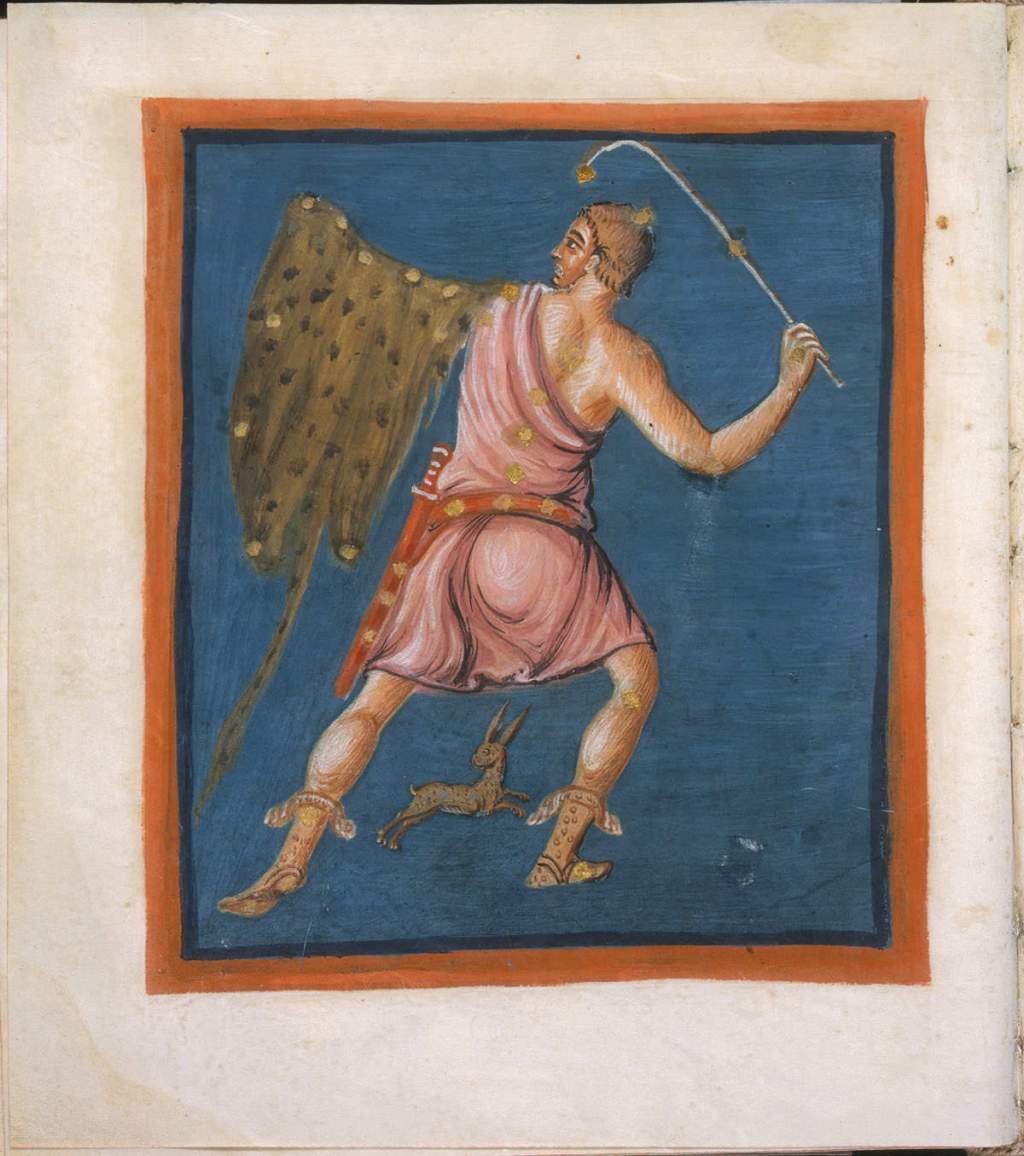
The conventional story of Orion portrays the tale as one of heartbreak, jealousy, and undying love. Artemis, the goddess of the Moon and the hunt, falls in love with a legendary hunter named Orion. Her brother Apollo, god of the Sun and archery, grew jealous of the pair.
Apollo went with Orion to a beach and challenged the hunter to swim far out into the Azure Sea. The hunter took up the challenge, soon becoming a black speck in the brilliant blue of the ocean.
Whilst Orion swam in the empty blue, Apollo brought Artemis to the same shore that the hunter had set off from. Apollo then handed Artemis a bow and taunted that she would not be able to shoot a black speck far off in the distance. Artemis took up the challenge, notched an arrow, and loosed.
Struck through with Artemis’s arrow, Orion’s body washed up on the shore several hours later. In her grief, Artemis cast the body of her lover into the unforgiving sky, so that she could be reunited with her lover every night as she pulled the moon across the stars.
The traditional tale is somewhat less lovelorn. In the Iliad, we are introduced to Orion only as a constellation, so seemingly after his death. Within the Odyssey, one part of the conventional tale stays true. Orion is indeed killed by Artemis, except he is killed for lusting after Eos, the goddess of the dawn.
In his Early Greek Myth Timothy Gantz suggests that whichever classical version of the tale is to be believed, three key elements remain true. Artemis dispatches Orion, but not out of love, rather rage that he had left her for Eos or pursued both goddesses at the same time.
After casting your eyes down at the ineptitude of man, gaze up once more and search the stars for confidence, power, and fire. Hear the proud roar of a lion echo within your inner ear as your eyes settle upon Leo, to give him his Latin name, Leo Nemeum – otherwise known as the Nieman Lion.
Hercules’s first labour is perhaps one of the most well-known classical tales. In Theogony Hesiod informs us that the Nieman Lion was born of Typhon and Echidna, and then brought by Hera to terrorise the people of Nemea. For his first labour, Hercules was tasked with slaying the predator. After a brief bloody battle, Hercules overcame his foe, skinning the animal to wear it as a cloak.
Most are exposed to the somewhat true-to-the-source portrayal of Hercules first labour through Disney’s 1999 classic Hercules, yet the labour is seemingly the third and the Lion in question bears a remarkable similarity to Scar from the 1994 version of The Lion King.
As the proud roar of the lion interwoven with “I Just can’t waaaiittttt” echo in your mind’s ear, look up from the Lion and gaze unto the most recognisable constellation in the moonlight sky: Calisto, commonly known as “the Great Bear” or most beautiful.
Many versions of the tale exist, the one present within book two of Ovid’s Metamorphoses is distinctly succinct. Calisto, a follower of Diana (in Greek myth known as Artemis) was bathing in a verdant forest. Jupiter (Zeus) spied her resting amongst the grass and transformed himself into a figure of Diana.
Jupiter, disguised as Diana, approached Calisto. Thinking that she was meeting her goddess, Calisto embraced the intruder. After a heroic struggle against a god, Calisto’s innocence is stolen from her.
Calisto re-joined the hunters of Diana, attempting to hide and forget the pain of the encounter in the woods. Nine months later, Calisto’s efforts proved to be in vain as the hunters of Diana bathed in the presence of the goddess and Calisto was clearly with child.
Seeing that Calisto had broken her vow of chastity, Diana cast her out from the Hunters. As Calisto was no longer under the protection of Diana, Juno (the wife of Jupiter) took this moment to enact her vengeance on the broken beauty of Calisto.
After cornering her in a forest, Juno turned Calisto into a bear. After fifteen years hiding in the forest from man and beast alike, she came face to face with a young man. The man, whom she recognised as her son, raised a spear to strike the heart of the bear he saw in front of him, not knowing it was his mother. Jupiter, chose this moment to intervene and cast mother and child into the sky, forever adorning the night sky with another tale of tragedy.
When you gaze again into the luminous black of the night, hear the gut-wrenching roar of the Nieman Lion in your mind’s ear. The sickening *thump* of Artemis’s arrow as it buries itself in Orion’s chest. Let rage flow through you as you remember Calisto’s cries in an empty, evergreen forest.
Bibliography
Gantz, T. (1996). Early Greek myth : a guide to literary and artistic sources. Baltimore: Johns Hopkins University Press.
Homer, Iliad – http://www.perseus.tufts.edu.. Homer, Iliad, Book 18, line 462. [online] Available at: https://www.perseus.tufts.edu/hopper/text?doc=Perseus%3Atext%3A1999.01.0134%3Abook%3D18%3Acard%3D462 [Accessed 5 Apr. 2024].
Hesiod, Theogony – http://www.perseus.tufts.edu. Hesiod, Theogony, line 304. [online] Available at: https://www.perseus.tufts.edu/hopper/text?doc=Perseus%3Atext%3A1999.01.0130%3Acard%3D304.
Homer, Odyssey – http://www.perseus.tufts.edu. Homer, Odyssey, Book 5, line 92. [online] Available at: https://www.perseus.tufts.edu/hopper/text?doc=Hom.+Od.+5.121&fromdoc=Perseus%3Atext%3A1999.01.0136 [Accessed 5 Apr. 2024].
Ovid, Metamorphoses – ovid.lib.virginia.edu. (n.d.). Metamorphoses (Kline) 2, the Ovid Collection, Univ. of Virginia E-Text Center. [online] Available at: https://ovid.lib.virginia.edu/trans/Metamorph2.htm#476707504.
 Retrospect Journal