
Written by Darcy Gresham
You probably walk past multiple red post boxes when running errands or heading to work, but how often do you stop to look? Across the British Isles, our streets are adorned with these boxes that carry heartfelt messages between friends and families. In 2015, Royal Mail estimated that 98% of the UK population lived within 0.5 miles of one. Just as red double decker buses are a symbol of London, post boxes are another icon of the nation, featuring on postcards, Christmas cards, and beyond. But how much do we really know about such an everyday feature of our cities?
Post boxes have been a feature of the British postal system since 1852, when they were trialled in Jersey to simplify the previous system, which comprised of visits to receiving houses (early post offices) or collection by the Bellman. The demand for postal services driven by both industrialisation and urbanisation meant this new system was highly sought after to improve efficiency. The success of such a trial led to the construction of boxes on the mainland from 1853 onwards. Over the first few years, the design evolved in order to adapt to the trademark UK weather by engineering a slit that prevented rainwater getting in, whilst allowing letters to enter. A highly important feature, but one easily overlooked – personally, I have never worried about my letters arriving sodden so long as it doesn’t rain on my walk to the letterbox! The design of the post box was finalised in 1879 with a few iterations such as the Ludlow wall box and Penfold boxes. Within central areas, pillar boxes have been replaced with mounted boxes, into walls or houses, to ensure they don’t intrude on pavements or other spaces. The design is simple but effective – a historical development that is easy to overlook in the few seconds it takes to post a card.
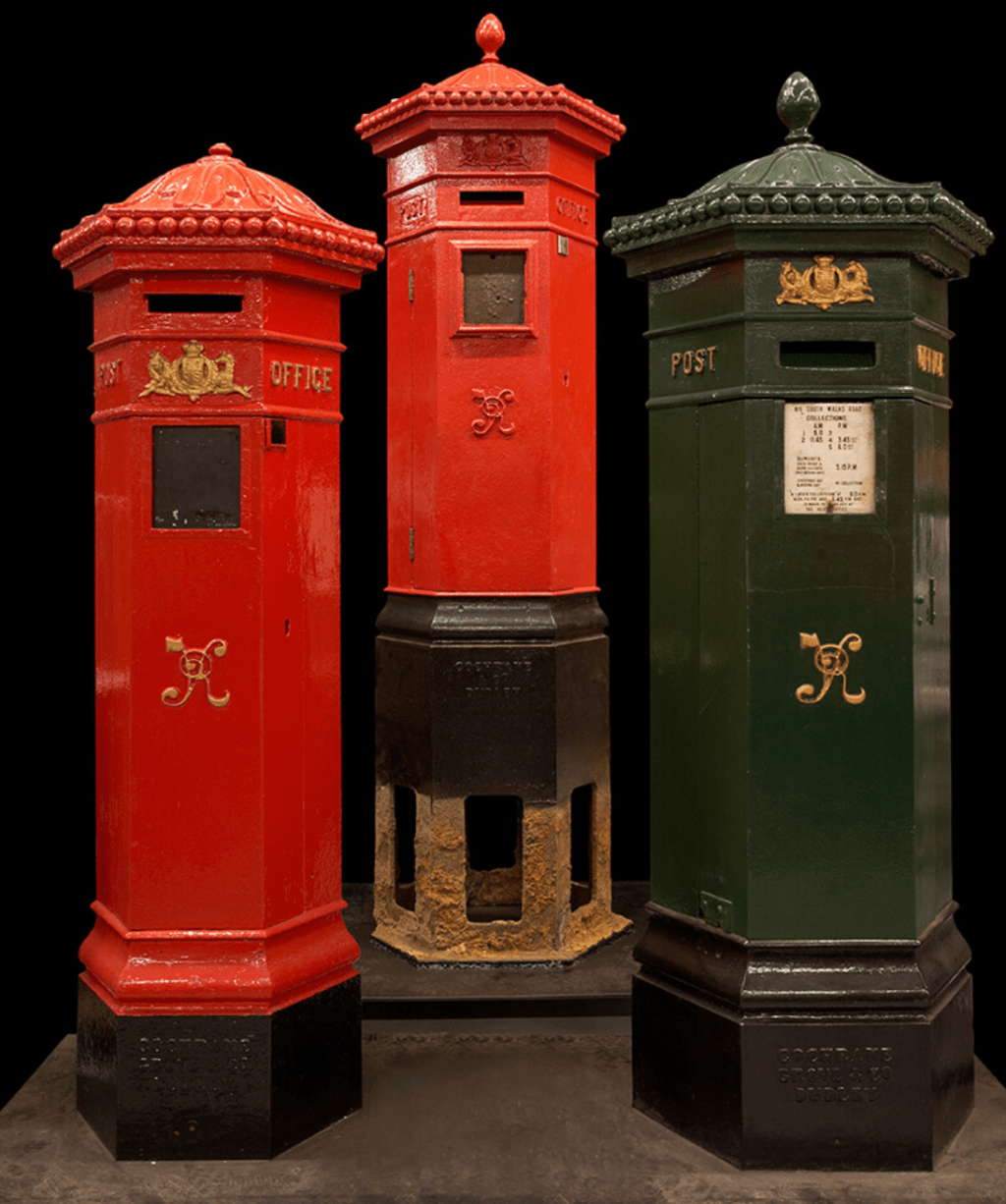
Another key to the icon status of the post box is its colour. The original trial boxes were red but in 1859 they were standardised to green; this was intended to make them unobtrusive and blend in with scenery. However, this backfired to the point that members of the public complained about being unable to find them. One is surprised they could be camouflaged so well, however the volume of complaints did lead to a reversal, and ‘Royal Mail Red’ returned in 1874. There is, however, an exception to this rule with golden post boxes. In commemoration of the 2012 London Olympics & Paralympics, the UK government repainted boxes in the hometowns of gold medal winners to celebrate their achievement. There are 110 in total in the UK, with one locally in Hunters Square for Sir Chris Hoy. If you have made the New Town-Cowgate pilgrimage you’ve likely passed it. Next time you spend an evening in Tron you’ll be just a stone’s throw away (a way to improve upon an already fantastic evening).
Cyphers are a fascinating aspect of this history, with cypher-spotting a term coined for the hobby of searching for the royal insignia on letterboxes. There have been eight royal cyphers in existence between the introduction of the post box and present day (two for Victoria, one each for Edward VII, George V, Edward VIII, George VI, and two again for Elizabeth II). You may wonder how many are still in existence today, and the answer is, at varying levels of scarcity, all of them! Post boxes only get new cyphers when they must be replaced or repaired, hence the endurance of previous monarchs’ insignia. This also affects the rarity of each cypher, with EVIIIR being the least common with only 168 due to Edward only reigning for 325 days. In contrast, more than half of roughly 115,500 British post boxes carry the EIIR stamp for Elizabeth.
Across Edinburgh older cyphers can be seen such as VR in St. Andrew’s Square, GR for George V in places such as Glengyle Terrace, and GVIR in Portobello. However, within Scotland, the inclusion of Roman numerals in Queen Elizabeth’s cypher sparked protests, as the previous Elizabeth was not Queen of Scotland, therefore rendering the ‘II’ inaccurate. Opposition to the EIIR cypher saw violence including explosives within post boxes. It was just south of the city of Edinburgh that the first EIIR post box was unveiled in November of 1952; just forty-eight hours later the symbol was defaced, and dynamite placed inside later in the year. Estimates suggest that over its three months of operation, twenty-eight destructions were attempted. Therefore, today Scottish post boxes bear the Crown of St Andrew, part of the Honours of Scotland instead.
As we move away from post, fewer and fewer post boxes are in operation. Only this week when trying to send a card to a friend I encountered a bolted up one in my village (apologies to you, H, it shall be delayed until I find another). Whilst a minor inconvenience and due to its VR cypher, it’s evidently an old one now, for those who cannot drive or walk further to another location to send their post this represents a stalling system. Where letters and cards were once a part of everyday communication, calls and texts have since overtaken them – and in some instances entirely replaced them. What this has led to, however, is a concentration of heartfelt communication by post; spam and advertisements that once came through letterboxes now clog inboxes. The only thing we students receive is bills through the post, and you don’t need to be told how easy it is to pick out a friend’s handwriting between menacing typed addresses. The postal system has now become a harbour for messages that matter and clamour to be heard away from the digitalised world.
On a personal level, anyone who knows me well will know of my adoration for cards, but I cannot pretend this is shared amongst many of my generation (although I would hope those in receipt at least enjoy that aspect). But I would say, next time a dear friend has a birthday, consider writing to them. You can pick up a card with your meal deal (Sainsburys actually has a surprisingly good selection). The excitement of an envelope on the doormat is an unparalleled, child-like joy. Amongst the hectic chaos of life, it’s a gentle remind that someone who cares about you is really not that far away. And to those who receive my letters with infinite joy each time, thank you for reminding me of this.
Trust me when I say that the joy the written word brings far outweighs any walk to the post box you are already passing – and now, you may even appreciate it more.
Bibliography
Jones, H.J. The postal experiences of Henry Jones. 2023
Campbell-Smith, D. Masters of the Post. 2012
Tomlinson, Georgina. How to spot Royal Cyphers. 2016
Robinson, M. Old Letter Boxes. 2000
“Preserving our post boxes,” Gov.UK, 15 July 2015. https://www.gov.uk/government/news/preserving-our-post-boxes
“Royal Mail Post Boxes: a joint policy statement by Royal Mail and Historic England” 2015 https://historicengland.org.uk/images-books/publications/royal-mail-post-boxes/heritage-agreement-for-royal-mail-post-boxes/
“About Boxes” The Letter Box Study Group. https://lbsg.org/
“Royal Cyphers on Letter Boxes,” The Postal Museum. 17 June 2016 https://www.postalmuseum.org/blog/royal-cypher-appearances/
“Battle of the Cypher,” Postal Museum. 2 January 2023 https://www.postalmuseum.org/blog/the-battle-of-the-cypher/
“2012 Games: Chris Hoy,” Special Post box finder map. https://specialpostbox.com/2019/10/15/Chris-Hoy-Cycling-Mens-team-sprint/
 Retrospect Journal