
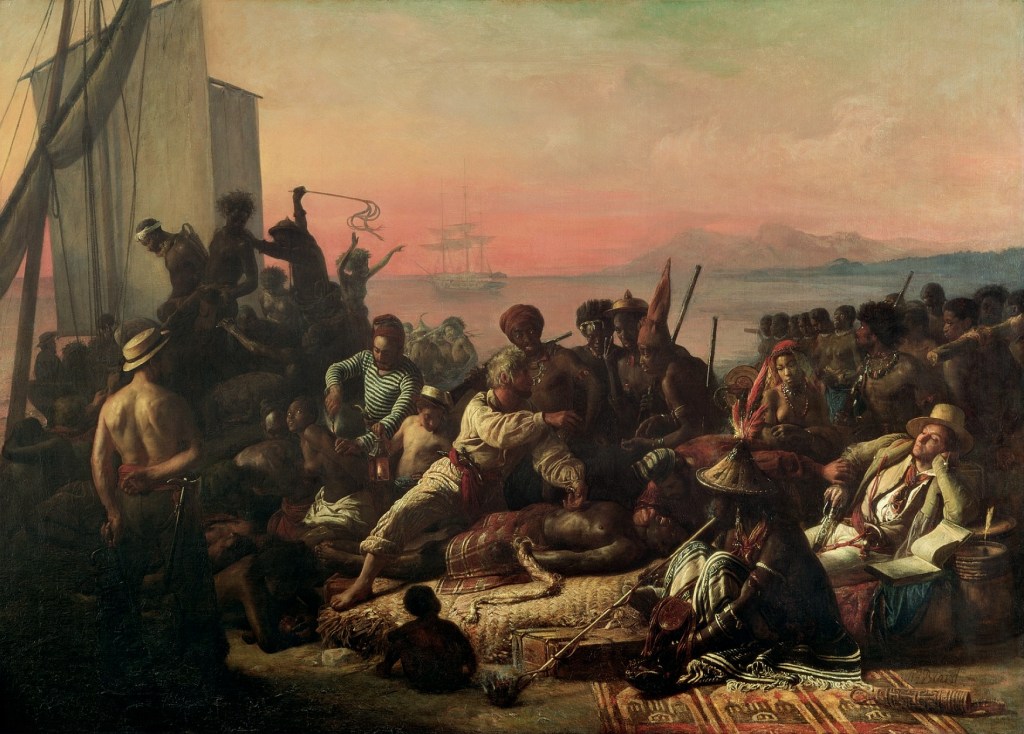
Written by Nadja Dixon
Between the years 1440 and 1720, two million enslaved Africans were forcefully shipped to the Americas. During this time the practice of medicine played a critical role in the survival and wellbeing of these slaves, but most importantly, provided them with agency and a sense of “irrepressible humanity.” Despite the many attempts to dismantle their identity, African captives were able to protect aspects of their culture, including medical healing knowledge. Slave medicine eventually became a topic of reputability, especially in Barbados and Jamaica, where slaves afforded themselves certain privileges to practice medicine as respectable physicians. This article will examine how engaging in slave medicine assisted in reversing the forced modification into commodities that European slave traders thrust upon Africans.
By the end of the seventeenth century, close to 250,000 African captives had been stripped of their identities and forcibly transported to Barbados and Jamaica, among other islands. This process began with the alienation of these prisoners from their homelands, kin, and any other “markers of social existence.” After rigorous attempts at dehumanization along the Gold Coast, enslaved Africans traveled the Middle Passage by slave vessel, eventually arriving in the Caribbean. Here, white plantation owners identified Africans as chattel, “conveyable property, without rights and without redress.” Thereafter, the expectation that an African’s sense of self was not to reach beyond that which the master imposed was fortunately unsuccessful, for not only were captives shipped from Africa, but knowledge was too, allowing a sense of culture to endure.
Despite the stripping of selfhood, enslaved Africans found ways to preserve traditional medical knowledge to sustain their familiar and long-established cultures. Transmission of this wisdom took place orally by way of slaves’ appealing for medical advice or requesting treatment for ailments from each other. As time elapsed, slaves skillfully began adapting this information to fit their new environment. Medical syncretism, or the borrowing of “remedies, knowledge, and techniques from another group,” became a significant means for slaves to unify traditions from multiple regions and design a new ideology. Overall, the preservation, modification, and integration of various African ideas provided updated remedies to suit new surroundings.
During the seventeenth century, mortality rates were “frightfully high,” and slaves were dying rapidly, offsetting birth rates. Environmental and microeconomic factors, such as poor food and filthy living conditions, merged with naturally occurring diseases on the islands, amplifying fatal sickness. Common illnesses included, but were not limited to yellow fever, malaria, tuberculosis, yaws, guinea worm, leprosy, and venereal disease. Smallpox, however, proved most lethal during this time and was unfortunately widespread throughout the Caribbean. With disease running rampant, medicine became an indispensable aspect of plantation life.
Healthcare was provided on the plantations in Barbados and Jamaica for enslaved populations, yet it proved ineffective and unequal. Generally, doctors were hired to “dose slaves and dress their sores.” Unfortunately, few doctors were available in the West Indies during this time, and the ones that were proved “overworked and underpaid,” diminishing their ability to perform their duties well. Additionally, the function of plantation medicine for the sick slaves left much to be desired; white masters’ sole objective proved economic in nature, meaning medical care only served to uphold the “fitness of the labor force,” often leaving the “lame, elderly, or otherwise incapacitated” medically unattended. Slaves were infrequently healed from their ailments and needed more efficacious care.
Due to necessity and aided by the skillful preservation of African culture, slaves developed a self-help medical system that functioned to meet their treatment demands. This system relied on individuals utilizing the healing specialties they brought to the islands to mend themselves and their community. Therapies for illness have been documented where possible by contemporary physicians and offer a glimpse into slave treatment. Sir Hans Sloane, for example, physician to the Governor of Jamaica between 1687 and 1689, noted the African slaves’ propensity to “take…Herbs in substance” instead of in infusions or distillations, remove Guinea worms by use of wrapping daily “upon a round piece of Wood,” and “sprinkle their Bodies all over” with herbed bath water for healing effect. These treatments were not only more available than European medicine, but slaves considered them more “relevant” to their needs. Overall, Africans successfully employed their own medical knowledge to develop a self-reliant system that healed their ill for the duration of the slave trade.
Slaves’ development of a self-care system not only restored their sick to health, but also cultivated bodily and intellectual autonomy not otherwise available to them. White plantation owners’ economic success relied on the subjugation of slave labor, and as such, enslaved Africans were meant to have little or no control over their bodies. This was evident in plantation masters’ attempts to “decide when a slave was sick and who should treat them” as well as provide the therapeutic care such sickness necessitated. Having the master as the “principal figure” of healthcare was yet another form of oppression and control. This said, engaging in self-care provided slaves with a type of “mantle of authority” over their decision-making processes and bodily functions that were usually seized from them. Slaves commonly chose not to report their illnesses to their masters and selected slave healers for therapeutic support whenever possible. Healing occurred quietly in these cases but was not discontinued; slaves invariably found ways to meet their health needs, generating a quiet sense of agency over their lives.
When not performed covertly, use of medical practices enabled slaves to develop reputability within the white community. Hercules, for example, a “Black Negro Overseer, and Doctor” obtained fame not only among the black people on his plantation, but “among Whites in the Neighborhood,” for his skill in curing, among other things, gonorrhea. Sir Hans Sloane even utilized the services of a “Negro, famous for her ability” to cure cases of “Chego” tumors in the skin, to heal his infection. In fact, confidence grew in Africans’ capacity to act as physicians to such a degree that Sir Henry Morgan, Lieutenant Governor of Jamaica, sent for a black doctor to step in as healer when he “became dissatisfied with Sloane’s treatment of his disease.” In Barbados, the same proved true: Ligon readily recognized the skill slaves had in remedying bruises, strains, and general illnesses via the regular use of Negro-oil. While much African treatment occurred in secrecy at first, with time, awareness of its effectiveness spread, as did slaves’ recognition.
This esteemed social standing afforded slaves’ greater sovereignty in an otherwise oppressive environment. Under other circumstances, it would be unnecessary for an individual to develop a positive reputation to ensure their ability to self-govern, but as the enslaved were under the strictest control by their masters, opinion mattered. If Africans influenced how slavers perceived them, they would be bestowed with even the slightest opportunity for dominion over their lives. Favorable perception provided slaves with a level of respect from their owners they would not have likely received without their fruitful practice of medicine. This regard further supplied Africans with liberties unavailable to them on regular bases, such as medically treating white plantation owners and their families, traveling to distant plantations to treat slaves and white folk there, and even working in hospitals in a variety of capacities. The movement out of the sugar fields and into close quarters with ailing patients is suggestive, too, of a lighter workload when compared to the ten-hour field toil other slaves were required to endure each day. In this way, enslaved Africans skilled in the medical arts, who earned the advantage of respectability, achieved a position of power in the white man’s world, little as it may have been.
It would not be too far of a leap, then, to briefly consider the connection between reputability and restored humanity. While it was not essential for others to recognize slaves’ identities for their enduring existence, when white individuals in positions of authority acknowledged slaves’ medical expertise and afforded them respect, they also restored their humanity. If slaves were truly “near beasts” as many had assumed, they would not be capable of complex human reasoning, let alone medical practice. By requesting medical support, and thus admitting slaves’ ability to reason, masters contradicted themselves and the very underpinning of the institution of slavery. The continuation of slavery past this point displays a grotesque level of cognitive dissonance. Consequently, the brutal attempt to dehumanize captured Africans for the economic benefit of white plantation owners was never achievable, especially as Africans fought their enslavement with the preservation of culture and engagement with medical ideology.
From the evidence presented, it can be argued that the conservation of medical knowledge led slaves to cultivate an effective self-help healthcare system while restoring their enduring sense of humanity. Examining the impact medicine has had on slave autonomy revealed the miraculous resiliency and will to survive seventeenth century slaves possessed, despite the unimaginable cruelty they experienced. This said, it is imperative to consider slave medicine as a form of resistance, as it displays slaves’ talented way of employing choice despite subjugation.
Bibliography
Primary Sources
Ligon, Richard. A True and Exact History of the Island of Barbados. Edited by Karen Ordahl Kupperman. 1657. Reprint, Indianapolis: Hackett, 2011.
Sloane, Hans. A Voyage to the Islands Madera, Barbados, Nieves, S. Christophers and Jamaica. London: B.M., 1707.
Secondary Sources
Cook, Harold J., and Timothy D. Walker. “Circulation of Medicine in the Early Modern Atlantic World.” Social History of Medicine 26, no. 3 (August 2013): 337–51. https://doi.org/10.1093/shm/hkt013.
Dunn, Richard S. Sugar and Slaves: The Rise of the Planter Class in the English West Indies, 1624-1713. Chapel Hill: The University of North Carolina Press, 1972.
Handler, Jerome S. “Slave Medicine and Obeah in Barbados, circa 1650 to 1834.” New West Indian Guide / Nieuwe West-Indische Gids 74, no. 1-2 (January 1, 2000): 57–90. https://doi.org/10.1163/13822373-90002570.
Laguerre, Michel S. Afro-Caribbean Folk Medicine. South Hadley, Mass: Bergin & Garvey Publishers, 1987.
Murphy, Hannah. “Re‐Writing Race in Early Modern European Medicine.” History Compass 19, no. 11 (October 31, 2021): 2. https://doi.org/10.1111/hic3.12692.
Schiebinger, Londa L. Plants and Empire: Colonial Bioprospecting in the Atlantic World. Cambridge, Mass.; London: Harvard University Press, 2007.
Sheridan, Richard B. Doctors and Slaves: A Medical and Demographic History of Slavery in the British West Indies, 1680-1834. Cambridge: Cambridge University Press, 1985.
Smallwood, Stephanie E. Saltwater Slavery: A Middle Passage from Africa to American Diaspora. Cambridge, Mass.: Harvard University Press, 2007.
Image credit: By François-Auguste Biard – Bridgeman Art Library: Object 112033, Public Domain, https://commons.wikimedia.org/w/index.php?curid=3134563
 Retrospect Journal