
By Darcy Gresham
1066 is a date seared into the minds of those who grew up learning about English history. It’s where most histories tend to start when working chronologically on the British Isles, with vague Roman, Viking, and Anglo-Saxon references interspersed into the tale, but few and far between. 1066 was of course the year of the Battle of Hastings. As the Bayeux Tapestry depicts, the climax of the contestation of the throne saw Harold Godwinson defeated by William, Duke of Normandy to become William I, or ‘Wiliam the Conqueror’. This is undoubtedly a key moment in history, bringing a new monarch to the throne (a line the current Charles III can trace lineage to) and characterising vast swathes of change. However, in Viking history, 1066 is monumental for an earlier battle: the Battle of Stamford Bridge.
The Viking Age is claimed by many historians to begin in 793, as for many decades this was the earliest recorded Viking attack in Northern England. (There have since been earlier records uncovered, dating into the 780s). Traditionally, the period ends in 1066 with the defeat of Harald Hardrada, King of Norway. The Vikings had extreme influence over England and controlled the northern and eastern areas under the ‘Dane Law’. In fact, by the mid-ninth century the Vikings controlled all of England bar Wessex, where Alfred the Great was able to maintain influence. Danish impacts were so significant it took until the 1200s for those in Dane Law territory to assimilate with the rest of the population.
It was Harald Hardrada who invaded England in conquest for the throne in 1066 after expanding colonial possessions in Orkney, Shetland, and the Hebrides. Harald as King of Norway is known by the regnal name of Harald III Sigurdsson as well as ‘Harald the Ruthless’ in which ruthless is a translation of the Viking word Hardråde meaning harsh or brutal ruler.
In 1066, after landing at York, Hardrada travelled east to Stamford Bridge. Having arranged with locals to deliver supplies, the army were well fuelled and supported. However, Harold Godwinson marched his army north at a rapid speed, arriving in York after only four days, surprising the Norwegians at Stamford Bridge. The Icelandic poet Snorri recounts the events in ‘The Saga for King Harald Hardradi of Norway and Viking Chieftains’. Snorri is the author of one of the central texts of Norse mythology, as well as a history of kings of Norway from early times. Snorri’s saga details the reasoning behind the invasion as an attempt to grow Hardrada’s kingdom, as well as to claim a right to the throne following the deaths of relations and successors. It is in Snorri’s sagas that he attributes the success of William, Duke of Normandy, just weeks later to the weakening of the English army by Hardrada.
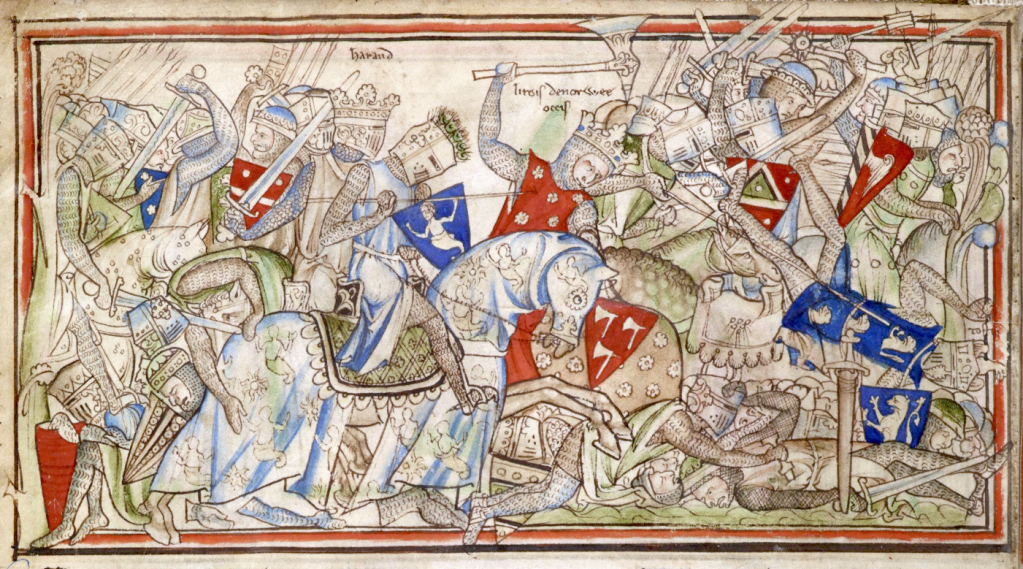
The battle itself took place on 25 September 1066. The surprise arrival of Godwinson led to attempted negotiations between Harold Godwinson and his brother Tostig, who had joined the Viking forces. This alliance between Hardrada and Tostig supported the Viking invasion and lent added agency. However, on rejection of peace between the brothers (Godwinson only offered Tostig amity, Hardrada was promised to be killed), fierce fighting followed. Many Vikings had left chainmail and weaponry on their ships and were ill-prepared for attack. An arrow to Hardrada’s throat killed him, followed later in the battle by Tostig. The Viking shield wall broke, and only twenty-four of three-hundred ships carried the defeated back to Norway.
Overshadowed by the Battle of Hastings, the Battle of Stamford Bridge has lost prominence in history. It should hold a greater place in historic memory as the last Viking attempt to conquer England. Viking conquests forged a large influence over English lives and culture, and whilst prominent in popular representations, it can be easy to reduce them to just that. The Viking age shaped England and the Battle of Stamford Bridge is no exception.
Bibliography
Harald II Sigurdsson, Britannica https://www.britannica.com/biography/Harald-III-Sigurdsson
Battle of Stamford Bridge, Historic UK https://www.historic-uk.com/HistoryMagazine/DestinationsUK/The-Battle-of-Stamford-Bridge/
Stamford Bridge, 1066, Danmarks Historien https://danmarkshistorien.dk/vis/materiale/slaget-ved-stamford-bridge-1066
Stamford Bridge, Vikingeskibs Museet https://www.vikingeskibsmuseet.dk/en/professions/education/the-viking-age-geography/the-vikings-in-the-west/england/stamford-bridge
Snorri Sturluson: Harald Hardradi Saga https://www.librarything.com/work/63305
Featured image credit: By Matthew Paris – http://cudl.lib.cam.ac.uk/view/MS-EE-00003-00059/1, Public Domain, https://commons.wikimedia.org/w/index.php?curid=21914431.
 Retrospect Journal