
Written by Edie Christian
The 1956 Suez Crisis was a watershed moment in international politics, particularly surrounding both Egyptian self-determination and Britain’s imperial downturn. Beyond the impact upon geopolitical relations, the crisis also demonstrates the importance of media in shaping national narratives. The way that different media organisations—particularly British and French—framed the crisis in order to justify their imperial actions brings into question unchecked media influence and colonial entitlement.
The Suez Canal connects the Mediterranean Sea to the Red Sea through Egypt. It was officially opened in November 1869, and provides the fastest maritime trade route between Europe and Asia. In 1956, the route controlled two-thirds of the oil used by Europe; even today, approximately 12% of all global trade passes through it. Egypt was occupied by the British from 1882 during the Anglo-Egyptian War, with the Suez Crisis providing the catalyst for the withdrawal of British troops in 1956. Although Britain had ostensibly declared Egyptian independence in 1922, this was a pretence—in reality, they kept control over the Suez Canal and their troops remained. In July 1956, Egyptian president Gamal Abdel Nasser seized and nationalised the canal, transforming him into a national hero and angering Britain, France, and Israel, who quickly invaded. Despite military success, there was immediate international condemnation—superpowers such as the Soviet Union and United States saw the invasions as a threat to the stability of the Middle East, as well as a violation of Egyptian sovereignty. The United Nations established the United Nations Emergency Force (UNEF) to supervise the withdrawal of foreign troops by December 1956, with Egypt retaining control over the canal, the crisis therefore securing Nasser’s position as leader of Egypt and the Arab states.
Despite being a diplomatic failure, the British media were able to contort coverage of the crisis into a pro-government narrative verging on ‘right-wing propaganda’. Although some editors—such as Hetherington of the Guardian—denounced the Anglo-French collusion as an ‘act of folly’ that ‘pours petrol on a growing fire’, these papers were accused of treason. The supposed impartiality and independence of the British Broadcasting Corporation (BBC) from the state was brought into question. Inspired by the success of Cairo-based radio station Voice of the Arabs (Sawt al-Arab), the Near East Broadcasting Station was officially renamed the Voice of Britain in 1956. Following the nationalisation of the Suez Canal, Prime Minister Anthony Eden put pressure on key media figures, employed censorship, and held confidential press briefings—the BBC was utilised by the government at home and overseas to fight their propaganda war. As well as radio, the use of newsreels became instrumental in spreading a pro-government message across Britain. These newsreels were aired in cinemas across the country, with almost three million people visiting the cinema every day. As they were neither strictly news nor entertainment, newsreels existed as a hybrid medium, and were therefore able to be less objective in their depiction of events. Newsreel companies such as Movietone reproduced Eden’s broadcast of 3 November, in which he claimed he was taking ‘police action to stop the fighting and separate the armies.’ Britain and France were continually portrayed as the heroes limiting the threat of unchecked Egyptian power.
In contrast, the newsreel companies in France were a little more cautious, preferring to depict France as a supporting actor in Britain’s operation to reclaim the Suez Canal. This may have been due to France’s involvement in the Algerian War of Independence from 1954-62. Not only did the conflict drain much of their physical and military resources, but it was also a propaganda battle with the National Liberation Front (FLN) for the approval of the Algerian population. Actualites francaises was a newsreel company with a state majority interest of 60%—it overtly espoused anti-Soviet and anti-Nasser propaganda to an extent that made the other three French newsreel companies appear relatively neutral. The difference in coverage can be attributed to the visual material of the crisis, which were bought either from foreign companies or directly from the cinematic office of the French army. Many companies depended on photographs from state sources, bringing the authenticity and accuracy of their depictions into question. Furthermore, there was a distinctive anti-Nasser sentiment being advocated; production companies drew direct visual comparisons between understated diplomats and the populist Nasser before an unruly crowd. In this way, the French depicted Nasser as dictatorial in order to justify their colonial endeavours in Egypt and the wider region.
The Suez Crisis of 1956 was unprecedented in Egypt’s militaristic demand for national self-determination. Whilst the coalition of British, French, and Israeli armies did achieve some military success, the international pressure and condemnation forced them to withdraw and surrender, resulting in public humiliation and the end of Britain’s imperial monopoly. The disingenuous use of British and French media organisations in order to convince their populations of their right to colonial control over the Middle East demonstrated the strength of the relationship between a country’s government and media. It begs the question of how we would view and understand the Suez Crisis had the coalition been successful in retaining their control of the canal and their deposition of General Nasser.
Bibliography
Boddy-Evans, Alistair . “Timeline: The Suez Crisis.” ThoughtCo, July 3, 2019. https://www.thoughtco.com/timeline-the-suez-crisis-4070809.
Dupéré, Mélanie. “BBC Independence and Impartiality: The Case of the 1956 Suez Crisis.” Revue Française de Civilisation Britannique XXVI, no. I (December 6, 2020). https://doi.org/10.4000/rfcb.6992.
History.com Editors. “Suez Crisis.” HISTORY. A&E Television Networks, November 9, 2009. https://www.history.com/topics/cold-war/suez-crisis.
Hulbert, Jeff. “Right-Wing Propaganda or Reporting History?: The Newsreels and the Suez Crisis of 1956.” Film History 14, no. 3/4 (2002): 261–81.
Partington, Richard. “What Is the Red Sea Crisis, and What Does It Mean for Global Trade?” The Guardian, January 3, 2024, sec. World news. https://www.theguardian.com/world/2024/jan/03/what-is-the-red-sea-crisis-and-what-does-it-mean-for-global-trade#:~:text=Sea%20trade%20route%3F-.
Rusbridger, Alan. “Courage under Fire.” The Guardian, July 10, 2006, sec. Media. https://www.theguardian.com/media/2006/jul/10/pressandpublishing.egypt.
Sorlin, Pierre. “French Newsreels and the Suez Crisis: How to Make a Failure Look like a Positive Outcome.” Historical Journal of Film, Radio and Television 39, no. 4 (July 18, 2019): 788–802. https://doi.org/10.1080/01439685.2019.1622284.
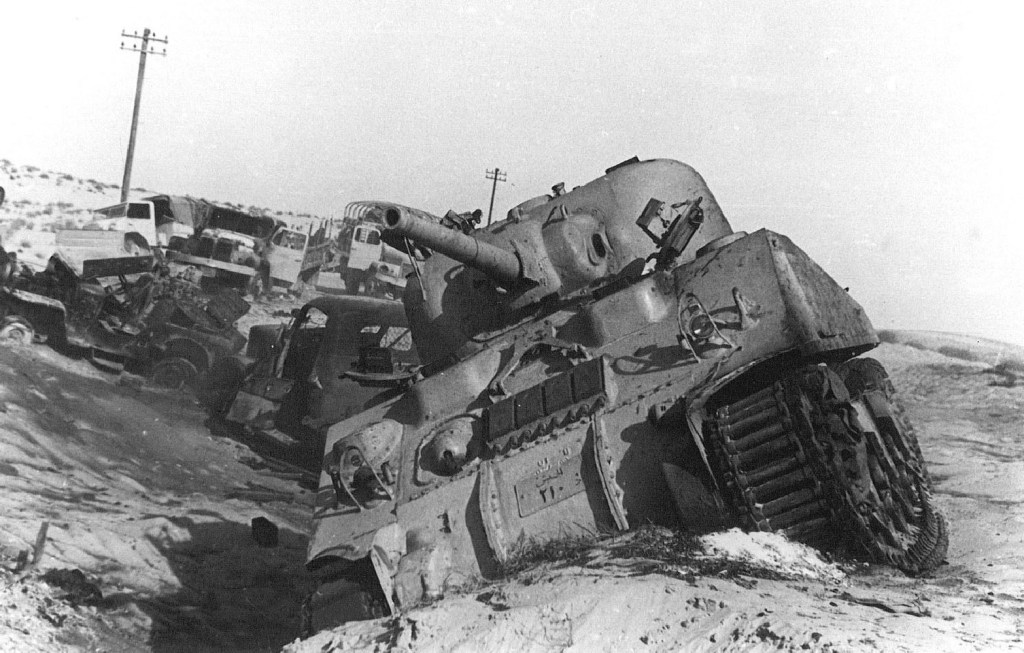
Featured image credit: By United States Army Heritage and Education Center – http://ahecwebdds.carlisle.army.mil/awweb/main.jsp?flag=browse&smd=1&awdid=1 (Marshall, S.L.A. collection), Public Domain, https://commons.wikimedia.org/w/index.php?curid=9645548.
 Retrospect Journal