
Written by Kat Jivkova
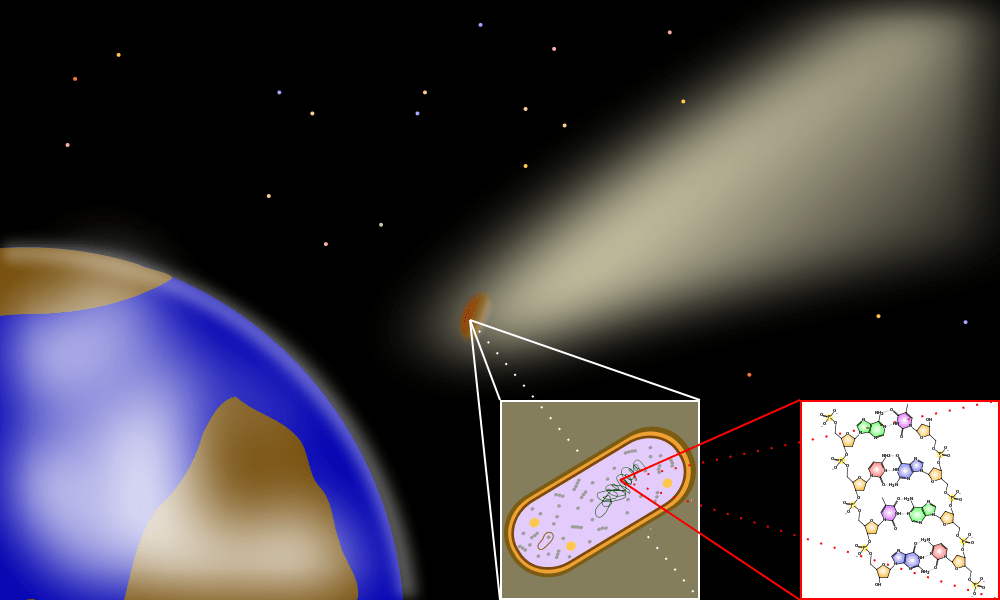
In their seminal paper titled “Directed Panspermia” (1973), Francis Crick and Leslie Orgel proposed that life was deliberately seeded on Earth by an extraterrestrial civilisation: “it is possible that life reached the earth this way, but scientific evidence is inadequate at the present time to say anything about the probability”. Indeed, though acknowledging that such a theory is speculative, they reasoned that it was entirely plausible for an intelligent civilisation to have dispatched microorganisms to another planet to preserve their own race. In the twenty-first century, ethical questions surrounding whether humanity should spread life to other solar systems have been explored in various academic studies, re-surfacing interest for Crick and Orgel’s original research. I trace the origins of directed panspermia and how it has manifested in twenty-first century discourse on space ethics.
The first account of directed panspermia arose in 1930 within a science fiction novel: Olaf Stapledon’s Last and First Men. The novel follows the history of humanity across the span of two billion years, during which the human species transform into eighteen different “Men”. “The First Men” are attributed to our own species, which almost die out because of a subterranean explosion in the twenty-fourth century and split up into two subspecies ten million years later. “The Eighteenth Men” (“The Last Men”), residing on Neptune and on the brink of extinction, decide to spread life to other worlds. Forty-three years before the publication of Crick and Orgel’s paper, Stapledon wrote the following:
“In respect of the future, we are now setting about the forlorn task of disseminating among the stars the seeds of a new humanity. These objects we shall project from beyond our atmosphere in immense qualities at certain points of our planet’s orbit, so that solar radiation may carry them toward the most promising regions of the galaxy.”
Thus, while Stapledon did not use the term “directed panspermia”, the central concept of the theory originated within his piece of science fiction. “The Last Men”, in spite of their hyper-advanced civilisation, realise that their species is doomed. Their planet of Neptune grows rapidly hotter due to a supernova infecting the sun, and they are left with no choice but to create a new sentient species on another planet before their demise. While Stapledon identifies our human race with “The First Man”, the eighteenth species of human does, in some ways, resonate with us: just as Neptune grew hotter, so too is global warming rendering parts of our planet inhospitable. There are already numerous studies, for instance, on the possibility for Saturn’s moon Enceladus to sustain Earth-like life or directed panspermia. The most popular account of directed panspermia among twenty-first century science fiction can be found in Douglas Adams’ The Hitchhiker’s Guide to the Galaxy, which is worth reading for its excellent premise.
Another critical study which preceded Crick and Orgel’s paper was J.B.S. Haldane’s “The Origin of Life”, published in 1954, in which he conjectures that the origins of life came from seeds “launched into space by intelligent beings”. This reasoning was extended a decade later in Carl Sagan’s Intelligent Life in the Universe, where he outlines the panspermia hypothesis. Sagan, in contrast, labels directed panspermia “untenable as a fundamental concept”, particularly given that the conditions of the universe twenty billion years ago would have deemed the existence of life highly improbable. Notably, there have been various studies and concepts of life being eternal and living organisms transmitting themselves from one planet to another rather than simply arising from non-living matter. It is the “directed” part of panspermia hypotheses which the aforementioned studies contributed to theories centred on the plurality of worlds.
Finally, we arrive at Crick and Orgel. Their argument to support the Theory of Directed Panspermia developed the following reasoning:
“The chemical composition of living organisms must, to some extent, reflect the environment in which they evolved. Thus, the presence in living organisms of elements that are extremely rare on Earth might indicate that life is extraterrestrial in origin.”
They hone in on the example of the Earth metal molybdenum to substantiate their thesis. Given that the abundance of molybdenum on Earth is only 0.02 per cent, whereas we may find that it is abundant on another planet, this could provide evidence to suggest that life did not originate on Earth. Their second point centres on the universality of the genetic code, which alludes to life being descended from a clone derived from an individual extraterrestrial organism.
In response to their argument about the abundance of molybdenum on Earth, a group of biologists based at the University of Colorado argued that molybdenum is more abundant than initially outlined by Crick and Orgel – for instance, they highlight that it is “relatively abundant in sea water”, and also suggest that it is no less abundant on the planet than chromium and nickel, the two other elements which scientists have determined vital for animal life. Further, they point out that, in working out the respective abundances of the three elements, Crick and Orgel used the average values for the whole Earth in their figures, which is misleading. However, the aim of this paper was not to denounce the theory in its entirety, but to “aid those interested in pursuing [this theory] in developing a more sophisticated approach”. Thus, it seems that the concept of directed panspermia attracted the attention of even the most sceptical of scientists.
The reason why directed panspermia gained momentum in the 1970s can be attributed to developments in space exploration, rocket propulsion, and air flight, all of which contributed to the worldwide construction of astroculture. The persisting popularity of science fiction further fuelled scientific curiosity about the origins of Earth. Interest in panspermia has been sustained by the Earth’s current circumstances in relation to climate change concern. Crick and Orgel make a very relevant comment in their paper: “in view of the precarious situation on Earth, we might well be tempted to infect other planets if we became convinced that we were alone in the galaxy”. As aforementioned, there have been studies on how directed panspermia could be achieved using today’s technology. In their paper on a hypothetical extra-terrestrial colonisation programme, for instance, Roy Sleator and Niall Smith argue that we have “the tools necessary to not only set sail for the stars, but to colonise them”.
On the other hand, other scholars have outlined the negative implications of directed panspermia. Gary O’Brien, for example, uses procreative ethics to reason that creators have an obligation to their sentient creations, “which cannot be met in directed panspermia missions”. Indeed, there is no guarantee that the newly created sentient animal life will live a life worth living in an unguided biosphere. O’Brien concludes: “we have a duty to provide our creations with a reasonable chance of flourishing” but we cannot possibly know what life will evolve on our selected planet, and whether they will lead a good life. Thus, humanity may need to find a less unethical route to safeguarding humanity against the risk of extinction.
Thus, directed panspermia in the 1970s was taken up by scholars out of pure interest, but ultimately dismissed because of the dubious evidence surrounding it. In the present, discussions about directed panspermia centre around how we can sustain our own life, rather than on how extraterrestrial beings may have done so on Earth – we are instead looking towards the future rather than the past. Arguments for directed panspermia focus on the possibilities for life to be sustained for 3.5 billion years further than predicted, which could be especially important if we are the only living beings in the galaxy. 0n the other hand, directed panspermia poses the risk of interfering with other indigenous life elsewhere in our solar system, or introducing these new beings to a possible life of suffering. It is my view that these implications alone render directed panspermia highly problematic. Rather than focusing on how we can use this concept, it would be far more interesting for scientists to re-direct their attention back to the origins of life on Earth, as Crick and Orgel originally proposed.
Bibliography
Adams, Douglas. The Hitchhiker’s Guide to the Galaxy. New York: Random House, 2007.
Chappell, W.R., Robert R. Meglen, and D.D. Runnells. “Comments on ‘Directed Panspermia.’” Icarus 21, no. 4 (1974): 513-515.
Crick, F.H.C., and L.E. Orgel. “Directed Panspermia.” Icarus 19, no. 3 (1973): 341-346.
Ginsburg, Idan, and Manasvi Lingam. “The History and Origins of Directed Panspermia.” Research Notes of the AAS 5, no. 6 (2021): 154.
O’Brien, Gary David. “Directed Panspermia, Wild Animal Suffering, and the Ethics of World‐Creation.” Journal of applied philosophy 39, no. 1 (2022): 87-102.
Sagan, Carl. Intelligent Life in the Universe. Ulmschneider: Springer, 2004.
Sivula, Oskari. “The Cosmic Significance of Directed Panspermia: Should Humanity Spread Life to Other Solar Systems?” Utilitas 34, no. 2 (2022): 178-194.
Sleator, Roy D., and Niall Smith. “Directed Panspermia: A 21st Century Perspective.” Science progress 100, no. 2 (2017): 187-193.
Smith, Harrison B., Alexa Drew, John F. Malloy, and Sara Imari Walker. “Seeding Biochemistry on Other Worlds: Enceladus as a Case Study.” Astrobiology 21, no. 2 (2021): 177-190.
Stapledon, Olaf. Last and First Men. London: Penguin Books, 2021.
Featured Image Credit: Silver Spoon Sokpop, English: Panspermia, October 12, 2009, October 12, 2009, Own work; For the proto-bacteria I used an adapted version of File:Bacteria-.svg by JrPol and for the DNA I used an adapted version of File:DNA chemical structure.svg by Madprime. Earth from File:Earth Flag.svg by Himasaram, https://commons.wikimedia.org/wiki/File:Panspermie.svg.
 Retrospect Journal
