
Written by Marnie Camping-Harris
Historians have long speculated whether a standard, stereotypical witch, appearing in records across the globe, can be exactly pinpointed. While most scholars tend to agree that old women were the primary witch-hunt target, this portrayal does vary from area to area, as well as differing through time. Therefore, John Demos’s portrait of a witch is most helpful in allowing scholars to understand what stereotypes appear in New England witch accusations specifically. This essay is organised thematically, following Demos’s argument by each singular step, ultimately demonstrating that Dorcus Hoar did fit Demos’s nine-point portrait of an accused witch. Hoar fulfilled all nine elements, as described by Demos: she was a woman between the ages of forty and sixty years old, who was of an English background and had been married with children; her family had a turbulent relationship and she herself had been accused of other crimes, like theft, in the past; she openly practiced fortune telling, was of a low social position and possessed an abrasive and contentious character.
The most widely agreed upon stereotype for witches is their female sex. This is the first point in Demos’s portrait of a New England witch and is arguably the first noticeable attribute about Hoar. Ultimately, the statistics speak for themselves, with the ratio of females to males being 4:1. On top of that, the majority of the men accused in New England were only implicated because of their relationship with the female accused; it was guilt by association. Moreover, Demos notes how a large proportion of witchcraft accusations “were brought against women by other women”. Therefore, Hoar does not only fit Demos’s first point regarding the accused’s sex, but she also matches the sex of her accusers; with those being Mary Walcott, Mercy Lewis, Abigail Williams, Ann Putnam Jr, Elizabeth Hubbard, and Susannah Sheldon.
As mentioned before, the age of accused witches is another point of contention that historians can relatively agree upon, when it comes to producing stereotypes or similarities across different times and locations of crisis. With regards to New England, Demos claims that the “most accused witches were themselves persons in midlife”, meaning the densest age cohort was between forty and sixty years old. Hoar fits perfectly into this category, as the records show that she was born around 1635 to parents John and Florence Galley, making her approximately fifty-seven years old at the time of her accusation. Demos also includes Hoar in Table Six, demonstrating that she follows a clear pattern of suspicion, due to being previously accused at the age of forty-three in 1678. As to why it was this age demographic that received the most amount of speculation and accusations in New England, Demos proposes that it was due to the “change in life” that most women of this age experienced when they went through menopause. Therefore, their target being young women and girls makes more sense, as they were expected to be jealous of their youth. This connection must have been understood or felt by the accusers, as when Hoar was first examined on the 2 May 1692, a majority of the afflicted girls fell into fits as soon as she was brought into the room.
Demos’s next point relates to the background of each of the accused. This, however, can be rather difficult to place, with the source materials lacking when it comes to the early life of these witches. Nevertheless, Demos concludes, despite a few anomalies, that most accused witches in New England were “of solidly English stock and mostly ‘Puritan’ religion”. Regarding her religion, Hoar was most likely a Puritan. This assumption can be made by there being no record complaining of her lack of church attendance or anything similar. Moreover, her ethnic background can be more accurately defined, as according to John Winthrop’s diary from 1638, Hoar was among those brought to Boston on a ship named Desire in that same year. This ship came from England, meaning that Hoar emigrated to New England as a toddler. Therefore, there is little doubt around Hoar’s background fitting Demos’s demographic for a witch: she was Puritan and English.
The next category is where New England differs from other crazes, with hunts in places like East Anglia and North Berwick targeting lonely, isolated women; instead, Demos claims that the majority of accused witches in New England were married and with children. A reason for this different stereotype could be the investigators’ obsession with the suckling of imps; this being a clear “parody of normal maternal function”. For instance, during Hoar’s first examination in May, her questioner inquires as to who and what Hoar has let suckle her in the past, accusing her of suckling two cats, but she is adamant that she has not suckled anyone “but my child”. Moreover, it is rather surprising that most of the accused were not only married, but that their spouses were living at the time of their accusations. This is largely due to husbands offering women security at this time, as they would be expected to defend any accusation against their wife. Nevertheless, there are two categories within Demos’s point, and Hoar only really fits one. Firstly, it was recorded that Hoar had two daughters of her own, named Elizabeth and Joanna. This fulfils Demos’s point regarding childbearing, as Hoar has demonstrated that she is able to produce children, with Elizabeth and Joanna serving as evidence to that. The records also show that she was married to William Hoar in 1655. However, as is also mentioned in her examination, Hoar’s husband died during the previous winter of 1691, leaving her now a widow. Now, some may view this newfound loss as stopping Hoar from fulfilling Demos’s portrait of a witch, as she was not married at the time of her accusation in 1692. Yet, Hoar was married when she was first accused, back in 1678, ultimately proving that Hoar does fit Demos’s nine-point portrait of a witch.
Linking from the previous category, Demos’s next point relates to family relationships. He claims that most of those accused were “frequently involved in trouble and conflict with other family members”. This was largely due to the Puritan ideal of a gentle and peaceful household serving as the foundation to all social order. Marilynne Roach describes Hoar’s family as “rowdy”, which can be identified as far from the description of calm. However, one relationship that stands out in the records as being believed to be troublesome and most definitely conflict filled, was that between Hoar and her husband; as it was speculated by her accusers that Hoar was in fact responsible for his death, with Elizabeth Hubbard claiming that she had choked her husband. Moreover, Hoar allegedly told Reverend John Hale “that she would live better after her husband died”. Her interrogators also repeatedly question whether she did murder her husband or not, yet Hoar remains vehemently certain of her innocence. Nevertheless, these accounts clearly confirm how Hoar fulfils Demos’s nine-point portrait of a witch.
One point of contention that would either unite or divide family members, was crime. Regarding Hoar, the rowdiness of her family most likely stemmed from their notorious crime rate. As Demos points out, not only was witchcraft a crime by itself, but the accused were viewed as special type of criminal too. Around a half of those accused had also been previously accused or charged with another crime of sorts; the most common being theft. Hoar’s criminal escapades are well documented by Roach. She claims that Hoar and her family would steal from the household of Reverend John Hale, who was their neighbour, with Hale’s maid as their accomplice. Once discovered and fined for their crimes, the Hoars did not stop tormenting the Hales; they clubbed their cow to death and would scare the household at night when the Reverend was away, by throwing stones at the house. All these claims can be corroborated by the Essex County records, with warrants for Dorcus and her family appearing in 1678. The reason why a history of theft was so closely linked with an accusation of witchcraft can be based around what witchcraft meant to the people of New England. As Demos puts it, maleficium was the “theft of property, theft of health (and sometimes of life), theft of competence, theft of will, theft of self”, and these were all the practices of witchcraft. If someone can be guilty of stealing food or money by their own means, then surely, they can be guilty of stealing someone’s property or health through the means of witchcraft. Therefore, Hoar continues to fulfil Demos’s nine-point portrait of a witch, as she had also been found guilty of theft prior to 1692.
Partially due to the medical world being a predominately male one, the idea that a woman could join through midwifery was very frowned upon. It could, therefore, be argued that in an attempt to keep medicine a male profession, the association between midwifes and witchcraft was generated. According to Demos, witches and midwifes were often considered to be the same people in New England, and that their practices overlapped. Other occupations that also garnered more witchcraft suspicion than on average included those who were known to foretell people’s future: such as Hoar. In his testimony, Reverend John Hale recorded that he had “heard discourses revived of Goody Hoars fortune telling”. More neighbours also testified about Hoar’s occupation, with one claiming that she foretold the death of a woman’s son and that she claimed to have received this training from a doctor. Ultimately, this evidence proves that Hoar does fulfil Demo’s point, as she practiced this form of alleged medical vocation on an informal basis.
51 out of 86 accused witches in New England can be classed as being of “low rank”. Demos offers the opinion that the recruitment of these less powerful and more humble citizens of New England was disproportionate. Reasons as to why these people were accused more often could be due to how the devil was known to offer his followers riches and an ease from labour. Nevertheless, Hoar continues to fulfil Demos’s nine-point portrait of a witch. Accounts of her family’s behaviour and actions all point towards them being classed as a family of lower rank in Puritan New England, during the seventeenth century.
Encompassing most of the points above, Demos’s final point in his portrait of a witch is that of character. A witch’s character can be defined as one full of conflict; relating to their possible controversial occupation, difficult family dynamics, or their history of crime. Although difficult to fully reconstruct each accused witch’s character and personality, the remaining evidence can be utilised to see why the accusers themselves were so staunchly prejudiced against those they accused. Demos concludes that the common personality traits found amongst the accused was a tendency to be abrasive and, most of all, stubbornness. Therefore, it can be cited that Hoar does fulfil this final point. Her reaction to being fined for stealing from Reverend Hale was far from a repent; instead, her actions can be described as stubborn and most definitely conflict inducing.
To conclude, Dorcus Hoar fulfils Demos’s nine-point portrait of a witch, allowing her to be depicted as the archetypal stereotype of the accused recorded in New England. Despite not having a husband alive at the time of her second accusation in 1692 and not fully working in the medical field, Hoar still fits all of Demos’s points: she was a fifty-seven-year-old woman from England; widowed with two living children, who had a history of stealing, as well as fortune telling; and was of a low social rank with a stubborn character. Nevertheless, her stubbornness must have worn off, when she confessed to witchcraft on 21 September 1692.
Bibliography:
Carol F. Karlsen, The Devil in the Shape of a Woman: Witchcraft in Colonial New England (New York: W. W. Norton & Company, 1987)
“Examination of Dorcus Hoar” in The Salem Witchcraft Papers, ed. Paul Boyer and Stephen Nissenbaum (New York: Da Capo Press, 1977) web.
John Demos, Entertaining Satan: Witchcraft and the Culture of Early New England (Oxford University Press, 2004)
George Francis Dow, ed., Records and Files of the Quarterly Courts of Essex County (Salem, Massachusetts: Essex Institute, 1911)
Marilynne K. Roach, The Salem Witch Trials: A Day-by-Day Chronicle of a Community Under Siege (Taylor Trade Publishing, 2004)
Marilynn Roach and Bernard Rosenthal, ‘Biographical Notes’ in Records of the Salem Witch-Hunt (Cambridge University Press, 2009)
Mary Beth Norton, In the Devil’s Snare: The Salem witchcraft Crisis of 1692 (New York: Vintage Books, 2002)
“Petition of John Hale, Nicholas Noyes, Daniel Epes, and John Emerson, Jr.” in The Salem Witchcraft Papers, ed. Paul Boyer and Stephen Nissenbaum (New York: Da Capo Press, 1977) web.
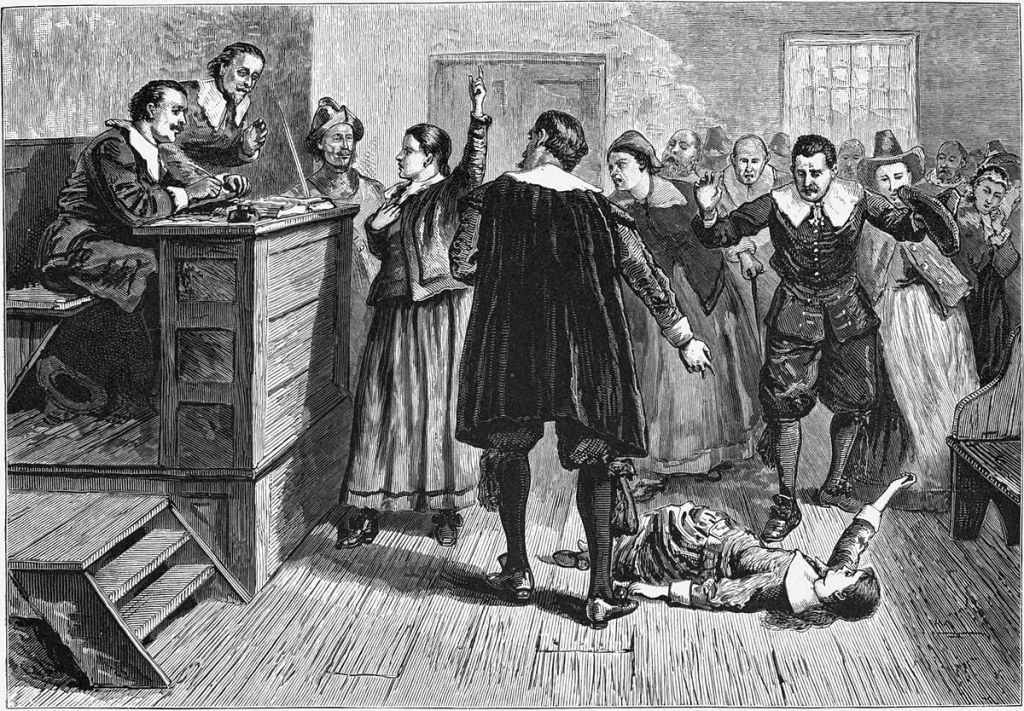
Featured image credit: Witchcraft at Salem Village, 1876. Accessed via Wiki Commons: File:Witchcraft at Salem Village.jpg – Wikimedia Commons
 Retrospect Journal
