
Written by: Olivia Norbury
10/03/2024
Whilst the word ‘carnival’ might initially provoke connotations of innocent celebrations, dressing up in costumes, and partying, it is imbued with power and deeper meanings. Originating as European pre-Lenten celebrations, enslaved people in the colonies co-opted these celebrations as a space in which the oppressive social order in which they lived in was suspended, and thus could be challenged. Carnival theorist Mikhail Bakhtin argues that the carnivalesque is a space in which social hierarchies were suspended and people were temporarily liberated from the oppression of the social order. By placing carnival in its historical context, Trinidad and Jamaica emerge as useful case studies to uncover its multiple functions as a site of liberation, protest, and transgression, enabling historically oppressed people of colour to subvert entrenched notions of sexuality, race, gender, and class.
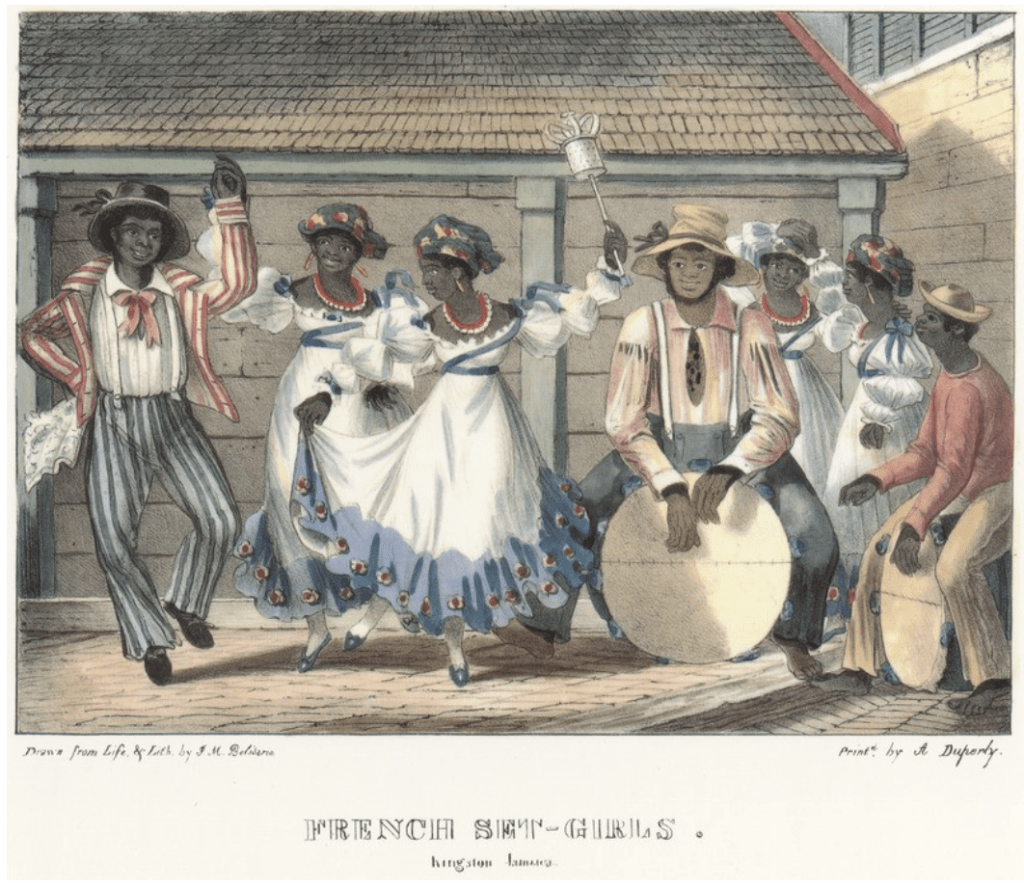

Enslaved people came to Jamaica with their owners from Saint-Domingue during the 1791 Revolution. The performance of Jamaican set-girls (Fig. 1) seeks to challenge the social position of enslaved people. Set-girls paraded through Jamaica dressed up as elites during Christmas, thus capitalising on the weakened social order to express and celebrate their own unique hybrid black culture. The fusion of African and French elements found in their dress and accessories enables them to express their Saint-Dominguan heritage — assert belonging in a new setting. By dressing up as elites, enslaved people—especially Afro-Creole women—declared themselves at the centre of society, therefore protesting the social and racial hierarchies which enslaved them. Carnival was therefore, more than playful entertainment — it represented a symbol of freedom. The female dancer holding the rattle bears similarity to instruments found in other Caribbean islands, suggesting a Creole influence which further serves to show carnival as a uniting force for enslaved people. The performance happens in a secluded space, outside the white gaze of their oppressors, implying that carnival is an escape from the constant racial and social subjugation of colonialism.
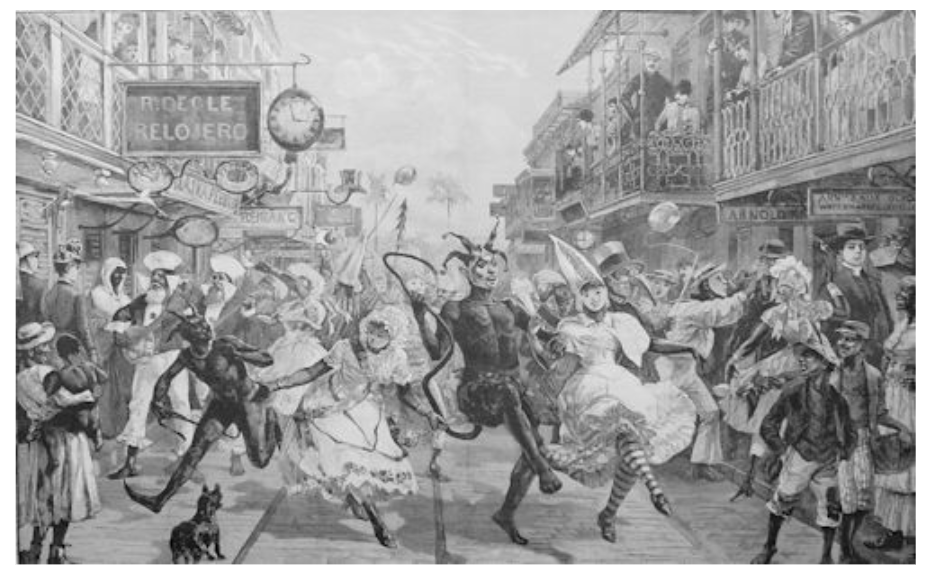

The notion of utilising space to transcend social and racial boundaries is further exemplified (Fig. 2), though diverting in argument on this occasion as they purposefully infiltrate a traditionally elite space. Following the emancipation of enslaved people in 1838 in Trinidad, carnival assumed additional weight as a symbol of defiance of the rigid social hierarchy. Prior to 1888, there had been attempts to sanitise and tidy up carnival following the Canboulay Riots in 1881 whereby Trinidadians rioted against the attempts of colonial authorities to restrict aspects of carnival. Melton Prior’s illustration speaks to the resilience of carnival-goers as they seek to transgress both their marginalised status as former enslaved people in Trinidad and protest their ongoing racial suppression under colonialism. Women in the illustration, dressed up as elite women in fancy dress, disrupt traditional social hierarchies, and it seems—as depicted on the right-hand side—to embarrass polite society by suggesting that elite men have fathered their children. Their subversive, loud, and satirical act demonstrates carnival as a site whereby formerly enslaved people can take back space which they have been excluded from, protesting the violence and social control they have been subjected to. The devil-like figures at the front commemorate the figure of an enslaved person who fell into the molasses, known as the jab molassie. Their use of masquerade is bold and striking to the onlooker, again a way of subverting traditional expectations imposed on the black population of Trinidad which historically marginalised and silenced them. The contrast of the white, dull spectators with the animated people of colour in the parade suggests the social difference which exists between them, the very thing which carnival-goers are protesting by taking up space in one of the busiest streets in Port-of-Spain. Carnival becomes a site of power and protest whereby former enslaved people subverted boundaries of race and class which had been imposed upon them.
Women in Trinidad similarly co-opted carnival as a site where they could subvert traditional gender boundaries which historically had previously silenced them. Calypso, a style of Afro-Caribbean music fundamental to carnival, was one area where Trinidadian women could challenge their status. Women had previously been excluded from public performances since 1900 following a long history of female chantwells in Trinidad. Thus, Calypso Rose spearheaded the return of women to calypso in the 1960s, reclaiming the genre from which they had been excluded and transgressing colonial gendered boundaries imposed upon them. These women could further subvert these boundaries as the lyrics of calypso functioned as a social and political commentary. In Calypso Rose’s 1993 ‘You No Need Dem’, she challenges the tendency of working women to submit to their unemployed partners by asserting that ‘dem man dey, dem a waste of time (…) / They’ll take your sweet life’ and they are ‘allergic to work / (…) dey cause you plenty pain’. She refuses to be subjugated by men and rejects patriarchal hierarchies, urging other women to take control of their lives too. Calypso Rose was the first woman to win the calypso contest in 1978, forcing the title to become Calypso Monarch instead of Calypso King. Her popularity is indicative of the power of calypso as a form of transgression which promoted female solidarity and empowerment within a male-dominated society. Singers such as Calypso Rose were able to employ calypso’s function as a vehicle for social and political protest in order to protest subordination, subvert traditional gender boundaries which had silenced them from the genre, thus reclaiming calypso from the patriarchal colonial order.
Carnival in Trinidad and Jamaica supports Bakhtin’s notion that carnival became a site of transgression, enabling a subversion of social norms and liberation of those oppressed under social, racial, and gendered hierarchies. The appropriation of elite culture by Jamaican set-girls transgresses colonial expectations upon them; similarly, the subversive, loud performance of carnival in 1888 sought to assert former enslaved people’s position at the centre of the society, where they are not supposed to be. Women in Trinidad further used calypso as a form of protest against gendered boundaries. Carnival, then, must be understood as a site of transgression of entrenched notions of race, gender, sexuality, and class. Its intersectional function became a political act which facilitated the protest of subordination, and continues to provide a site for black, queer, female liberation.
Bibliography
“Carnival in Port-of-Spain, Trinidad”, Caribbean Memory Project, accessed February 13, 2024. https://www.caribbeanmemoryproject.com/the-prior-sketches-illustrated-london-news-1888.html
Cowley, John. Carnival, Canboulay and Calypso: traditions in the making. Cambridge: Cambridge University Press, 1996.
Dubois, Laurent. ‘Emigrants.’ In The Princeton Companion to Atlantic History, edited by Joseph Miller, 182-184. Princeton: Princeton University Press, 2015.
“French Set-Girls”, Slavery Images: A Visual Record of the African Slave Trade and Slave Life in the Early African Diaspora, accessed February 10, 2024. http://www.slaveryimages.org/s/slaveryimages/item/2307
Johnson, Sara E. The Fear of French Negroes: Transcolonial Collaboration in the Revolutionary Americas. Berkeley: University of California Press, 2012.
Mahabir, Cynthia. ‘The Rise of Calypso Feminism: Gender and Musical Politics in the Calypso.’ Gender and Sexuality 20, no.3 (2001): 409-430.
Smith, Hope Munro. ‘Performing Gender in the Trinidad Calypso.’ Latin American Music Review 25, no.1 (2004): 32-56.
Featured Image Credit: Footprints in Culture, The History of Trinidad Carnival. https://www.footprintsinculture.com/the-history-of-trinidad-carnival/
 Retrospect Journal