
Written by Fleur O’Reilly
When translating any piece of literature out of its original language, translators are faced with the difficult job of choosing the right words and phrases to convey the sentiment. Translations can entirely alter the meaning of a sentence, turning a phrase from angry to light-hearted by simply changing the sentence order. The role of the translator is vital in our understanding of texts outside their original language. One main example of this is the Iliad.
The first line of any piece of literature sets the tone and expectations, and the Iliad is no exception. The Iliad opens in the original Homeric Greek with the word μῆνιν (mēnin). And this is where our difficulties with translations begin already. One word in and we find ourselves faced with a choice: the word mēnin could be translated in a variety of different ways. It could be used to mean wrath or anger. So, the first question a translator of the Iliad is met with is what version of the word to use? The second question they are faced with is where in the sentence the word should go. In the original Greek, the epic opens with an invocation to the muse as was traditional in an epic, which placed the word mēnin at the start of the sentence. This allows the epic to open with the striking word of wrath or anger, defining it by that word. However, in English, it would make more grammatical sense to incorporate the word into the sentence.
Even just starting a translation with the word anger or wrath changes the meaning of the sentence, therefore changing the focus of the Iliad. Starting it with ‘sing goddess’ instead of the statement of anger changes the placement of emphasis. The whole meaning of the epic can be transformed. The starting word betrays the translator’s view of the epic – what they view the plot to revolve around; the main theme, so to speak. Alexander Pope declares in his translation of the Iliad in 1773 that the epic is about the wrath of Achilles, choosing to open with the words ‘Achilles’ wrath’, but some upon translating do not see the need to emphasise this. I would say that the anger present in the epic is the focus and should therefore be the first word the audience reads. The opening sentiment that sets the scene is a constant reminder that this isn’t the story of Troy, despite what the title may suggest, but is just a snapshot of the war, centring on Achilles’ anger. The epic is a story of anger: it begins with the anger of Apollo and ends with the anger of Achilles. Whether you agree that Achilles’ wrath is justified is up to you.
I prefer to start the epic with the word anger. Wrath holds too many connotations of accusations against Achilles – that the whole story that proceeds is his fault, his making. Anger suggests his actions are justifiable, simply the product of the moment, spurred on by the actions of Agamemnon and the anger he experiences, the palpable emotions that cause the epic. But the consequence of his anger is more than simply his story. The epic tells the story of many characters’ anger: that of Hector and Andromache at the war and Helen, of Priam for his son’s body, and the anger of Agamemnon and the gods that kickstarted the entire epic. Without the anger of Apollo at Agamemnon there would have been no fight. Without the anger of Agamemnon Achilles would have had no reason to get angry himself, and so on it goes. But the epic is also about the anger of Achilles at his fate. That he must choose whether to die or be happy. Wrath simply does not carry the same tone; it condemns Achilles before you have even read of his actions. It brandishes the events of the Iliad to be Achilles’ fault: not Agamemnon’s, not the gods, just his. Which I simply do not agree with.
This brings me onto the next point of translating. The role of translating the concept of fate and inevitability. How much weight to put on the events of the epic as the consequence of fate and how much was the hero’s own choosing. I am getting into the cliches here, but did Achilles really have a choice in Book IX to quit the war and live a long life or was his death already decided before he was even born? Does Zeus get a choice when the characters die? We could compare it to the Aeneid where the whole plot centres on Juno attempting to delay fate and the prophecies foretold for all of time despite knowing she cannot do more than delay.
There goes a saying that “no culture can be represented completely in any literary text, just as no source text can be fully represented in a translation”. Translations of popular texts are in some regard the only way many people consume them. But do the texts lose some meaning when translated? The role the translator plays in our understanding of texts that are originally composed in a different language is important to consider. The translator is vital in our understanding of words and sayings and in conveying the tone of characters’ speech. They are fundamental to how a story is understood.
Some other questions to consider are: should a text be updated to keep up with the contemporary audience, so it retains the same impact? If you are already translating why not keep going? If you’ll excuse me for straying from Antiquity, here I want to draw an example from a Gaelic book, Cré na Cille. Written in 1949 the book has only been translated into English twice, and both versions differ wildly. Both were published within a year of each other in 2015 and 2016. Even their titles differed: the first to be published, The Dirty Dust, was less concerned with a direct, word-for-word translation and more attempted to convey the dark satiric and vulgar tone whilst the second, Graveyard Clay, attempted a more literate translation. The second translation, Graveyard Clay, wrote: ”I threw out a spit. It was as stiff as a male briar.” Meanwhile, the first, The Dirty Dust, attempted to modernise the language to keep its humour and bawdiness and translated it as: “I spat out a glob. It was as stiff as a hard-on.”
Another new branch of translation to emerge recently have been through a feminist lens. Stories written through this feminist lens most notably include Emily Wilson’s translations of the Odyssey and Iliad, which grant the women of the epics more agency than previous translations. But that’s a whole other question.
Bibliography:
Mac Con Iomaire, Liam, and Tim Robinson, trans. The Dirty Dust. New Haven: Yale University Press, 2015.
Ó Cadhain, Máirtín, Cré na Cille, 1949.
Pope, Alexander, The Iliad, 1773.
Titley, Alan, trans. The Dirty Dust. New Haven: Yale University Press, 2015.
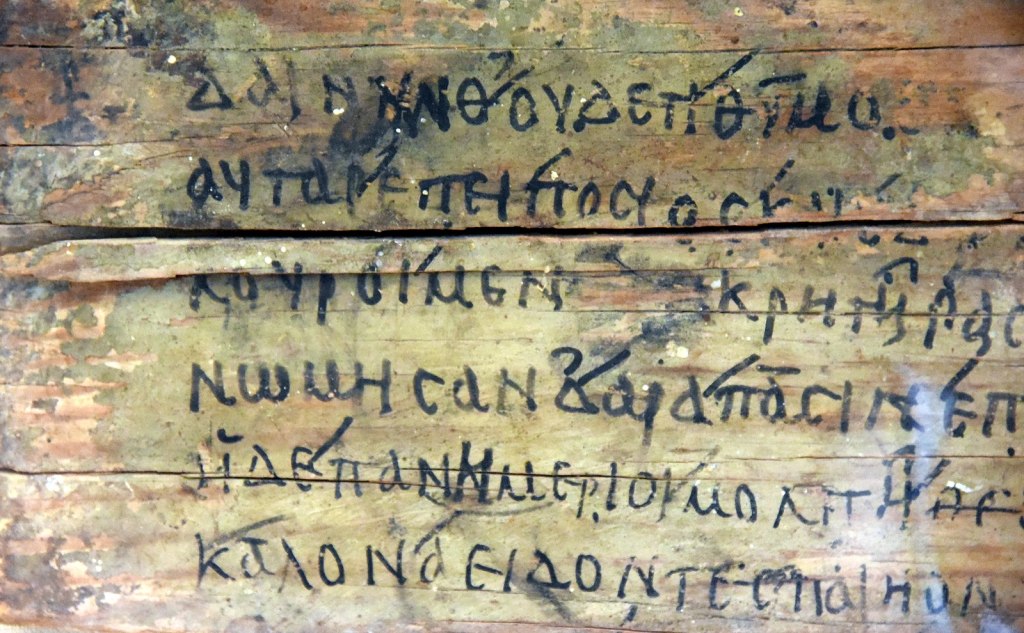
Featured Image Credit: Osama Shukir Muhammed Amin FRCP, English: Detail. Wooden Board (Writing Tablet) Inscribed (Greek) in Ink with Lines 468-473, Book I of Homer’s Iliad. From Egypt, Made 400-500 CE. On Display at the British Museum in London. Donated by the British School of Archaeology in Egypt., July 22, 2016, July 22, 2016, Own work, https://commons.wikimedia.org/wiki/File:Detail._Wooden_board_inscribed_in_ink_with_lines_468-473,_Book_I_of_Homer%27s_Iliad._Roman_Egypt._On_display_at_the_British_Museum.jpg.
 Retrospect Journal
