
Written By: Darcy Gresham
The little-known tale of the ‘Blood in the Water’ match is arguably the most famous, and bloodiest, water polo match in history. Taking place under the shadows of the Cold War, the confrontation between the USSR and one of its satellite states, Hungary, in the semi-finals of the 1956 Olympics blurred the line between politics and sports more than ever before.
The 1956 Olympics were held in Melbourne, Australia, during the months of November and December to coincide with summer in the Southern Hemisphere. This not only caused ripples through some international sporting communities who were unsettled by the move from the traditional earlier months of July, but it also had bigger impacts due to the state of international relations in the final months of 1956. In response to the actions of the USSR, the Netherlands, Spain, Switzerland, and Liechtenstein boycotted the games. Additionally, Egypt, Iraq, Cambodia and Lebanon announced their boycott as a result of the Suez Crisis.
The activities of the USSR in Hungary were the central driving factor for such action. Only a couple of weeks before the Games kicked off in Melbourne, the Hungarian Revolution had been put down by an invasion sent from the Soviet Union, killing thousands and wounding hundreds more. Beginning in October, the Hungarian Revolution started in protest against the domination of the USSR through political and geographical means. Protestors shared their demands for both political and economic reforms but were met with violent opposition from the secret police. As fighting ensued, militias were organised by revolutionaries to retaliate against the communist leaders and police. Repression from the USSR continued until mid-November brought Soviet victory, finally overpowering Hungarian revolutionaries. At this point, there was less than two weeks to go until the start of the Games, and Cold War tensions were high on everyone’s mind.
Now, to switch from the political backdrop to the stage on which such an encounter took place – the pool. The Hungarian men’s national water polo team is one of the most successful in the sport, and this is present tense as they still maintain a degree of dominance. They have won sixteen Olympic and twelve World Championship medals; they have been Olympic champions on nine occasions, a record number, and are also record-holders of the European Championship title. In 1956, not only was an Olympic gold medal on the line, but the team members felt a national responsibility and pride in the representation of their country. Despite attempting to shield players from the circumstances at home, they were crucially aware of what was at stake. Many had left family at home and their preparation for the Olympics had been interrupted by the evacuation of their training camp in Budapest.
The semi-finals brought Hungary up against the USSR in a high intensity match that exemplified the tensions of the Eastern Bloc and Cold War tensions rippling across the globe. In the strategy employed by the Hungarian team, they utilised the Russian language that had been enforced upon them in school to taunt their opponents. There are reports claiming this was to distract the Russians in attempts to goad them into committing fouls. Water polo already had (and still has) a reputation as a physical contact sport, and this match highlighted this on every level. With the water used to mask offences, players endeavoured to take every jab at their opponents: punches, kicks, and shoves were all exchanged.
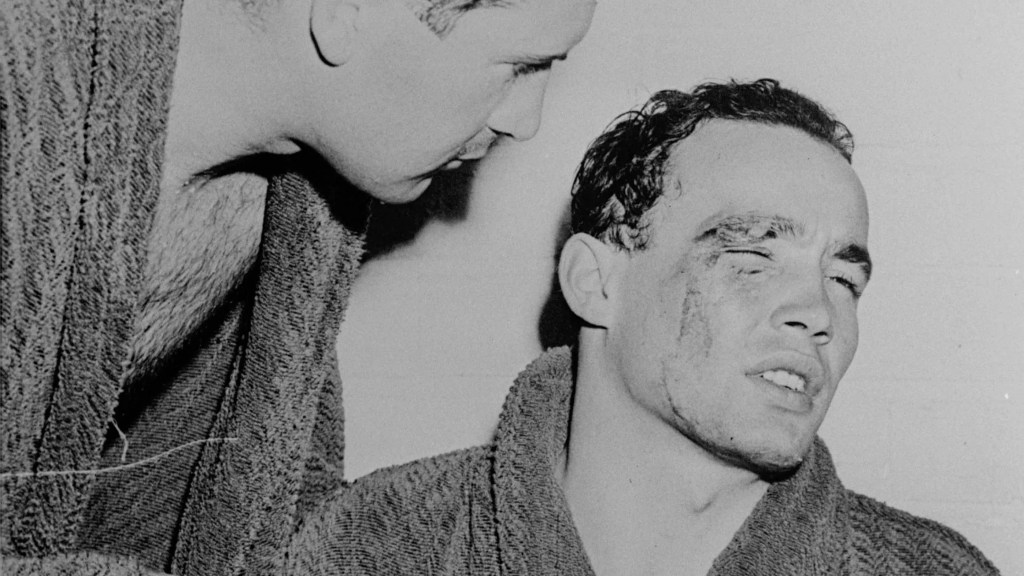
In the last two minutes of the match, the Hungarians were leading 4-0. The young star of the Hungarian team, Ervin Zádor, turned to mark the USSR’s Valentin Prokopov who had just burst the ear drum of a Hungarian. Unleashing what was apparently a string of offences too insulting to be repeated in the press, Zádor taunted his Russian counterpart and angered him into vengeance. Prokopov struck out, punching Zádor in the eye in a blow that drew blood. With blood streaming down his face, Zádor had to leave the water. This proved the last straw for both the spectators and officials. Those watching jumped onto poolside, shouting at the Russians so much that the police had to dispel them. Referees who had stopped the match called the end early and pronounced Hungary as the winner.
The Hungarians went onto win the Olympic title (beating Yugoslavia 2-1), although Zádor himself was unable to play. Following the games, both Zádor and some of his teammates left Hungary, making them a part of the forty-six athletes who defected to the West after the Olympics. It is reported that despite the Australian authorities banning CIA agents, many posed as journalists and members of the press to arrange visas for those wishing to defect. Zádor moved to California where he stayed involved in water sports and later became a swimming coach. Briefly, one of his own star pupils was Mark Spitz, the first to win 7 gold medals in a single Olympics at Munich in 1972 — he held the record until it was broken by Michael Phelps in 2008.
The image of Zádor’s injury has become synonymous with the ‘Blood in the Water’ match, being reproduced in papers across the world in the days following. Sometimes also referred to as the Melbourne Blood Bath, the match has gone down in history as a prime example of the intertwined natured of sport and politics. It became about more than just sporting prowess and morphed into a tale of national pride and liberty.
As one Hungarian publication put it; “[Hungary] showed the world that in conditions where seven men fight seven men, where the rules are the same for everyone, where there is no dictatorship, no informer network, and no iron curtain, we are capable of winning. Without tanks – with a ball.”
Bibliography
https://www.history.com/news/blood-in-the-water-1956-olympic-water-polo-hungary-ussr
https://olympics.com/en/athletes/ervin-zador
https://olympics.com/en/olympic-games/melbourne-1956
https://olympics.com/en/video/hungary-win-blood-in-the-water-battle
 Retrospect Journal