
Written by Naomi Wallace
CW: detailed description of the death of a child.
“For he cometh into vanity, and goeth into darkness: and his name shall be covered with darkness”
Ecclesiastes 6:4
The darkness had a heartbeat. It was neither still nor tranquil, instead animated by the rhythmic symphony of crickets in the hedgerows; the call of a lonesome owl in the distance; the occasional, echoing laughter of stragglers ambling home from the alehouse. The balmy midsummer night was alive, infused with the damp scent of dew collecting in the grass, moonlight illuminating the whispering stream. The darkness had a heartbeat, or so the man thought to himself, his own pounding resoundingly in his chest as he took strenuous care not to be seen.
It was all too familiar, the short route to the chapel. A humble yet enduring structure, it served the people of Poulton well. For a population fractured by the turmoil of recent decades, it had become a reliable beacon through pestilence, famine, and unrest. Everyone had buried family in the surrounding churchyard or baptised their children at the little altar inside; most had done both. It was cyclical, a place of birth and death for a people persistently, and often cruelly, reminded of life’s transience. Under the cover of hazy darkness, as he traced the footprints left on the path by his own treading that morning, the church felt distinctly unrecognisable to its lonesome visitor.
He had last walked this way just hours earlier under the invigorating morning sun with a giddy skip in his step. This did little to conceal his compounding panic, that only seemed to grow as he placed one foot in front of the other, fatherhood looming over him. A pleasant enough reason to panic, but nevertheless one that stirred in him a torrent of nausea while he had paced outside the bedroom in anxious anticipation. He had never felt so utterly useless, lingering behind the thin wooden door, listening to the primal, guttural screams of his wife on the other side. But he had done his part, eight moons ago, and childbirth was the unique occurrence in life from which his sort was excluded. Mothers rallied around their daughters as they breathed life into their own, babies whose bedsides they would attend when they became mothers themselves. So rather than helplessly loiter, banished from the hallowed chamber of woman’s work, the expectant father had resolved to pray, in the very same place he had beseeched God to send him a child; this child, that was making its bloody, brutal entrance to the world as his knees met the familiar chill of the chapel’s stone floor.
Upon his hasty return from Church, fretful to remain away from the house and miss the first irretrievable moments with the child, he was ushered to the bedside by the midwife in attendance. The room had a scent, which clung to the air, hot and heavy as oppressive rays of sunlight streamed through the sheer curtains. It was animalistic, the metallic odour of blood and sweat mingling with a fragrant selection of dried herbs and oils that were supposed to aid with the birth. Soiled rags were strewn across the floor, the water in the washbasins now tinged a light pink hue. Then there was his wife, naked, dishevelled, splayed on the linen sheets in a pool of crimson. Her stomach was swollen and round; certainly, she bore the body of a mother, only where was the life her growing belly had promised all these months? He felt light-headed. Never had he seen so much blood, save the time his father had slain a pig before his eyes. His wife, lying there, whimpering, thighs sticky with blood, reminded him of that creature. Hers were the defeated eyes of a slaughtered animal. And he knew, before anyone spoke, that all was not well.
Clutched at her breast was a tangle of fabric, unnervingly silent, grotesquely still. She, motionless as the limp thing in her arms, would not meet his crestfallen stare. There was nothing to be done, he heard a female voice whisper. Glancing around at the vacant expressions on the faces of the women that watched on quietly, he felt bewildered by their nonchalance, their composure. Was their sex not composed of a more melancholic humour? Why had not one of them thrown herself to the floor in woeful lamentation, as he so wished to do himself? Why did they not weep at this monstrous scene? It dawned on him that not one of these women was witnessing such an occurrence for the first time. Babies died all the time. Childbirth was the toss of a coin as your desperate prayers fell on the deaf ears of a ruthless, punitive God. You crossed your fingers that the planets would align to bring you good fortune and remembered that the Lord giveth and the Lord taketh away but sometimes he just takes and takes. For this babe had never even drawn breath, never cried with the shock of being thrust from his mother’s womb into the cold air. He was dead without ever having lived. As it pleased the Lord, so be it done, he thought grimly.
“He is not baptised,” were the first words she uttered once they were alone, grief festering between them.
His heart fell as he met his wife’s eyes, bereft. Unable to offer any remark of solace, he knelt at the bedside and gently pulled back the cloth to reveal the unbreathing child. Inexplicably, seeing the baby, smelling him, beholding the tiny miracle, overwhelmed him with joy. Three times now had they been with child, praying more despairingly every time for God to show them mercy, to deliver them of a healthy infant. Three times now these pleas had gone unanswered, and they had watched each child bleed away into nothing. There had even been a quickening, that euphoric flutter in the belly that promised there was life, only to be cruelly ripped away once more. Now, here at last, there was a child before them.
A dead child. A head of hair the colour of honey; cheeks flushed with rosy warmth; little white fingernails smaller than grains of wheat. Every perfect inch of him, here in the flesh and yet gone all the same. Rage swelled in him; a surge so intense he feared he would explode with ugly, unmitigated ferocity. A dead, doomed child. Unsanctified. Excluded from the rites observed by all others by mere coincidence of his birth, by being too early it was too late for him. The Church did not allow unbaptised infants to find eternal peace under the blanket of its consecrated ground, it treated babies that hadn’t the chance to wail out of turn like dirty sinners. Were they truly expected to discard of the child in some damp, cold ditch, toss him away to become worm food? It confounded him that those weighed down by a lifetime of misdoings had a clear path to heaven, so long as they lived long enough to be splashed with a bit of water as a prayer was said over their screaming head.
His wife had placed the tiny body in a wooden chest that had been passed down the generations of her family, carefully laying him to rest on his side, as though he were the peaceful sleeping baby she longed for. A final glance at her squandered hopes and she had pushed him out of the door, the casket under his arm, before retreating with her broken, bleeding body back to bed. Any reluctance he felt towards defying the laws of the Church was diminished by her anguished pleas, and the certainty that if he had refused then she would have dragged herself to the cemetery and buried herself with the baby.
So here he was, sweating under the cloak he had worn out of fear of being caught with his contraband baby. His cargo was heavy. How could he be sure that the ground he trod was holy, in the total absence of light? Any closer to the Church he risked being seen, so he settled on a spot just within the perimeter, facing east. He knelt, just as he was accustomed to doing in the building which now cast upon him a safe shroud of darkness. The earth beneath him was merciful, giving way to his scrambling, shaking hands. He thanked it, as he began to dig.
A note on context:
This piece is based on an archaeological study by Kevin Cootes, Matthew Thomas, David Jordan, Janet Axworthy, and Rea Carlin for the International Journal of Osteoarchaeology. The report (which is open access and available here), titled “Blood is thicker than baptismal water: A late medieval perinatal burial in a small household chest”, reveals the discovery of the remains of an infant buried just within the perimeter of a cemetery in Poulton, Cheshire. The authors discuss the implications of this upon the archaeological record, and for the historiographical study of Catholic Church Law and clandestine burials. Though it is impossible to determine the exact circumstances under which the infant in question was buried, the paper argues that this was a clandestine burial by grief-stricken parents who sought to bury their child in Church ground. As it was forbidden by the Catholic Church to bury unbaptised infants in consecrated ground, the report is a compelling and emotive glimpse into the agency of those who buried the perinate, and the sense of grief and desperation that drove their actions.
This piece speculates on these themes, and endeavours to incorporate aspects of the wider contextual setting in which it takes place. The circumstances under which the child in the report was buried were tragic and emotionally fraught, and one can only imagine what was going through the heads of their parents. That said, I hope that I have begun to bridge that gap here and humanised a set of people who experienced and acted upon a devastating loss in a context completely foreign to us today.
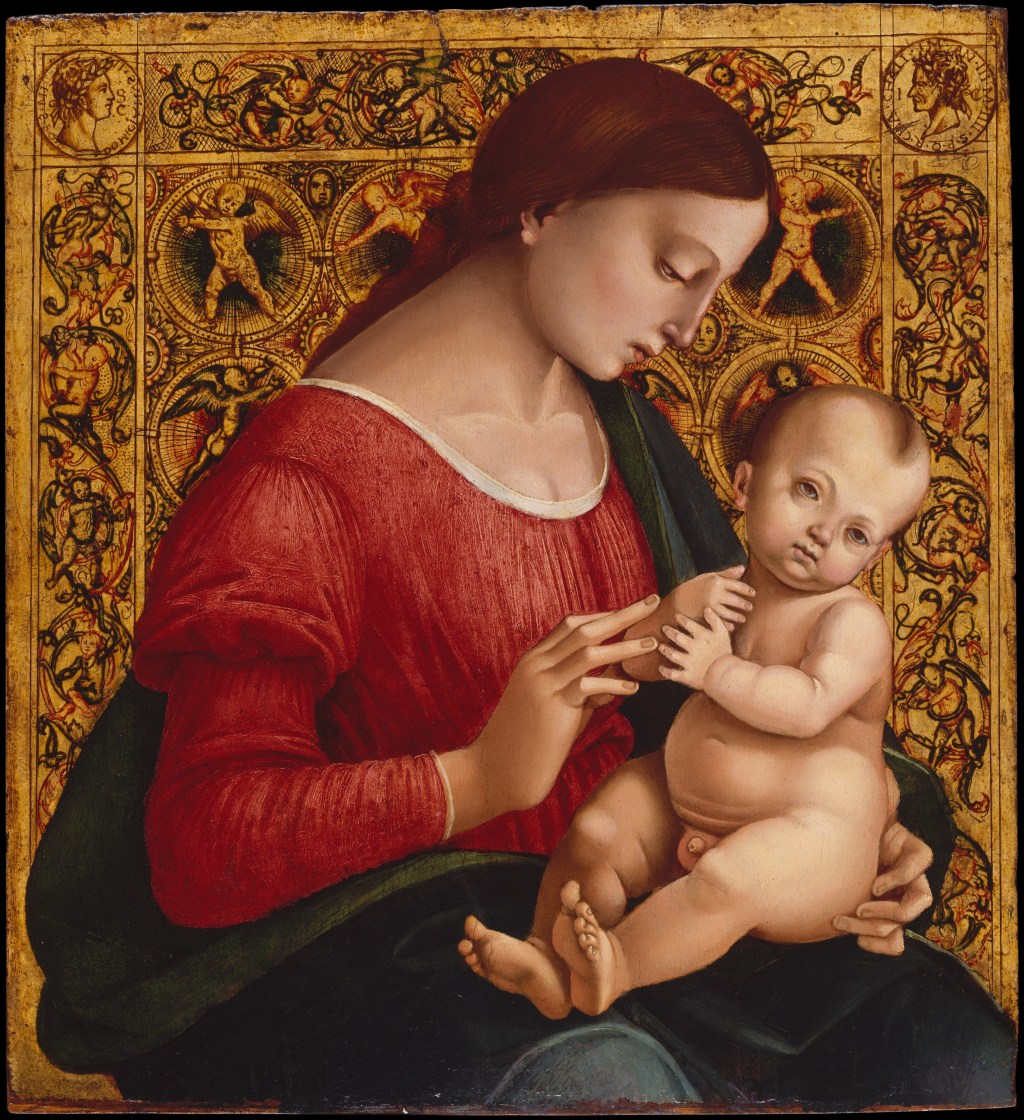
Featured image credit: Madonna and Child by Luca Signorelli, 1505-7. Accessed via Wikimedia Commons: https://commons.wikimedia.org/wiki/File:Madonna_and_Child_MET_DT1344.jpg
 Retrospect Journal