
Written by Edie Christian
John Milton’s Paradise Lost was published in 1667, seven years after the Restoration of the English monarchy. A ten-thousand-line epic poem, Paradise Lost is a retelling of the biblical story of Satan’s revolt against God and the subsequent fall of mankind. As a Republican, Milton used his work to supersede a religious retelling and create an allegory for both the Civil War and the decline of its figurehead, Oliver Cromwell – this is epitomised through the characterisation of Satan as a relatively sympathetic rebel leader. Despite the work’s evidently rebellious dimension, the fall of mankind is seen to derive from the upsetting of established authority; it is the convergence of pro- and anti-monarchical sentiment that creates a paradox within one of the masterpieces of literature.
The poem begins after the expulsion of Satan and the rebel angels to Hell following their revolt against God. The narrative oscillates between Hell, Heaven, and the Garden of Eden; as we know, Satan eventually enacts his revenge by transforming into a serpent and persuading Eve to eat from the Tree of Knowledge, thereby condemning mankind. The parable (based on Genesis chapters 1-3) sees Satan subsequently banished back to Hell, thus securing God’s rule in Heaven. It is thought to illustrate how sin and corruption are introduced into a previously idyllic world and historically acts as a cautionary tale against disobeying God’s teachings. Biblical tales – particularly well-known ones – work well as political allegories within strictly religious societies, as the reader can relate to both the religious and political dimensions. In this way, both the instability of British politics and arguably the entire monarchical system are inextricably linked with Milton’s work.
Milton would have lived through a period of huge political turbulence; seven years of war between Loyalists and Oliver Cromwell’s Parliamentarians had culminated in the execution of King Charles I in 1649 and the replacement of the monarchy with the new Commonwealth of England, headed up by Cromwell. This new political structure granted Puritans newfound power, resulting in increased persecution of Catholics and rigid enforcement of their own morality through law. Alongside this, Cromwell enacted a monstrous genocide in Ireland, with modern sources estimating that as much as half of the population lost their lives; resources were stripped from the land, and the country was reduced to extreme poverty. Cromwell was succeeded by his son, Richard, in 1658; within two years, his weakness meant the monarchy was reinstated by Charles II in the 1660 Restoration. The turmoil that plagued the short-lived Republic led to the monarchy being far more favourably viewed, with many celebrating the return of stability and the established order, a central theme to Milton’s Paradise Lost.
Despite the poem ostensibly supporting the restoration of the monarchy, Milton himself was a devoted Republican. Following the reinstatement of the English Republic, Milton published his The Tenure of Kings and Magistrates (1649), in which he argued regicide to be heroic and defended the right for people to hold their leaders to account. The same year, he was appointed Secretary for Foreign Tongues – principally Latin – and was expected to produce Republican propaganda. Upon the Restoration, Milton’s history of Republican sentiment led to the burning of his writings as well as his imprisonment; it is believed he was only spared from his sentenced execution due to his age and almost total blindness. Not only did Milton live through the turbulence of the Civil War, but he was fundamentally linked with the rise and fall of the English Republic. It is therefore undeniable that his history of seditious beliefs is apparent within his seminal work, with some scholars arguing it is a text characterised by its rebellion.
Paradise Lost is seemingly paradoxical through its depiction of its divine figures within its allegory, despite Milton’s strong Parliamentarianism. The comparison of Oliver Cromwell to the archetypal villain of Satan in seventeenth-century Britain would typically be viewed as a renunciation of rebellion, particularly as the established order is upheld and arguably strengthened by the end of the poem. Furthermore, God’s depiction as omniscient in his certainty that “so will fall/He and his faithless progeny” suggests that Satan’s rebellion was never truly a threat to God, seemingly demonstrating the indomitable nature of the English monarchy. The pro-monarchical nature of Milton’s work can be seen in his use of chiaroscuro and light imagery as an extended metaphor for good versus evil. The declarative “God is light” casts him as the physical manifestation of goodness. Indeed, it could be argued that Milton seemingly changes his old views in the years following the Restoration. His apparent support for the re-established monarchy may be due to its role in ending the years of turbulent rule under the Republic.
Although elements of the work suggest a pro-monarchical sentiment, Satan is positioned almost as a protagonist; the first four books of the poem are predominantly from his perspective. Although he is evidently a flawed character in his greed and selfishness, he is also portrayed as one of the most complex. The reader is drawn to the “charismatic, transfixing image of evil” that differs from archetypal medieval depictions. His inner turmoil and doubts surrounding his involvement in the fall of mankind humanise him to the reader, gaining their sympathy despite his divine status. His motivations lie in his belief in the “tyranny of [God’s] Heav’n”, with Loewenstein arguing he “skilfully impersonates the role of radical revolutionary”. Interestingly, the initial attraction to Satan’s character has remained prescient in authoritarian countries in regions such as the Soviet Union and the Middle East. So much so that in the early days of the Arab Spring in 2011, the Syrian government was incredibly fearful that a new translation of the work would be interpreted as anti-authoritarian through its depiction of Satan; they disseminated warnings through state-run newspapers about the dangers of opposing the government.
However, seventeenth-century British critics would have certainly been less receptive to this almost sympathetic depiction, especially considering the apparent cruelty of Milton’s God. The banishment of Satan and the rebel angels to Hell following their rebellion solidifies the perception of Milton’s God as despotic and tyrannical. Of course, it is difficult to draw direct literary comparisons between God and a monarch, especially due to the declining belief in monarchical absolutism and the divine right of kings in the seventeenth century. There was not necessarily a decline in religious belief itself, but the idea that monarchs are delivered from God was drastically reducing in popularity. Indeed, there was still an unequivocal faith in the great chain of being, a hierarchical structure of belief that all living creatures were headed by God. Furthermore, it was arguably not monarchy that people had an issue with so much as with Charles I, who had refused to concede governmental power to Parliament; it is in this way that the poem appears less paradoxical.
Despite appearances, John Milton’s Paradise Lost is not inherently paradoxical in its depiction of monarchy in Restoration England. Although the poem is a retelling of the biblical tale of original sin, it also reflects the challenges of seventeenth-century Britain; there are comparisons drawn between Satan’s rebellion against God and the War of the Three Kingdoms. The simultaneous support and disdain for the monarchy and seditious figures can, in fact, be seen in relation to the dwindling belief in the extricable link between sovereignty and religion. Milton’s hatred for Charles I would no longer have been viewed as inseparable from his views on monarchy. In the end, however, Paradise Lost leaves us questioning the essence of the monarchy through its depiction of rule and rebellion, as well as the nuanced portrayal of the consequences of absolute authority.
Bibliography:
CBC. “Sympathy for the Devil: Milton’s Satan as Political Rebel,” August 31, 2020. https://www.cbc.ca/radio/ideas/sympathy-for-the-devil-milton-s-satan-as-political-rebel-1.5497049.
Loewenstein, David. “‘An Ambiguous Monster’: Representing Rebellion in Milton’s Polemics and ‘Paradise Lost.’” Huntington Library Quarterly 55, no. 2 (April 1992): 295–315.
Milton, John. Paradise Lost. Edited by John Leonard. London: Penguin Books, 2003.
Ramm, Benjamin. “Why You Should Re-Read Paradise Lost.” http://www.bbc.com, April 19, 2017. https://www.bbc.com/culture/article/20170419-why-paradise-lost-is-one-of-the-worlds-most-important-poems.
Trubowitz, Rachel J. “Body Politics in ‘Paradise Lost.’” PMLA 121, no. 2 (2006): 388–404.
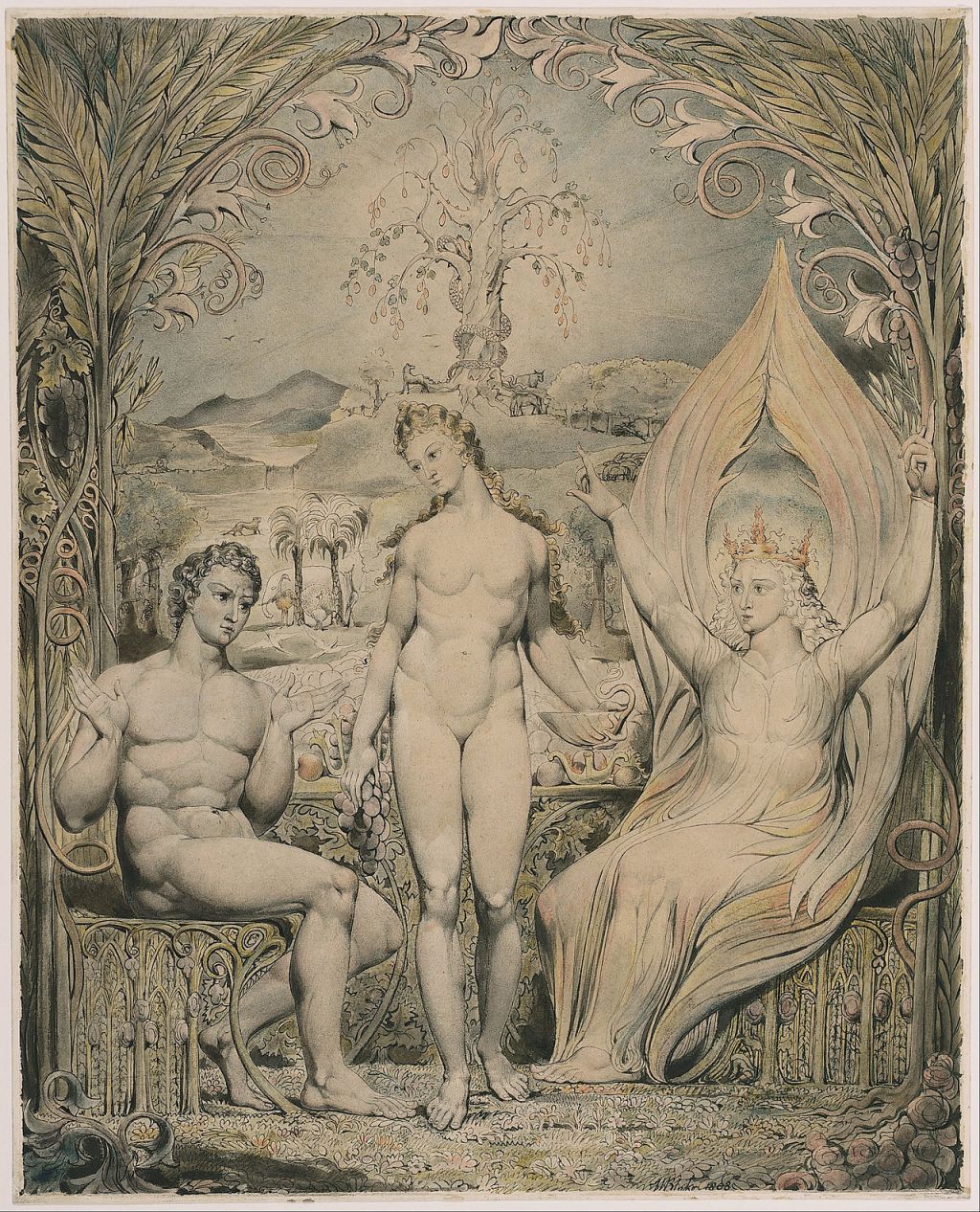
Featured Image Credit: The Archangel Raphael with Adam and Eve (Illustration to Milton’s “Paradise Lost”) 1808, Museum of Fine Arts Boston, https://commons.wikimedia.org/wiki/File:William_Blake_-_The_Archangel_Raphael_with_Adam_and_Eve_(Illustration_to_Milton%27s_%22Paradise_Lost%22)_-_Google_Art_Project.jpg.
 Retrospect Journal
_-_Google_Art_Project.jpg)