
Written by Emilio Luppino
“Our interest was to develop a strategy capable of involve and thus build, we called ourselves armed proletarian power, this dynamic, the clash with the state, was inevitable and therefore we thought that the strategy of armed struggle was the only one possible, capable of maintaining and giving a perspective to the movement of those years, to its expectations, hopes, even to its utopias why not!”
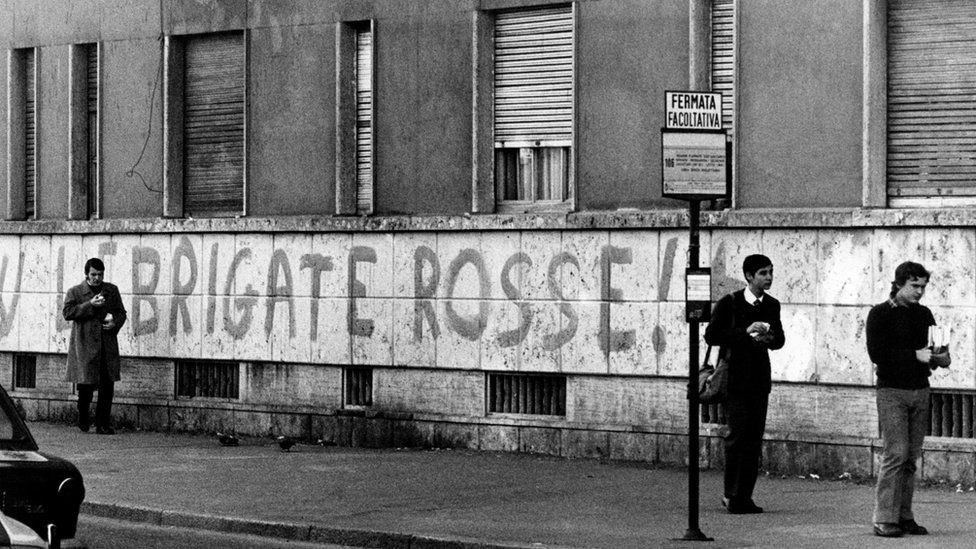
In this transcript from 1978, the Italian left-leaning terrorist Mario Moretti converses with journalist Sergio Zavoli on the sentiment that convinced the terrorist group the Red Brigades to kidnap and kill the Secretary of the Christian Democratic Party, Aldo Moro.
Subjugation, oppression, the inability to communicate with institutions, and the victimisation of a conventio ad excludendum; were all common issues observed by extremist political fringes — especially on the left — after the Second World War in Western Europe.
The kidnapping of Moro came after ten years of political struggle that began during the 1968 Student Movement. While the squares were full of students advocating for civil rights and peace, a whole network of terrorist cells were beginning to take shape. When the International Vietnam Congress took place on 17 February of that year in Berlin, the capital of the Federal Republic of Germany, the city was not only the setting for public demonstrations against the Vietnam War, but some of its buildings were hosting a series of secret meetings organized by political activists intended to plan the creation of a new front to fight the United States and what was considered to be its imperialist project. Despite failing in creating a new active battlefield against the USA in Europe, leftist secret organizations rose in the following years, especially in FRG and Italy, where the two main groups respectively took the names Rote Armee Fraktion (Red Army Faction/RAF) and Brigate Rosse (Red Brigades/BR).
The two former dictatorships were facing the aftermath of their authoritarian years, dealing with what remained of the Nazi and Fascist party: their members, their institutions, and the mindset that they left behind.
In West Germany, by 1965, approximately 60 per cent of military officers had participated in past Nazi operations, and a minimum of two-thirds of judges had been associated with the Third Reich. Despite numerous trials such as those held in Nuremberg and Auschwitz, the publication of books, television documentaries outlining the horrors of the Holocaust, educational materials addressing the crimes committed by Hitler’s officials, and reparations provided to the victims of the Nazis, recent German history had remained a taboo within German households with parents that seldom discussed their experiences during the years after 1933.
The younger generation looked at university professors, bureaucrats, police officers and could not see them without their brownshirts. The transition to the liberal, democratic, and capitalistic system appeared to them as a mere sweetened glaze covering a rotten society.
The situation in Italy was even more dramatic.
In 1946, Palmiro Togliatti, the Minister of Justice and Secretary of the Italian Communist Party, observed a significant presence of industrialists and officers who had collaborated with Mussolini’s regime. To prevent additional conflicts — especially in the aftermath of the intense civil war between antifascist partisans and fascists — he opted for an amnesty which erased the collaborationists’ legal responsibility for war and political crimes. The country failed in facing its past, the twenty years of dictatorship suddenly fell into oblivion, and the National Fascist Party assumed an aura of mistake in the history of the Nation.
The second half of the twentieth century saw the rampant effects of capitalism radically change Italy. The shifts brought about by economic growth, industrialization, and urbanization allowed leftist groups to look at the plight of workers exploited by ex-fascists businessmen, at the proletarian masses ruled by the conservative Christians who excluded the biggest communist party in western Europe from all the institutions, at the attempted anti-communist coups, and at the violence of the police.
This world, perceived by leftist radicals as unjust, hypocritical, and unresponsive, further convinced them—already indoctrinated by the hope for a new October Revolution—that the most viable course of action was armed conflict and the subsequent dismantling of this system.
However, if the societies these radicals grew up in provided them with motivations, they did not develop in isolation. The civil rights movement in the United States during the fifties and sixties, having garnered global attention, ignited Western hearts. The iconography and substance of the African American struggle also captured the interest of many Europeans — including those in western Germany and Italy. While the mainstream press covered its various phases, left-leaning media offered in-depth and critical analysis of the movement’s progression right from its inception. At the beginning of the 1970s, West German students discovered their passion for Frantz Fanon’s theories on decolonization and the cathartic features of violence. Contrarily to the movements in USA and France, German protesters did not avoid the terroristic path. Especially in the case of the RAF, their insistence on a convergence of Black Power, postcolonial identity redefinitions, and a reckoning with the National Socialist past formed a uniquely intense template for German terrorism.
The BR looked at the Black Panthers and Cuba in a similar way. They refined their ideological training by imitating Tupamaros in Uruguay; exercised on the manual of urban guerilla by the Brazilian revolutionary Marighella; and let themselves be inspired by the leadership of Che Guevara in Bolivia.
It was because of these motivations and preparations that in few years they succeeded in upsetting Europe, claiming in just thirty years a total of forty-one homicides in the FRG and 179 in Italy.
While Western European leaders were busy preaching the values of liberalism in the parliaments, a web of anonymous individuals with false names were fermenting: visiting workers in factories, stealing weapons, and organizing secret meetings in religious silence. With Lenin as prophet, balaclava as cowl, and the red star as cross, these sects were preparing for their Last Judgment: the dictatorship of the proletariat.
Bibliography
Conway, Martin. Western Europe’s Democratic Age: 1945-1968. 1st ed. United States: Princeton University Press, 2020.
Klimke, Martin. The Other Alliance: Student Protest in West Germany and the United States in the Global Sixties / Martin Klimke. Princeton, N.J.; Princeton University Press, 2010.
Saporito, Paolo. “Cultural Memory against Institutionalised Amnesia: The Togliatti Amnesty and Antonioni’s I Vinti.” Modern Italy: journal of the Association for the Study of Modern Italy 23, no. 3 (2018): 299–313.
Schmidt-Petersen, Jennifer. “Red Army Faction.” In Routledge Handbook of Terrorism and Counterterrorism, 350–360. 1st ed. ABINGDON: Routledge, 2019.
Sommier, Isabelle, Graeme Hayes, Sylvie Ollitrault, Isabelle. Sommier, and Graeme Hayes. Breaking Laws: Violence and Civil Disobedience in Protest / Isabelle Sommier, Graeme Hayes, and Sylvie Ollitrault. Amsterdam: Amsterdam University Press, 2019.
Terhoeven, Petra. “Terrorism as Third Front: The Radicalization of the New Left in Italy and West Germany.” In The Oxford Handbook of the History of Terrorism. Oxford University Press, n.d.
Varon, Jeremy. Bringing the War Home: The Weather Underground, the Red Army Faction, and Revolutionary Violence in the Sixties and Seventies / Jeremy Varon. Berkeley, Calif: University of California Press, 2004.
 Retrospect Journal