
Written by Ambrose Brown
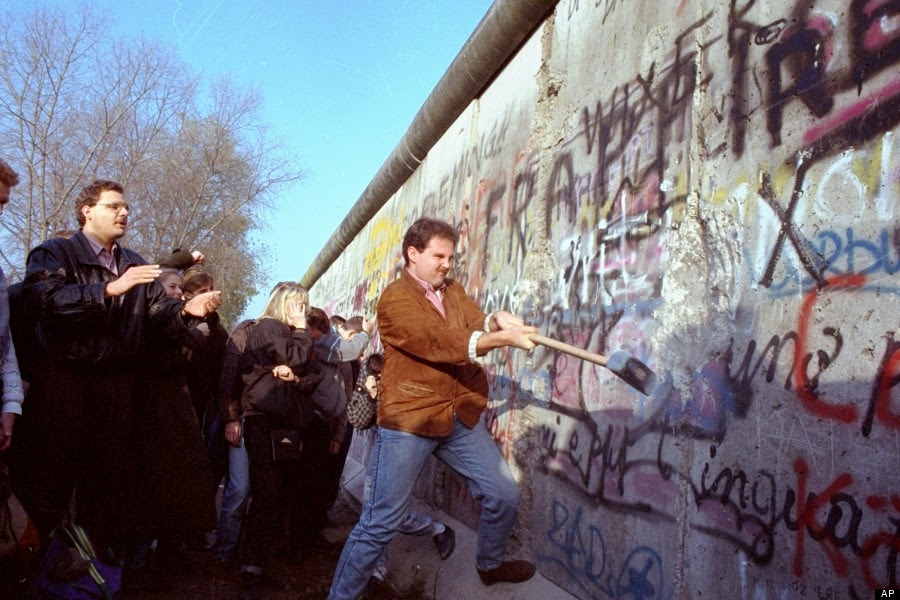
My tape recorder clicked to life, ready to capture a fragment of history even as the murmur of a restless crowd swelled against the Berlin Wall, an imposing symbol of division looming ominously over us. It was 9 November 1989, in East Berlin, and the air was thick with anticipation. The Wall was about to come down.
Amidst the gathered throng of East Berliners, I moved with purpose, my eyes wide with a mix of curiosity and determination. My recorder, a cherished relic, was my means to preserve the voices and emotions of this historic eve – the stories of those who lived in the shadow of this gray colossus.
Approaching a middle-aged man whose gaze was locked on the towering wall, I asked, my voice barely above a whisper, “Can you tell me what you feel about tonight?” The man’s eyes, reflecting a lifetime of restrained hope, met mine as he contemplated the question. After a moment, his voice, tinged with cautious optimism, broke the silence. “Hope, young lady. After all these years, just a sliver of hope.”
His words resonated deeply, each syllable a poignant echo of the collective yearning from a divided city. I continued through the crowd, the recorder a silent witness to the chorus of anticipation, fear, and tentative joy. With every recorded voice, every captured sentiment, I felt a growing sense of connection – to Berliners, to the moment we were all living, and to the history we were all writing.
Each person I approached as I edged through the crowd seemed to carry their own unique story, a testament to life in the shadow of the Wall.
An elderly man, his face carrying years of silent endurance, shared, “We’ve been living in a pause, waiting, hoping. This Wall… it’s not just concrete; it’s years of life lost.” His voice was the first of many I captured.
A young woman, gaze fierce and determined, spoke of her dreams, “I want to travel, to see the world beyond this… prison. I want to live, not just exist.” Her words, full of longing, echoed the sentiment of many East Berliners.
As I moved, I encountered a stoic middle-aged woman. “My father went west on a business trip, never returned. That was a decade ago. We’ve only exchanged letters since. I wonder if he still looks the same,” she said, her voice a mix of wistfulness and resignation.
I met a former scientist, his voice laced with bitterness, “My research was my life. But here, your work means nothing if you don’t toe the line, don’t wear their pin. So much wasted potential.”
A young man, barely out of his teens, recounted his narrow escape, “I fled through Hungary, with nothing but a handful of marks and a heart full of fear. But freedom, it tastes different when you’ve fought for it.”
The voices continued – a mother who’d lost her son to the West, a student barred from her chosen study, a man who’d been under constant surveillance for his so-called ‘subversive’ ideas.
Each story was a thread in the fabric of our shared existence, a fabric torn and patched over the decades. I felt a heavy weight in my chest as I listened, recorded, and preserved their narratives. This Wall had not only divided a city but also fragmented lives and dreams.
Seeking a moment’s respite, I found a quieter spot near a section of the Wall that bore the scars of time. I noticed a small, worn hole, barely noticeable unless one looked closely. Intrigued and with a journalist’s instinct, I placed my recorder near the opening, curious about what – if anything – it might pick up from the other side.
At first, there was only a rustling, then a voice, muffled yet clear enough to discern words. It was a man’s voice, filled with a familiar ache. “I’ve been in Berlin all my life. My mother, my sister… they’re out there, somewhere. I lost them when this damned Wall rose. I wonder, every day, if I’ll ever see them again.”
His words, stark in their simplicity, struck a chord. I found myself leaning closer as if drawn by the raw emotion in his voice. There was something in his tone, a cadence that tugged at the edges of memory.
As his voice continued, speaking of years of separation, of a life lived half in shadow, I felt an inexplicable connection, a sense of knowledge beyond mere empathy. His story, much like the others yet so deeply personal, stayed with me as I lowered the recorder.
The man’s voice from the other side of the Wall trembled with emotion. “I was just a boy when they took them away. My sister, Lena, was even younger. I remember her cries that night. They haunt me.”
A shiver ran down my spine. My heart raced as I pressed the recorder closer to the hole, my breath catching in my throat.
“I’ve kept her picture, you know,” the voice continued, “hoping that one day, the Wall would fall, and I’d find her again. Maybe she’s out there, listening, just like I am.”
Tears blurred my vision. The recorder fell from my trembling hands as I asked, “What’s your name?” barely loud enough to be heard.
There was a pause, and then, “Karl. My name is Karl.”
Time seemed to stand still. Karl. My brother’s name. Memories flooded back – laughter, games, then soldiers, separation, a night of tears. It was him. He was on the other side of this concrete barrier that had kept us apart for so long.
I dropped to my knees, overwhelmed by the tidal wave of emotions. Years of separation, the pain of lost family, all converging into this single, miraculous moment.
“I’m here, Karl,” I cried out. “I’m here!”
Author’s Note: In ‘A Voice Beyond the Wall,’ I sought to capture the interplay of hope and heartache experienced by those separated by the Berlin Wall.
 Retrospect Journal