
Written by Georgia Smith
“I write with the blood that goes to the ends of my fingers, and it is a very sensuous act.”
A.S. Byatt
There are few essays as singular and intellectually provocative as Hélène Cixous’ The Laugh of Medusa. First published in her native French as Le Rire de la Méduse: et autres ironies in 1975, and translated into English in 1976, Cixous’ work is both striking and subtle in equal measure. Her thesis is deceptively simple: to write the female subject women must use the female body as a medium of communication – they “must write through their bodies, they must invent the…language that will wreck partitions, classes and rhetorics.” Cixous’ idea of text is one which depends upon dreams and the unconscious, imagination and fantasy, senses and sensuality. She positions sexuality and the body as essential to this radically new idea of text. Politically rich and deeply iconoclastic, Cixous writes with a smooth lyricism and commands a prose which is replete with ironic intent. The Laugh, as it is known, stresses the impotence of literary discourse, its phallocentric logic and restrictive conventions – proposing instead the seductivity of a more sensuous form of intellect divorced from the fatigue of reason and rationality and sourced within the body.
Influenced closely by the postmodernism of Jacques Derrida and his theory of deconstruction – and more broadly by the likes of Lacan, Freud, and Bataille – in Cixous’ writing one feels an instinctual pull towards open questions. A desire to source potentials beyond that of accepted normativity, flirting with ideas of text which remain perhaps more faithful to the impulses of the body than the rationality of the mind – for a woman’s body can “articulate the profusion of meanings that run through it at every direction.” One thinks of Cixous’ influences clearly here. Take the place of ego in Lacan’s idea of infancy and the “mirror stage” (in which children use the image of their bodily reflection in order to form an early sense of psychological subjectivity) or the primacy of the unconscious, dreams and dream symbols, and the libido in Freudian psychoanalysis. This obsessive concern for the body and bodily is resolute in the writings of Georges Bataille, who shares with Cixous the critique of a modern rationality which devotes itself to the imposition of social limits.
As such, the emotive and the personal remain essential to Cixous’ practice. When interviewed for the F/W 2015 issue of Purple Magazine, and asked about her childhood, Cixous’ maintains that she is “a mass of continents, contradictions, [and] compatible incompatibilities.” Born in 1937 to Jewish parents in French Algeria, Cixous moved to Paris in 1965, earning her doctorate in 1968. Along with The Laugh of Medusa (1975) Cixous’ other major works of criticism include: The Newly Born Woman (1975), Coming to Writing (1977), and Stigmata: Surviving Texts (1998). Cixous’ work quite naturally transgresses the boundaries of genre and includes, but is not limited to, literary criticism, philosophy, fiction, and drama.
To Cixous “writing has been run by a libidinal and cultural – hence political, typically masculine – economy.” It is this economy of blind rationality which too constitutes the accepted cannon of the history of ideas. She clarifies that “nearly the entire history of writing is confounded with the history of reason.” Cixous’ most sensational statement, both in terms of the formidable and stirring claims it seeks to make, reads “censor the body and you censor breath and speech at the same time.” Self-evident and undeniably convincing, such a statement is effective as it hinges on the physical palpability of breath and the double meaning of speech as something both bodily and consciously constructed outside of the body and interpreted by an audience.
The Laugh of Medusa is perhaps the most famous of Cixous’ works as it conceives of the idea of écriture feminin. To Cixous, all history is the history of the repression of the female body. Thus, to write the female subject into history women must make acquainted themselves with the bodies which serve to “vitally support the logic of [their] speech.” It is this kind of bodily language that Annie Ernaux seeks to replicate in her prose, writing in I Will Write to Avenge My People that she hopes for the “clamour of a language which conveyed anger and derision, even crudeness; a language of excess, insurgent.” In order to write through, by and with one’s body one must accept the liminality of écriture feminin, it is a linguistic practice defined not by a consistent logic but by the unpredictability and latent potential of the sensual body.
The excruciatingly lucid portrait of desire which constitutes Annie Ernaux’s Simple Passion and the “insomnia-infused logic” of Elizabeth Hardwick’s slim novel Sleepless Nights both approach a fulfilment of the sentiment of écriture feminin, be it as it is a form without definition. Elizabeth Smart’s genreless but lyrically sublime By Grand Central Station I Sat Down and Wept being another appropriate example. Cixous’ theory is in pursuit of the “infinite richness” of female subjectivity. Écriture feminin, in practice is a disavowal of the “infamous language of antilove” which defines a woman’s response to the female form under patriarchy. Cixous goes as far as to suggest that phallocentric discourse has been successful in manipulating womanhood to the extent that it has “made for woman an antinarcissism.”
Sex sells, but it also innovates. In a rejection of the body as simply “the uncanny stranger on display”, Cixous sees the female body and its sexuality as conducive to the production of a thoroughly dynamic mode of thought. In a provocative turn part-way through her essay, Cixous asserts the act of female masturbation as a “production of forms” or a veritable series of “visions.” The invocation of Platonic thought (Plato’s forms being aspirational symbols representative of the ultimate goodness of a thing), and the further readings of masturbation as both an “aesthetic activity” and a “rapture”, serves to vest in the body a serious intellectual potential. The body, and its reactions, then being a medium through which one can both articulate opinion and challenge the “infamous language of antilove”.
Without the substantive content of fantasy, Cixous’ thinking on masturbation would be redundant. As she writes a “woman’s imaginary is inexhaustible, like music, painting, writing: their stream of phantasms is incredible.” Leslie Jamison, a writer defined by her capacity for profound sensitivity, writes on the salience of the daydream. As she understands them, daydreams are like pain, they are “impossible to compare across the bodies of dreamers” and vary in texture, intensity, and constancy but are nevertheless continually present in the mind of the individual. Jamison’s daydreams are prolific: moving across the territories of desire, shame, compulsion, and play. Yet, she maintains that they all serve the same or similar functions: in one way they are a method of imagining “escape and alternatives—about imagining difference, envisioning an outside to your life” and in another “about imagining how things might stay the same.” The former function is most evocative of Cixous’ view of the intellectual potency of fantasy and dreams.
From daydreams to their nightly counterparts, fantasy finds its natural expression within the dreamscape. In an idea most succinctly expressed by Barthes, “dreaming allows for, supports, releases, brings to light an extreme delicacy of moral, sometimes even metaphysical, sentiments, the subtlest sense of human relations, refined differences, a learning of the highest civilization, in short a conscious logic… dreaming makes everything in me which is not strange, foreign, speak: the dream is an uncivil anecdote made up of very civilized sentiments.” It is this idea of dreams to which Cixous subscribes, subtly invoking the importance of dreams to consciousness and pointing out the role they have played in a female sensibility defined by its propensity for fantasy. As she explains, women “have lived in dreams, in bodies (though muted), in silences, in aphonic revolts.” What Cixous, Jamison, and Barthes – to an arguably lesser extent – move towards is an understanding of the role of the sensual body in producing a kind of intellect.
Cixous’ relationship to feminism is complex and not without controversy. While personally ambivalent towards the term, she is often labelled as a poststructuralist and an essentialist feminist. Extreme Fidelity, another of Cixous’ landmark essays, proposes distinct masculine and feminine “economies” – an idea not easily divorced from its biological determinism. Cixous’ understanding of sex and gender thus requires careful reading. If one reads Cixous on motherhood as restrictive, they forsake the potential which is inherent to her philosophy. To Cixous the invocation of a woman’s body as the potential body of a mother (the “white ink” of breast milk) is just one of a myriad of options suitable to a woman’s choosing. Cixous relies heavily on the rich symbol of the mother as a shorthand for an emotional sensibility. A sensibility which is too deeply sexual, empathetic and responsive to the senses – a sensibility which is not as inhibitory as it may initially appear.
Bibliography
Barthes, Roland. 1976. The Pleasure of the Text. London: Jonathan Cape.
Cixous, Hélène. 1976. The Laugh of Medusa. Translated by Keith and Paula Cohen. Signs, Vol. 1, No. 4 (Summer), pp. 875-893.
Jamison, Leslie. 2022. Dreamers in Broad Daylight: Ten Conversations. Astra: The Ecstasy Issue. Issue One (August).
Sellers, Susan. 1994. “Extreme Fidelity” in The Hélène Cixous Reader. London: Routledge.
Zaham, Olivier and Grau, Donatien. 2015. “Hélène Cixous” in Purple Magazine. Issue 24 (F/W).
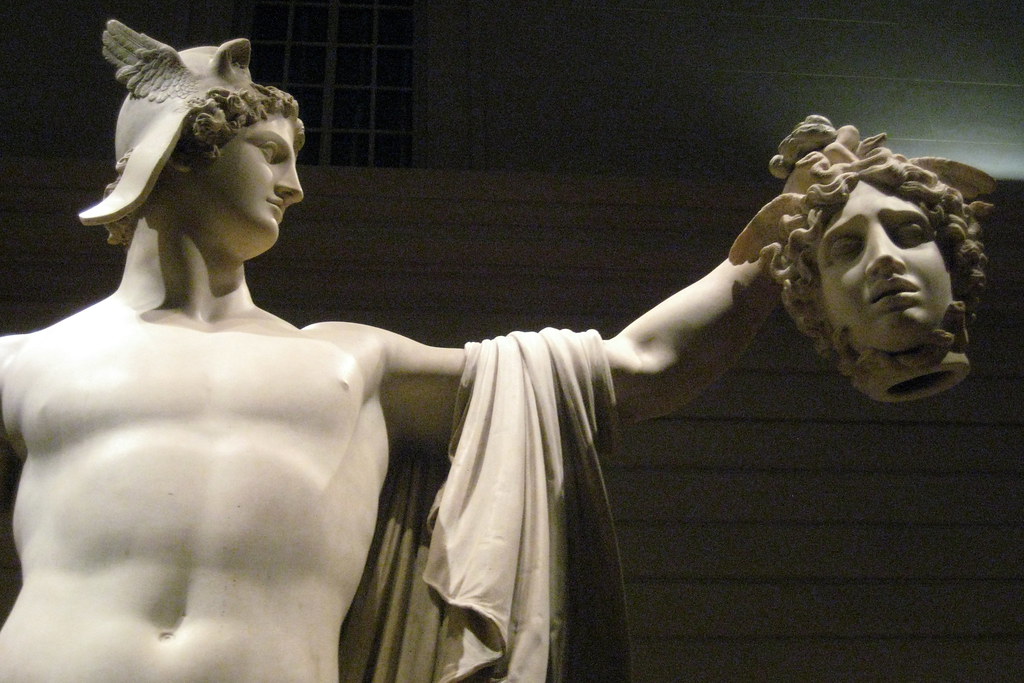
Featured image credit: “NYC – Metropolitan Museum of Art – Perseus with the Head of Medusa” by wallyg is licensed under CC BY-NC-ND 2.0.
 Retrospect Journal