
Written by Megan Crutchley
The trailer for Napoleon has been circling my social media feed as well as cinema screenings for months. Its ambient music and promise of great battle scenes sell this film to be another Gladiator-esque trip, telling the story of a ‘great man’. However, I was pleased to see that this was not the narrative of the film. Like with one of Ridley Scott’s other films, The Last Duel, Scott humanises historical characters by portraying the good and the bad, without a pompous and masculine idealisation of characters and their actions. In my opinion, it provides a refreshing lens through which to view history, and brings us closer to the stories. We can much more easily relate the antics of aristocrats and politicians in Napoleon to the workings of politics today, through a common absurdity. By the end of the film, we find ourselves asking “how did it come to this?”, despite having been told how for the previous two hours.
This translates into some of the more than disappointing battle scenes in the movie. The first we see from a semi point-of-view of Napoleon, accompanied by Joaquin Pheonix’s awkward heavy breathing throughout. His awkward stumbling about and appalling hand to hand combat skills instantly tell the audience that this will not be another ‘war film’. The realism of his failure as a man of direct combat allows us to see him as a man, not a figure. The greatest battle scene, the Battle of Austerlitz between the Russians, Austrians and the French, creates a sense of brutality, and is one of the only battle scenes in the movie where a sense of loss is created. The shots of Russian and Austrian soldiers drowning underneath the ice combined with the droning music, emphasises the brutal ways in which these people died, and all for the ambition of one man.
The scene where Napoleon conquers Egypt could also be seen as disappointing, or rather more matter of fact. When Joaquin Pheonix’s character interacts with presumably one of the mummies from the pyramids, placing his hat on top of its coffin and pretending it whispers in his ear, we see an interaction between two great figures of history. However, the cut from the music and the way that other characters around him react creates an awareness in audiences and introduces a sense of perspective. We are presented with a number of power structures here – Napoleon himself, the Pyramids in the back, the mummy as well – each representing a different period. Napoleon and the mummy present a reflection of one another and serves to remind us that one day, we shall all return to dust. Symbols of power like the pyramids remain, but they are pointless if their power can be transferred, like they were to Napoleon, and that will continue to happen.
One point of contention which spurred controversy when it comes to Napoleon was its lack of historical accuracy, especially when it comes to Napoleon’s relationship with Josephine, played by Vanessa Kirby. One such point was the age gap between the two, and the age of Josephine more generally. Hollywood has a bone to pick, it seems, with older women and their portrayal in films as being anything other than a sort of spinster. Josephine in actuality was older than Napoleon by six years, and the reason for their divorce and her not being able to have children, was due to her age. Many feel this was not paid attention to in the film. Their love in general, to me, felt slightly disjointed. With the more than awkward- indeed laughable- sex scenes, and the lack of any sort of affection on Josephine’s behalf, it is difficult to see that she even like him at first, let alone loved him. This may be true, but there was no development into their love- rather a continuation of Napoleon’s love for her, and an oddly displaced desire from Josephine to stay with Napoleon. Before Josephine’s death, she seems completely in love with Napoleon and heartbroken she may not see him. Obviously, creative choices were made when portraying their relationship, possibly to emasculate Napoleon even more than he was in his military defeats.
I think artistic license is important when retelling history, as film has never claimed to be an exact extraction of events. The very essence of creating art from history, like Napoleon has shown, means we must add something to it in order for it to speak to a modern audience. Although, I can see where the artistic decisions made in the creation of this film could perpetuate negative stereotypes in film. Overall, however, I think this is a refreshing break from the ‘great historical figure’ narrative we see spun out so often, for example in Elvis, Gladiator and Rocky.
Bibliography
Avildsen, J. G. (Director). (1976). Rocky [Motion Picture].
Luhrmann, B. (Director). (2022). Elvis [Motion Picture].
Scott, R. (Director). (2000). Gladiator [Motion Picture].
Scott, R. (Director). (2023). Napoleon [Motion Picture].
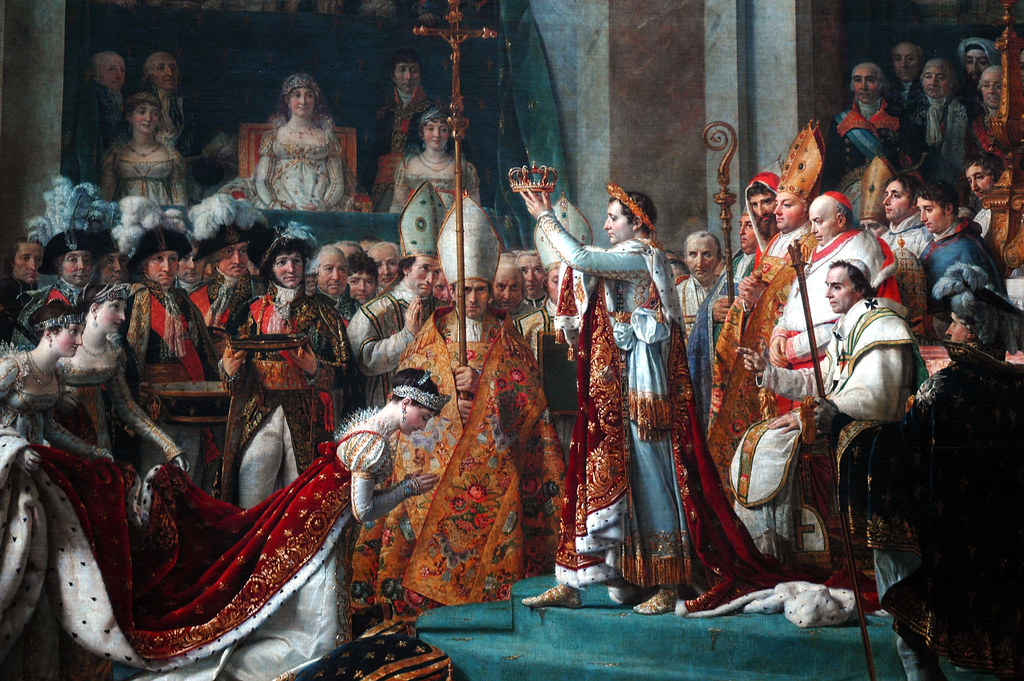
Featured image credit: “Napoleon Crowning Josephine” by caribb is licensed under CC BY-NC-ND 2.0.
 Retrospect Journal