
Written by Meenakshi Nirmalan
Hugo Chávez’s presidential career started off promisingly. He was a typical caudillo, loosely translated as “strongman”, which was typical of political figures in twentieth century Latin America. When Chávez was elected into power in 1998, he intended to utilise Venezuela’s oil reserves to diminish poverty and increase equality across the country. Chávez appealed to the public with false promises of prosperity and with the illusion of easy money. His appeal was in line with populist trends prevalent throughout the century. Unfortunately, due to the economy’s extreme dependence on oil, combined with political and economic mismanagement, Chávez’s vision for Venezuela was short-lived.
During the oil boom of the 1970s, Carlos Andrés Pérez, an earlier president of Venezuela, implemented reforms, ensuring the nationalisation of the oil industry. However, as global oil prices sunk in the 1980s, Venezuela’s economy suffered, and inflation rose. In response, a series of protests, lootings and riots broke out, starting in Guarenas and eventually reaching Caracas, worsening in magnitude. Starting on 27 February 1989, this period of turmoil was named the Caracazo. The people of Venezuela were disillusioned with Pérez. In February 1992, Chávez planned a coup d’etat directed against the government but was unable to complete it successfully. However, this did thrust Chávez into the national spotlight. He delivered a speech broadcasted nationally, urging his fellow supporters to withdraw from the operation. Chávez famously asserted that his plans for the coup d’etat had not been realised, “por ahora” (for now). These words were impactful, as he simultaneously admitted responsibility whilst displaying glimmers of hope for future endeavours. The public found him refreshing, as it was rare to see political or military figures take accountability for their decisions. Chávez was eventually elected in 1998 after founding the political party Movimiento Bolivariano Revolucionario-200.
Shortly after coming into office, an election was held for members of the National Assembly, and an overwhelming majority of the seats went to Chavistas. Furthermore, he decided to replace Venezuela’s 1961 charter with a new one, marking the Chávez era. Chávez announced his plans for the country, which is known as his Bolivarian Revolution, named after the liberator of Latin America, Simón Bolívar. Chávez even changed the country’s name from The Republic of Venezuela to the Bolivarian Republic of Venezuela, further aligning with the spirit of Bolívar. With his charisma, Chávez highlighted the focus of revolution in his presidency, as in the decades prior to his election, Venezuela’s economy swung between the extremes of highs and lows, and the people were tired of uncertainty.
The first real test of his presidency was the Vargas Tragedy. On 15 December 1999, the state of Vargas was hit by days of torrential rain and thunderstorms, causing landslides that destroyed homes located on the face of the mountains. Thousands were left homeless, and it was evident that it would take many months and a substantial amount of money to rebuild homes for people displaced. The Clinton administration offered aid, which Chávez rejected, as Fidel Castro advised against accepting aid from the United States despite the damage caused by the tragedy. This marked the start of a strained relationship between the United States and Venezuela, and Chávez’s vocalness about his anti-American sentiments only increased throughout his presidency. Moreover, the interior minister, Jesse Chacón, revealed plans to build twelve thousand and seven hundred homes. However, this project was never fully realised, and numerous people were still left homeless, far into and throughout the 2000s, demonstrating that Chávez’s promises to reduce disparity were simply an illusion.
In addition, the government was consistently too reliant on its oil reserves as the primary pillar of the economy and consequently, Venezuela was vulnerable to what economists call “Dutch disease”. The term refers to the paradoxical effects that occurs when a boom in a natural resource has the potential to cause detriment to a country’s economy. A boom in a resource, such as oil, leads to a larger influx of foreign capital. As a result, the value of the country’s currency increases, and it becomes comparatively cheaper to export goods than to make them domestically. For example, it would have been cheaper to import Brazilian or Argentinian beef, than for Venezuela to produce it domestically. Over time, this took away from labour in a variety of Venezuelan non-oil related sectors, such as manufacturing and agriculture, which would have been important to the country’s growth. The economy was not diverse enough, as oil became the sole export, contributing to unemployment. This, combined with the fluctuating prices of oil, meant that economic collapse was likely to occur.
As the people grew unrestful, many PDVSA (Petróleos de Venezuela SA) workers decided to strike in 2002, hoping that Chávez would leave office. Prior to the production strike, Venezuela exported 2.8 million barrels of oil per day, and this activity stopped, significantly damaging the GDP (Gross Domestic Product). In response to the strikes, Chávez fired around nineteen thousand experienced PDVSA workers, replacing them with Chavistas. This decision only accelerated the country’s economic mismanagement and corruption, as the newly appointed individuals did not have the correct background knowledge to make effective decisions relating to oil, which was especially crucial, given that it was the country’s main export. This led to tremendous after-effects, including the vast fluctuation of the bolívar against the US dollar.
It is clear that Chávez’s first two terms in office were marked by mismanagement and unfulfilled promises, leading to economic instability. This only paved the way for the turbulence that followed in his later presidential terms, progressively worsening after Chávez’s appointment of his successor, Nicolas Maduro.
Bibliography
Amelia Cheatham, D. R. a. R. L., 2023. Council of Foreign Relations. [Online]
Available at: https://www.cfr.org/timeline/venezuelas-chavez-era
[Accessed 23 Nov 2023].
C.W, 2014. The Economist. [Online]
Available at: https://www.economist.com/the-economist-explains/2014/11/05/what-dutch-disease-is-and-why-its-bad
[Accessed 23 Nov 2023].
Cheatham, R. L., 2023. Venezuela: The Rise and Fall of a Petrostate. [Online]
Available at: https://www.cfr.org/backgrounder/venezuela-crisis
[Accessed 23 Nov 2023].
Grant, W., 2021. Populista!. London: Head Zeus.
Johnson, K., 2018. Foreign Policy. [Online]
Available at: https://foreignpolicy.com/2018/07/16/how-venezuela-struck-it-poor-oil-energy-chavez/
[Accessed 23 Nov 2023].
Rapier, R., 2017. Forbes. [Online]
Available at: https://www.forbes.com/sites/rrapier/2017/05/07/how-venezuela-ruined-its-oil-industry/
[Accessed 23 Nov 2023].
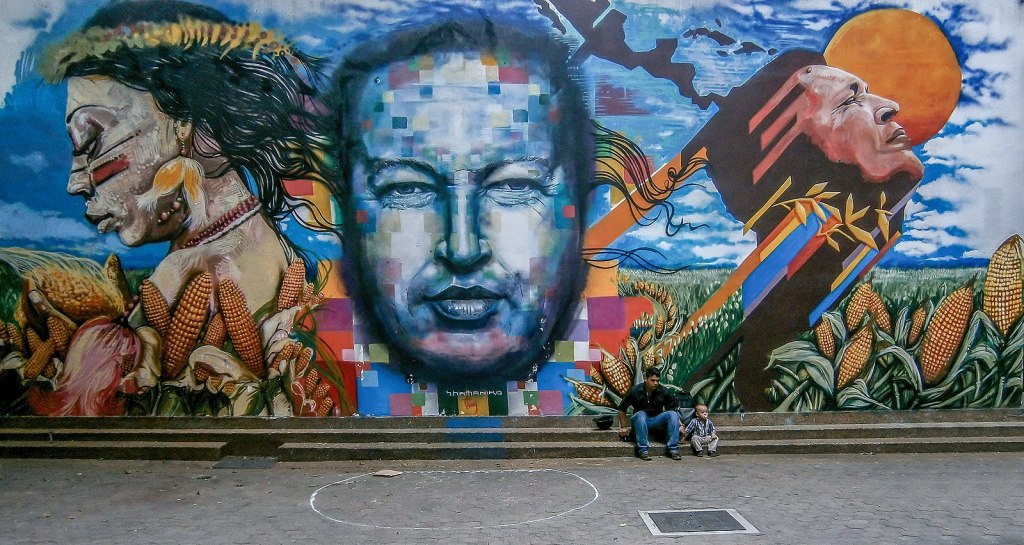
Featured Image Credit: Wilfredor, Español: Mural de Chavez y Su Asunción al Cielo, March 30, 2014, March 30, 2014, Own work, https://commons.wikimedia.org/wiki/File:Mural_de_Chavez_y_su_Asunci%C3%B3n_al_cielo.jpg.
 Retrospect Journal
