
By Kate Jensen
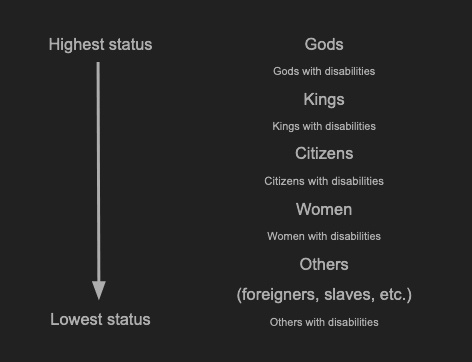
Taking a very broad overview of literature written in and about Ancient Greece, one of the most striking elements of the society’s social structure is its hierarchical nature. Going from highest to lowest in this hierarchy, there are categories like gods, kings, citizens, women, and others—including foreigners, slaves, and any other people who would not fit within the higher echelons. These categories defined nearly every aspect of life at the time, with each group having distinct norms, expectations, and experiences.
In all hierarchical systems, those at the top of the pyramid had infinitely more opportunities and social agency available to them. However, even within a single social category, there is no guarantee of equality. Other factors—like age, race, nationality, and ability—continue to impact the experiences of people at each level.
Today, one relatively recent movement to address the social inequalities experienced by people with disabilities in particular is the disability rights movement, which began in the nineteenth century. In addition to huge advancements in securing legal protections for people with disabilities, this movement presented a new model of understanding what disability is. The “social model of disability” asserts that disability is a social category that serves to isolate people from society.
Though this is a modern model of understanding, it is a useful conceptual tool that can be applied to other time periods—like Ancient Greece. In the following sections, I will evaluate the way that disability, as a social category, affected individuals of different groups within the social hierarchy of Ancient Greece, using examples from three disparate groups to illustrate the extent of these effects.
Gods
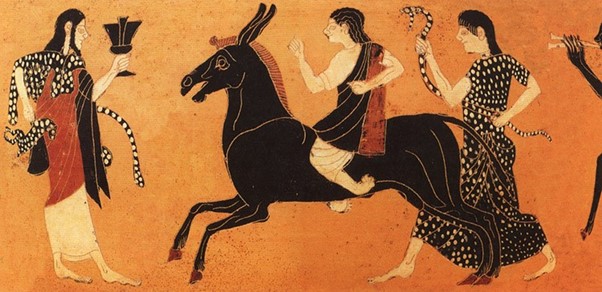
Hephaestus’ disability defines his difference from the other gods of Olympus. He is described as “lame” or “limping” [Ἀμφιγύεις], “club-footed” [Κυλλοποδίων], and “misshapen” [ἠπεδανός], among other descriptors. Although some of these words, in context, are merely used as physical descriptions of the god, others are used derisively — as in this description by Hera.
“…my son has turned out a weakling among the gods, Hephaestus of the withered legs, whom I myself bore. I picked him up and threw him in the broad sea, but Nereus’ daughter, Thetis silverfoot, took him in and looked after him together with her sisters; I wish she had done the gods some different service.” – Hymn to Delian Apollo, ll. 311-320
We also see some derision leveled toward Hephaestus in this scene from book 1 of The Iliad.
“Then he poured wine for all the other gods from left to right, drawing sweet nectar from the bowl. And unquenchable laughter arose among the blessed gods, as they saw Hephaestus puffing through the palace.” – Iliad ll. 1.570ff.
This scene from The Iliad is significant to the study of Hephaestus and is the origin of the expression “Homeric Laughter.” It shows the clumsy Hephaestus taking on the role of drink-bearer — usually a role taken on by attractive, young, able-bodied mortals — as a form of comic relief after a tense conversation amongst the gods. Regardless of whether this comedy was intentional, on Hephaestus’ part, it relegates him to the state of the Other, lying outside the norm and, therefore, at a lower social status.
Citizens
Many impairments that have been largely eliminated by modern medicine were very common in the ancient world. However, this does not necessarily mean that society was more accepting toward them. In her book, Prosthetics and Assistive Technology in Ancient Greece and Rome, Jane Draycott noted that “An individual who lost a body part was considered mutilated (kolobos in Greek, colobos in Latin) and thus curtailed and incomplete.”
Supporting this, some literary sources suggest that disability was thought of as a reason for a person to be excluded from normal societal functions, such as this passage from Menander’s Dyscolus in which Sikon, a cook, wishes harm about Knemon, a “cantankerous” old farmer in the story.
Sikon (about Knemon): “Start pouring out an offering, girls, but change the prayer to this: ‘May the old man be rescued, as a cripple with mutilated legs!’ That way he won’t be able to annoy the god, his neighbor, or bother those who sacrifice. If I get hired again to cook, I’ll want him out of action” – Menander, Dyscolus, ll. 559-665
Even in philosophical texts about law and administration, the assumption that people with disabilities — even if they are productive citizens — are at lower social status is apparent, as in this text from Plato’s Laws, which suggests that people would prefer “any other alternative” to marrying a person with a physical or mental disability.
“[The proposed law] appears to overlook the thousands of impediments which in human life prevent men from being willing to obey such orders and cause them to prefer any other alternative, however painful, in cases where either of the parties ordered to marry is suffering from diseases or defects of mind or body.” – Plato, Laws, 925 D-E
Women
Like all people in the ancient world, women were judged according to their proximity to an imagined ideal. This is well demonstrated by the example Lennard J. Davis gives in his 2013 essay Normality, Power, and Culture. Davis recounts a story from Pliny, wherein he describes the Greek artist Zeuxis taking individual ideal features from different women to craft a sculpture of the ideal Aphrodite. He requires so many models because no singular woman had all the ideal features he was searching for.
For women in Ancient Greece, this inaccessible ideal posed an additional problem. Women’s social value was determined largely by marriageability, something that disability or other departures from the “ideal” could jeopardize. This is shown in a passage of Herodotus describing marriage rituals.
“Rich men of Assyria who desired to marry would outbid each other for the fairest … for when the crier had sold all the comeliest, he would put up her that was least beautiful, or crippled, and offer her to whosoever would take her to wife for the least sum, till she fell to him who promised to accept least; the money came from the sale of the comely damsels, and so they paid the dowry of the ill-favoured and the cripples.” – Herodotus, Histories, ll. 1.196.1ff.
Although Herodotus claims this practice to be an observation of the Babylonian people, several scholars have suggested that it is more reflective of a Greek custom of the time, making it a relevant glimpse into women’s status in Ancient Greece. This same practice is seen again later in Herodotus with an account of Amphion’s daughter Labda.
“Now Amphion, one of these men, had a lame daughter, whose name was Labda. Seeing that none of the Bacchiadae would marry her, she was wedded to Eetion son of Echecrates, of the township of Petra, a Lapith by lineage, of the posterity of Caeneus.” – Herodotus, Histories, ll. 5.92B ff.
These practices constitute a literal devaluation of women based only on their physical impairments. This is something that is echoed—albeit in a less literal way—at each social level of Ancient Greek society.
Disability as a universal social detriment
Although these three categories do not encapsulate the whole of Ancient Greek society, taking these examples together, a common view of disability emerges. While the social hierarchy in Ancient Greece was quite structured, this did not preclude variability in individuals’ status within each level. Instead, disability functioned as somewhat of a universal social detriment in Ancient Greece, placing people with disabilities a step below their peers on the hierarchy.
Suggesting a more complete view of the social hierarchy within Ancient Greece, I would argue that a hierarchy that acknowledges the disadvantages that people with disabilities faced may have looked like this:
Bibliography
Bell, RH. “Homer’s Humor: Laughter in the Iliad.” Humanitas, vol. XX, no. 1-2, 2007, pp. 96–116.
Christiensen, Joel. “Beautiful Bodies, Beautiful Minds: Some Applications of Disability Studies to Homer.” Classical World, 2021.
Davis, Lennard J. “Normality, Power, and Culture.” The Disability Studies Reader, by Lennard J Davis, 4th ed., New York, NY, Routledge, 2013.
—. “The End of Identity Politics: On Disability as an Unstable Category.” The Disability Studies Reader, by Lennard J Davis, New York, NY, Routledge, 2013.
Draycott, Jane. Prosthetics and Assistive Technology in Ancient Greece and Rome. Cambridge, Cambridge University Press, 2022.
Herodotus, and Simon Hornblower. Herodotus, Histories. Book 5. Cambridge ; New York, Cambridge University Press, 2013.
Herodotus, and J H Sleeman. Herodotus. Book I. Bristol, Bristol Classical, 2002.
Homer, and A T Murray. The Iliad. London, W. Heinemann, -71, 1967.
Menander. The Dyskolos. Plume, 1984.
Michael David Chappell. A Commentary on the Homeric Hymn to Delian Apollo, with Prolegomena. 1995.
Plato. Plato: Laws. 1926.
Small, David B. Ancient Greece : Social Structure and Evolution. Cambridge, United Kingdom ; New York, Ny, Cambridge University Press, 2019.
Union of the Physically Impaired Against Segregation, and Disability Alliance. Fundamental Principles of Disability. 1976.
Willcock, Malcolm M. A Companion to the Iliad. University of Chicago Press, 1976.
Image credit: Dionysus and Hephaestus riding donkey, Caeretan black-figure hydria c. 6th B.C., Kunsthistorisches Museum
 Retrospect Journal