
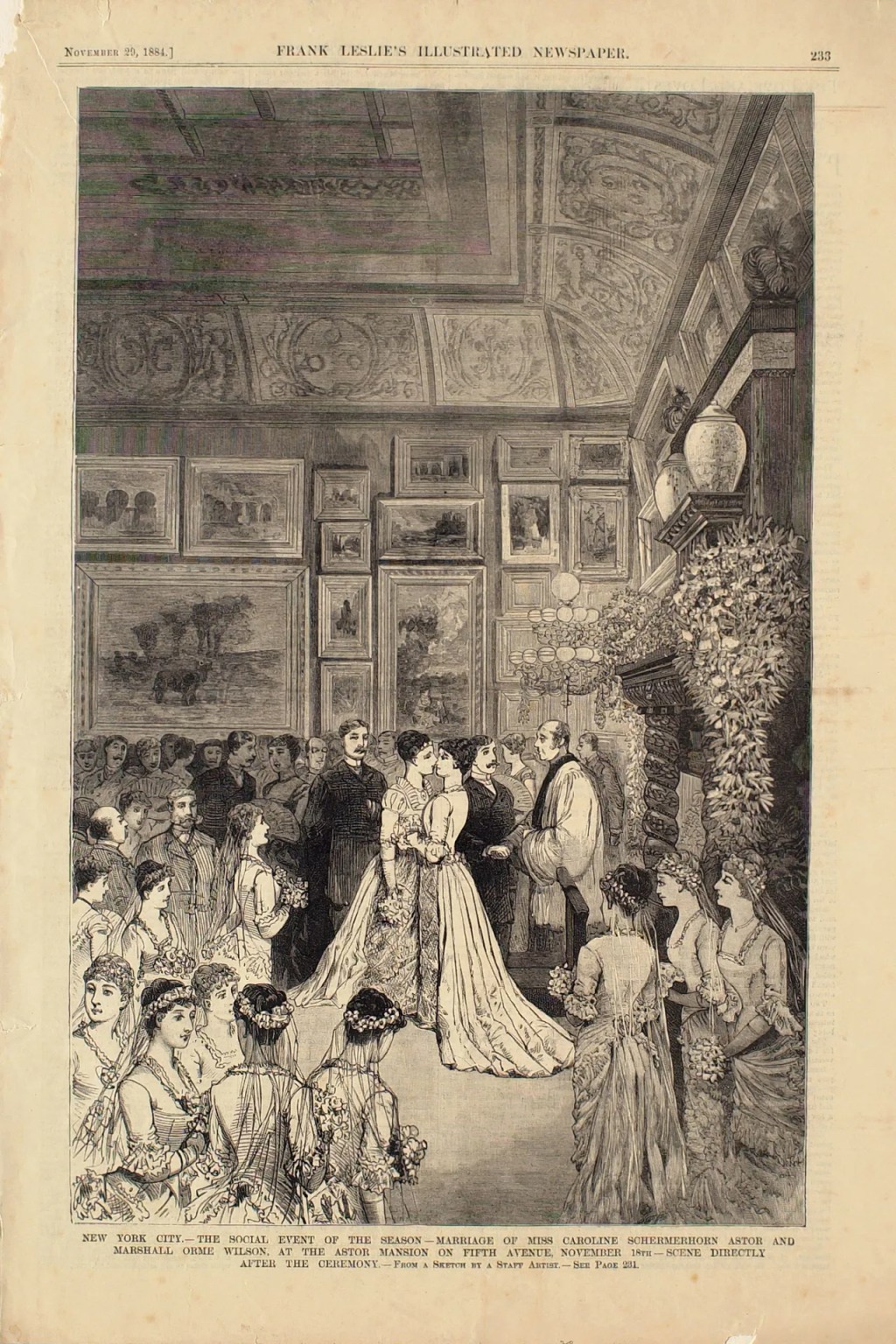
Written by Harry Fry
26/11/2023
Introduction
“There are only about four hundred people in the fashionable New York Society” is the repeatedly cited New York Times sentiment used to exemplify the nature of ‘The Four Hundred’ – a list of key aristocrats in high society during the Gilded Age. This line-up and the events that materialised it, led by Caroline Astor, conveyed who were the dominant authorities of New York aristocracy. All elite figures sought invitation to this societal structure, yet for those even slightly outside the most established families, this was unimaginable. Resultantly, ‘The Four Hundred’ ran laterally to the conditions and boundaries of high society. This investigation’s title covers a debate which will be answered through the use of popular culture representations and contemporary reports on ‘The Four Hundred’. It proposes to what extent this structure and therefore the World around it progressed, granting new actors a place in a traditionally segregated network. Further, if this league in New York high society represents its individuals as covertly perceptive or stereotypically hollow.
‘Let me explain, don’t you know’ – Gossip, Factions, and Exclusivity.
The above quote was spoken by a leading Gilded Age executive, Ward Mc Allister, who acted collaboratively with Mrs Astor in guiding high society politics. The tone of voice exemplifies their World as segregated and condescending to outsiders. What occurred inside the ballrooms’ that hosted ‘The Four Hundred’ each season is rarely scrutinised at a micro level. Although high society ought to be evaluated beneath its surface image – a theme which will be discussed in the final section –its artificial and competitive environment alone is significant.
Firstly, Mrs Astor’s list was publicised, informing all whom was a confirmed member of New York’s most elite, and who did not quite make it. Any alterations would carry meaning: to be thrown out of the list regularly meant a public scandal had occurred, and to be awarded a place officiated a new faction’s rise into the limelight. Gossip played a key role, mostly in removing those who had become controversial, financially unstable or irrelevant; the last two often as individuals aged. However, was there such a thing as good and bad gossip, or was all damning?
The concept of factions within high society is important, as competition between them crafted the dynamics around ‘The Four Hundred’ society. Matriarchs frequently led these social battles, yet their judgement and criticism towards other women – through making appearances and money the core of their interests – represents their shallowness and inauthenticity. Much alike to global aristocratic standards, one insubstantial error could ruin a family’s societal power. Further, the use of calling cards by dominant female authorities to elevate less influential women suggests an exclusive society, but for no productive reason. It can be argued that the Four Hundred actors’ sense of superiority is merely due to their capacity to be domineering.
To conclude, while societal gossip in the Gilded Age could in theory position a budding aristocrat favourably, the intense atmosphere exemplified through The Four Hundred’s structure, for mainly a popularity contest, illustrates heavy superficial undertones prevailing during the Gilded Age; following popular belief.
‘If you go outside that number…’ – White-Collar Reduction, Wealthy Diaspora, and Female Agency.
The nature of ‘The Four Hundred’ encompasses older established families separating from the newer actors in New York high society. An argument can be made to question the unmovable politics of these families, and if they became indirectly, or even directly, more inclusive.
Concerning the origin of financial prosperity, oil, steel and railroad-based employment was normalised as a respected journey to wealth. However, being in high society meant appreciating more unique forms of entertainment, notably classical music and broad forms of artwork. This meant that those without seemingly legitimate influences could begin to weave themselves into this societal structure, as ballroom events would typically require background performers. Although, at the most this positioned artists and musicians as secondary members of the institution and subordinate to the true participants of ‘The Four Hundred’. This resultantly makes evaluations go against the idea of elites becoming more progressive.
But what about in the context of different forms of the established wealthy in New York? This initiates discussion on two segments of this society: newcomers and diasporic individuals, which separately raises a question on whether high society had elitist ideology or simultaneously xenophobic mentalities. In short, if your ancestors migrated to the United States later than the eighteenth century and made wealth through an esteemed profession, entrance into the highest segment of society was a possibility. Being without these requirements would not give you a place, even if a family possessed equal or greater wealth, and behaved identically. This segregated aristocratic policy was narrowed further for migrants who brought wealth from across the World. The Gilded Age ushered in very few black aristocrats and virtually no racial minorities who immigrated from Asia, contrary to the high levels of Chinese migration. That being said, there were exceptionally irregular cases of non-white families gaining vast wealth and only a slim number of black Americans who did.
Regardless, “The Four Hundred” did centralise female aristocrats, importantly its leader, Mrs Astor. Her female successors, along with secondary actors who led this structure all exemplify personal agency for women inside New York high society. Equally though, this was intensely contained within families who had the status and stability to assert power. There are notable examples of women who went against this: Alva Vanderbilt pushed through the boundaries of her nouveau riche status and challenged Mrs Astor’s role as the sole host of the aristocracy through organising larger events. As a result, a calling card was brought to Alva’s home and her place within ‘true’ high society was confirmed. Whilst this proves the ability for those on the edge of ‘The Four Hundred’ to gain a place utilising the correct skills, numerous families with equal affluence and status – the Rockefellers, Carnegies and Vanderbilts – struggled to enter the most inner tier of societal respect and were unincluded in this institution. Despite this fact, personal female agency remained a consistent reality for many throughout the Gilded Age, as women continued to figurehead ‘The Four Hundred’.
‘And he felt himself oppressed by this creation of factitious purity, so cunningly manufactured’ – Superficial or Cunning Omniscience?
The world of ‘The Four Hundred’ emphasises more of an unmovable social structure over a progressive one, yet through what ways can the individuals within it be portrayed? Given these socialites craft an inhospitable environment, they are understandably perceived widely as exclusive and shallow. Despite these sentiments, historians can be equally narrow through portraying their mentalities in solely these ways. Popular culture has characterised New York aristocracy as rooted in gossip, excessive wealth and consumption, as well as often a lack of tangible productivity. These individuals, particularly women, are conveyed as merely forming social rivalries and conflict out of nothing else to do. However, ‘The Four Hundred’ provides an effective moment to challenge these premises, and truly centralise the mindsets of female aristocrats in the Gilded Age.
Historical cinema and fiction have taken on new considerations in its presentation of Gilded Age socialites, bringing into question the reality of this World beneath the surface layer. The quote which titles this final section is taken from Edith Wharton’s The Age of Innocence, which is an example of authors commenting on their lives under the Gilded Age. These writers frequently challenge the outward image of New York high society, implying that there was more complexity to its structures. To have established a precisely restrictive societal organisation contained within all of high society was not out of a lack of intelligence and pointless competing, but crafted a World contained exactly within their rigid standards. Ultimately, Mrs Astor and her successors were mostly victorious at excluding who they wished and at including the most ‘relevant’ families. This elite-oriented lifestyle cannot be disputed, yet there appears to be more to this institution than merely innocent plotting. Each event appeared to scrutinise all the participants from every angle, and cautiously observed even the smallest mistake from any individual. The Four Hundred’s orchestrators were more calculated and sophisticated than what is regularly depicted on the surface.
Conclusion
The Gilded Age marks a stagnation in aristocratic mindsets, where only those who navigated flawlessly around high society claimed the principal accolade of their name on ‘The Four Hundred’. Nevertheless, this was a thoughtfully constructed societal structure, where one mistake could throw an individual out of consideration and away from the rewards that true aristocratic power commanded.
Bibliography
Burrows, E, and Wallace, M, (1998), Gotham: A History of New York City to 1898, Oxford University Press.
History Extra, (2022), Mrs Astor and the Four Hundred, accessed through https://www.historyextra.com/period/victorian/mrs-astor-who-four-hundred-new-york-society-list-ward-mcallister-gilded-age/#, date accessed November 2023.
History Extra, (2023), The War of the Operas: new money vs old in The Gilded Age, accessed through https://www.historyextra.com/period/victorian/war-of-the-operas-gilded-age/#, date accessed November 2023.
MacColl, G, and McD. Wallace, C, (2012), To Marry an English Lord: Tales of Wealth and Marriage, Sex and Snobbery in the Gilded Age, Working Publishing Company.
Tatler, (2022), ‘The Four Hundred’: Tatler looks back at one of the most famous parties of the era, accessed through https://www.tatler.com/article/what-was-mrs-astor-four-hundred-party-gilded-age, date accessed November 2023.
Theodore Roosevelt Centre at Dickinson State University, (2020), Roosevelt and the ‘Four Hundred’, accessed through https://www.Theodorerooseveltcenter.org/Blog/Item/Roosevelt%20and%20the%20%22Four%20Hundred%22, date accessed November 2023.
The New York Times, (1892), The Only Four Hundred: Ward M’ Allister Gives Out The Official List, The New York Times.
Wharton, E, (1920), The Age of Innocence, D. Appleton and Company.
 Retrospect Journal