
Written by Emilio Luppino
Between 1821 and 1904, approximately 1.8 million Italians migrated to the United States. From 1904 to 1920, an additional two million Italians arrived. Considered uneducated, uncultured, and lacking in skills to assimilate into American society, they were often seen as unable to adjust to American institutions, potentially engaging with criminal groups and carrying unfavourable values.
Fuelled by the aspiration for personal growth and the desire to support their families back home, seeking improved economic prospects and a better quality of life, these hopes seemed distant once reports about a transformation in the Italian situation began to emerge from overseas.
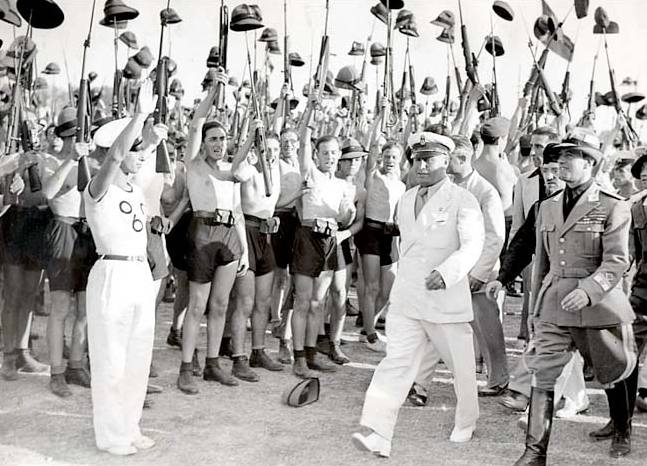
In the afternoon of 30 October 1922, Mussolini established his ‘national government’ while situated at the Hotel Savoia in Rome. By autumn, the Fascists had gained control over the majority of the country north of Rome. They wielded influence over local governance, collected unofficial taxes, and their syndicates held sway over the labour market.
However, to solidify their authority and make it official, the March on Rome emerged as the most effective display of power. Flags, exultations, joy screams, Blackshirts coming from all over Fascist headquarters toward the capital, while the train Mussolini was travelling on had to keep stopping to allow him to address the cheering crowds. A new era came, an era that would have been characterised by the Italian revenge against its enemies.
From his initial day in office, the Duce was deeply troubled by Italy’s status and its lack of prominence in international politics. Obsessed with this concern, upon assuming the prime minister’s office, he also assumed control of the Ministry of Foreign Relations. His objective was to project an image of reliable authority. It all began with the Locarno Pact, through which Italy aimed to position itself as a significant player in European political affairs. The Pact was swiftly welcomed by the United States as it promised favourable news for their economic and trade ties with the continent.
In the meantime, the circulation of news and propaganda started affecting Italian communities in United States and all those who emigrated.
Mussolini seemed to be revitalizing Italy and evoking the grandeur of ancient Rome, which instilled a renewed sense of pride and self-respect among Italian-Americans. He was believed to have empowered four million Italians in America to regain their dignity, earning him the moniker, “Doctor Dictator.”
For years, Italians faced marginalization and exclusion in the American environment, which became fertile ground for Fascist beliefs. Migrants found themselves torn between two worlds, holding onto their sentimental ties to the old motherland while embracing the promises of the new. This cultural ambivalence was a recurring theme in various Italian publications, reflecting the sentiment that while their bodies had migrated, their souls remained firmly rooted in Italy.
And the victim complex of Fascist rhetoric knew it.
When on 30 May 1927, two of fourteen Blackshirts who went out in the Bronx to take part in the Memorial Day parade were killed by anti-Fascists, the Italian government immediately took care of the case transforming the two Fascists in two martyrs.
Over fifty thousand individuals, among them the Italian ambassador De Martino from Washington D.C., the Italian consul, and representatives of the fasci, attended the funeral. The National Fascist Party’s newspaper swiftly employed imperialistic rhetoric, urging the return of these “glorious bodies” to the “Fascist homeland” emphasising that, “Fascism does not desire its martyrs to rest in foreign lands, condemned to solitude.”
Italian sympathisers of Fascism found relief later on with American economic crisis during the 1930s. Mussolini contended that the American system’s failure stemmed from the mechanization of production outpacing consumer capacity. Meanwhile, the editors of Il Progresso Italo-Americano, an Italian-language New York newspaper, minimized Italy’s poverty. Pre-crisis, Italy’s economic weakness fomented stereotypes about Italian immigrants as an underclass. Now, they portrayed Italy’s simple life as a model. They argued that Italy survived the depression due to Italians being uncorrupted by materialism, untouched by “American standard,” crediting this to the Fascist revolution.
Yet Mussolini’s ambition extended beyond reinstating Italy as a global power; he aimed to persuade immigrants to return and bolster the “savings of Italians abroad.” According to him, this would have augmented the workforce and military personnel. To encourage this, the Fascist government enacted laws offering financial incentives to those who chose to return, aiming to stimulate a new migration flow toward Italy.
The final showcase of “Italian glory” culminated in Fascist leader Italo Balbo’s flight to Chicago alongside his “Italian Air Armada.” Upon arrival, Balbo and his entourage engaged in an extensive schedule of visits, banquets, parties and speeches. Loyola University in Chicago conferred an honorary degree upon him, and the city honoured him with the “Balbo Avenue”. Additionally, a Columbus monument funded by the Italian American community was unveiled while Balbo was being invited to lunch by President Franklin Roosevelt.
Some Italian newspapers tried to justify or support the Fascist government’s racial measures by claiming that Il Duce—Fascists’ name for Mussolini, meaning ‘the leader’—aimed to safeguard the “Italian race” by preventing racial mixing in a nation that had recently acquired an empire in Africa. They asserted that the regime intended to set up a “separate but equal” system for Italian Jews. Fascist Foreign Minister Galeazzo Ciano specifically instructed Italian diplomats to downplay Fascist antisemitism to avoid worsening Italy’s international relations.
Even Il Corriere del Popolo, the San Francisco-based radical weekly and main anti-Fascist Italian-language publication on the West Coast, took a clear stance. While calling Il Duce’s policy “nonsense,” the paper also noted that, until then, Fascism’s racial policy had been limited to principles without the mass persecutions seen in Germany and Austria, questioning why there was so much uproar.
However, these sentiments drastically shifted following Italy’s declaration of war on the United States. As antisemitism escalated in Italy after Pearl Harbor, Italian Americans swiftly put aside their conflicts with American Jews to rally behind their adoptive nation’s war efforts against the Axis powers.
The shift was profound. Italian Americans, grateful to America for its freedoms, prosperity, and opportunities, unhesitatingly supported their country in its time of need. Yet, reaffirming loyalty to America didn’t necessarily mean abandoning their Italian heritage. Both Italians and Americans could now acknowledge that Benito Mussolini was the true betrayer of Italy. Some ardent pro-Fascists were detained by government authorities and sent to internment camps, while others chose to symbolically renounce their Fascist affiliations by burning their membership cards.
For them, patriotism did not coincide with a blind love for motherland, but with the valorisation of it.
The declaration of war to United States was only sign of a government ungrateful, a state that was neglecting its own citizens.
A state that, once again, was embodying the reasons why they emigrated.
Bibliography
Bertellini, Giorgio. “Duce/Divo: Masculinity, Racial Identity, and Politics among Italian Americans in 1920s New York City.” Journal of Urban History 31, no. 5 (2005): 685–726.
Cannistraro, Philip V., and Gianfausto Rosoli. “Fascist Emigration Policy in the 1920s: An Interpretive Framework.” The International Migration Review 13, no. 4 (1979): 673–92. https://doi.org/10.2307/2545181.
Clark, Martin. Mussolini. First edition. Boca Raton, FL: Routledge, 2014.
De LUCIA, FRANCESCA. “The Impact of Fascism and World War II on Italian-American Communities.” Italian Americana 26, no. 1 (2008): 83–95. http://www.jstor.org/stable/41353771.
Diggins, John Patrick. “Italian-Americans and Mussolini’s Italy.” In Mussolini and Fascism: The View from America, 77–110. Princeton: Princeton University Press, 2015.
Hull, Katy. The Machine Has a Soul: American Sympathy with Italian Fascism. 1st ed. Vol. 41. United States: Princeton University Press, 2021.
King, Amy. “The Battle for Influence: Commemoration of Transnational Martyrs in the Italian Diaspora of the U.S. under Fascism.” Memory Studies 16, no. 4 (2023): 740–755.
Luconi, S. “The Response of Italian Americans to Fascist Antisemitism.” Patterns of Prejudice 35, no. 3 (2001): 3–23.
Segrè, Claudio G. Italo Balbo: A Fascist Life. Reprint 2019. Berkeley, CA: University of California Press, 1987.
Spitzer, Yannay, and Ariell Zimran. “Migrant Self-Selection: Anthropometric Evidence from the Mass Migration of Italians to the United States, 1907–1925.” Journal of Development Economics 134 (2018): 226–247.
 Retrospect Journal