
Written by Karen Buecking
What is a meme? For many internet users (the so-called ‘chronically online’), they are so ubiquitous that it is a difficult question to answer. For the uninitiated, like older relatives, I usually go with some variation of ‘funny pictures on the internet,’ but that really does not get to the bottom of why memes are so captivating and important to younger generations. Modern day memes serve as a digital lingua franca, uniting almost all internet users with their ability to communicate information, emotion, and political ideology. Memes, with each in-group, subculture, and platform have their own different dialects. Unfortunately, internet memes have been the subject of relatively little academic study, probably because of their newness and their perceived triviality. So, if we want to get to the bottom of what memes are, how they work, and what they can do, we will have to look a little further afield.
Though they can take a lot of forms, internet memes are usually images, so it may be helpful to look at them through the lens of art. Because there are so many distinct types of memes, it is impossible to compare all of them to just one artistic movement. For now, I want to focus on the particular type of meme dubbed ‘surrealist memes’ by internet compendium knowyourmeme.com. The name of this category probably gives you some idea of where I’m going with this, but I am going to be more specific. The absurd and abstract nature of some of these memes is reminiscent of Dada, an early twentieth-century precursor to the main Surrealist movement. Learning more about Dada can help us better understand what these memes do and why we find them funny – and what deeper messages they may be hiding under the surface.
What is Dada?
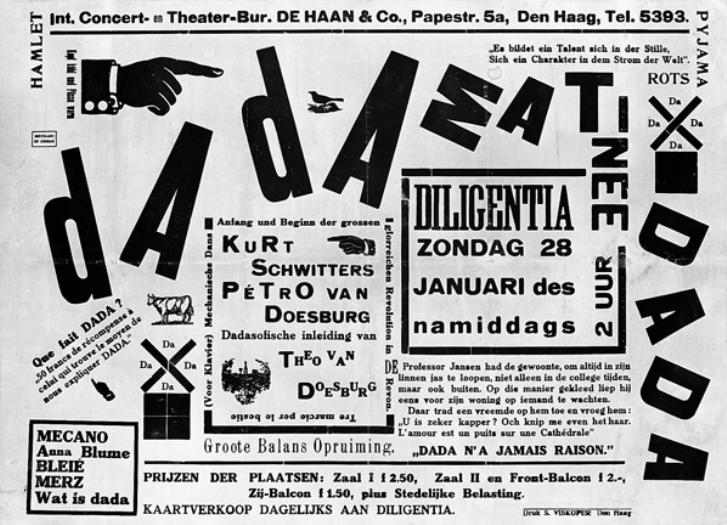
Unfortunately for us, Dada is difficult to define. This can be partially attributed to Dadaists’ own opposition to provide a definition for their own movement. In his Dada Manifesto 1918, Tristan Tzara says only that “DADA DOES NOT MEAN ANYTHING.” Dada was short-lived and decentralized, consisting of countless artists working in disparate mediums, united only by the concepts of “spontaneity, negation, and … absurdity.” Yet, despite the chaos of its exterior, Dada’s tactics reflect its underlying revolutionary politics.
Dada was established in Switzerland in 1915, surrounded by the destruction of the First World War. For many, the war was a microcosm of all the issues of an industrialised society. Ordinary citizens, whether soldiers on the front or labourers at home, died en masse due to new weapons technology and massive food shortages. It was this environment in which countercultural movements flourished in neutral cities like Zurich, Barcelona, and New York. Artists collaborated through journals, exhibitions, and cabaret performances. Soon, the idea of Dada, an artistic movement that completely eschewed the conventions of art, began to emerge.
Dada’s influence spread as the war drew to a close, and influential centres for the group formed throughout Europe. It became more overtly political in Berlin, as artists used photomontage and sculpture to attack the post-war decay of German society. Paris Dada further expanded the movement’s scope; the performance art aspect of Zurich Dada was combined with the political radicalism of Berlin to create controversy within the Parisian art scene. Dada’s rejection of traditional artistic methods alienated it from some of its avant-garde colleagues, and infighting about the future of the movement led to its gradual dissolution by 1924.
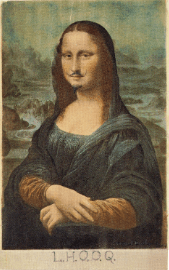
Understanding Dada’s history gives an introduction to its underlying themes, but only a cursory one. The Dadaists revelled in contradiction and inconsistency, making it difficult to parse what exactly it was that they were trying to communicate. Scholars like Leah Dickerman have suggested that Dadaists consistently used tactics such as abstraction, automation (the use of chance), contradiction, and performance to express explicit political messages.
This school of thought contests that Dada was not merely the work of artists loosely connected under a banner of rebellion and anarchy. Beneath its chaotic exterior lay a sharp critique of a world torn apart by war and the inability of traditional art to capture the experience of living in the modern age. It was both resolutely anti-war and eager to co-opt military language. Many Dadaists ironically claimed to be pro-war, as the war had been the catalyst of their movement, and the horrors of war were reflected in Dada’s rejection of order and embrace of “the flux of reality.” In short, Dada was a response to and product of the First World War, and thus inherently political. “Our cabaret is a gesture,” said Zurich Dada Hugo Ball. “Every word that is spoken and sung here says at least this one thing: that this humiliating age has not succeeded in earning our respect.”
Memes, Art, and Politics
Looking at the history of Dada can help us better see how memes could play an important role in cultural and political messaging. Dada was (and sometimes still is) seen as trivial and meaningless, not ‘real art’. But there can be value in challenging social expectations, and potent political messages can sometimes fly under the radar when they don’t come in the forms that people expect.
The political possibilities of memes have already become apparent in the rise of the alt-right, which employs the ironic humor and visual language of memes to advance their misogynist, white supremacist agenda. The weaponisation of memes for political purposes extends across the political spectrum, similar only in that they all adhere to the new culture of digital anarchy. They represent, according to Angela Nagle, the “hegemony of the culture of non-conformism, self-expression, transgression and irreverence for its own sake–an aesthetic that suits those who believe in nothing but the liberation of the individual and the id, whether they’re on the left or the right.”
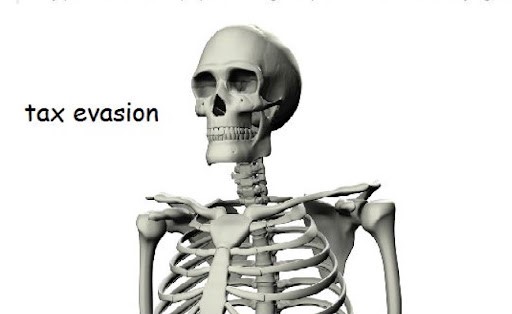
When viewed through this lens, Internet memes take on a much greater political and cultural significance than they are often credited with.
There is, however, one significant difference between Dada and the memes that sometimes resemble it. Dada was a purposeful movement that consciously featured political messages, and memes though some certainly have explicit political messages are generally more focused on personal expression. The nature of the internet means that an image created by one person to express something they were feeling about their personal life can spread quickly to thousands or even millions of people, taking on meanings it did not originally have, including a political significance. A well-known example of this, is the Pepe the Frog meme, which was taken from a freelance artist’s comic and became a symbol of the alt-right against its creators wishes. Memes may be political in a similar way to Dada, but they do not broadly seem to share its intentionality.

In its time, Dada caused quite a bit of controversy within artistic communities, eventually spurring the creation of the Surrealist movement known for artists like Salvador Dali and Pablo Picasso. However, its abstract concept meant that it had limited impact in wider society, and today is probably still best known in academic contexts. But the world has changed since the 1920s – the internet means that, for better and for worse, information and media is spread more quickly and comprehensively than ever before. Young people especially have more power in this digital landscape, as we have grown up with the internet and are more familiar with how it operates than many of our older peers. Perhaps it would be best to take a page out of the Dadaist handbook and harness the absurdity, chaos, and irreverence of meme culture in a more purposeful way, and to more deeply consider how our online footprint leaves a mark on the sociopolitical conversation.
Bibliography
Benson, Timothy O. “The Dada Text and the Landscape of War.” Dada/Surrealism 23, no. 1 (July 2020): 1–21. https://doi.org/10.17077/0084-9537.1358.
Benveniste, Alexis. “The Meaning and History of Memes.” New York Times, 26 Jan. 2022. https://www.nytimes.com/2022/01/26/crosswords/what-is-a-meme.html?searchResultPosition=1.
Dickerman, Leah. “Dada Gambits.” October 105 (2003): 3–12. https://www.jstor.org/stable/3397679.
Duchamp, Marcel. L.H.O.O.Q., 1919, drawing, height 19.7 cm, Minneapolis College of Art and Design Collection, https://www.jstor.org/stable/community.14396916.
Gale, Matthew. Dada & Surrealism. London: Phaidon Press, 1997.
Greene, Viveca S. “‘Deplorable’ Satire: Alt-Right Memes, Genocide Tweets, and Redpilling Normies.” Studies in American Humor 5, no. 1 (2019): 31–69. https://www.jstor.org/stable/10.5325/studamerhumor.5.1.0031.
Have You Been Disarranged meme, n.d.
Jones, Arthur, dir. Feels Good Man. 2020; New York City, NY: Wavelength Productions.
Judovitz, Dalia. “Marcel Duchamp: War, Trauma, and the Question of Art.” Dada/Surrealism 22, no. 1 (Oct. 2018): 1–18. https://doi.org/10.17077/0084-9537.1346.
Kristiansen, Donna M. “What Is Dada?” Educational Theatre Journal 20, no. 3 (Oct. 1968): 457–462. https://www.jstor.org/stable/3205188.
Lovink, Geert. “Memes as Strategy: European Origins and Debates.” In Sad by Design: On Platform Nihilism, 119-137. London: Pluto Press, 2019.
Pelz, William A. “Protest and Mutiny Confront Mass Slaughter: Europeans in World War I.” In A People’s History of Modern Europe, 103-114. London: Pluto Press, 2016.
Perez Alonso, Letitia. “Police, Politics, and Anti-Art: The Case of Berlin Dada.” South Atlantic Review 83, no. 3 (2018): 105–129. https://www.jstor.org/stable/90024984.
Rasula, Jed. “Can a Virgin Microbe Have a History?: The Poisonous Gift of Dada.” Dada/Surrealism 23, no. 1 (July 2020): 1–14. https://doi.org/10.17077/0084-9537.1357.
Stonks meme. Facebook, 2017.
Tumblr user deadfeline, original thread from kingcheddarxvii. Tax Evasion meme, c. 2015.
Van Doesburg, Theo. What is Dada? (Wat is Dada?), 1923, letterpress, 6 1/8 x 4 7/8” (15.6 x 12.4 cm), Museum of Modern Art, New York, Theo van Doesburg. What is Dada? (Wat is Dada?) (Information booklet). 1923 | MoMA.
Zenner, Eline, and Dirk Geeraerts. “One Does Not Simply Process Memes: Image Macros as Multimodal Constructions.” In Cultures and Traditions of Wordplay and Wordplay Research, edited by Esme Winter-Froemel and Verena Thaler, 167-194. Berlin: De Gruyter, 2018.
Featured image credit: Poster for Dada Matinée by Theo van Doesburg is in the public domain. Accessed via Wiki Commons. https://commons.wikimedia.org/wiki/File:Theo_van_Doesburg_Dadamatin%C3%A9e.jpg
 Retrospect Journal
