
Written by Jess Clark
Content warning: war, death gruesome scenes
During the latter decades of the Cold War, British media had reserved a special part of its scheduling and time towards drama, realistically and shockingly portraying nuclear war.
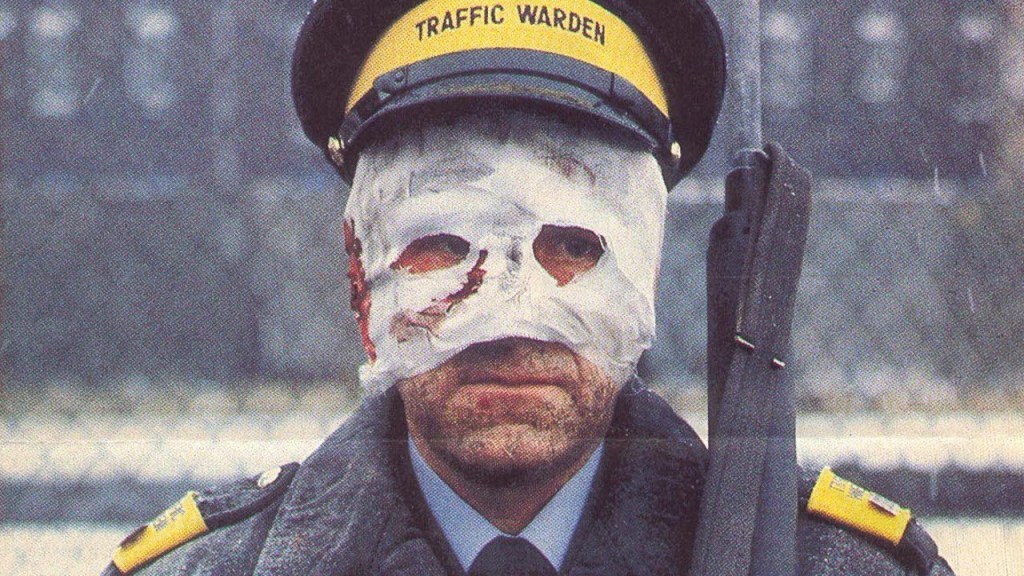
Threads—a BBC successor to the controversial 1966 programme the War Game—was released on Television in 1984 and focused on the perspective of two families from different social backgrounds in Sheffield in the build-up, and aftermath, to a nuclear war.
Threads shaped a generation through the horror and anguish that seeped through the screens, and on occasions, awoke politicians to the dangers which lay one command away.
Released in September 1984, Threads was shown on BBC 2 in a late-night slot. It followed the course of two families, the working-class Kemps and the middle class Becketts, as their adult children fell in love and began planning their lives together after Ruth fell pregnant, with Beckett’s son, Jimmy, the father.
In the background, a nuclear crisis is building between the United States and the Soviet Union. This culminates in a nuclear exchange between the two countries, with a nuclear strike over their city Sheffield leaving untold destruction behind and the decimation of these two families. One of the most harrowing parts of the film is that the members of the Beckett and Kemp families are not shown to have died on screen.
The characters simply vanish, with their deaths being heavily implied; Julie Mcdowall describes this well and as a way to show the finality of nuclear war, and the obvious fates of the characters. The film ends with Jimmy and Ruth’s daughter Jane, brought up and brutalised in the aftermath of the war, giving birth to her own stillborn child.
By the end of the film, language has broken down completely and society has reverted entirely to a mediaeval state, with regards to the low population levels, and the ways in which harvest is collected. Remnants of their old life remain, with Jane watching an old television series on a dilapidated television set.
This demonstrates to us, that although society had been completely broken, there were still some parts of their long-forgotten life that children such as Jane would never experience, but the children did not have the capacity or language to research this further. As a side point, it demonstrates to us the importance of cherishing our historical documents and our capability for education in academics, as the outcome may have been completely different.
Because there were only four channels available in the UK at the time, viewing figures were high, and Dominic Sandbrook describes a viewing for extras from Sheffield where they covered their eyes and were driven to tears due to the sheer anxiety and impact the films had, at a time when nuclear war was an ever present and realistic possibility for the public.
Julie McDowall in her Atomic Hobo podcast discusses how using local extras and unknown actors, such as Reece Dinsdale’s character Jimmy, and Karen Meagher’s character Ruth, raised the sense of realism for the audience as they were people that were difficult to identity, making it easier for the viewers to relate to them and see themselves in the roles or scenarios of the Threads characters.
McDowall also describes the horror and anxiety she felt when first watching Threads at a young age, which shows the direct impact that Threads had on all of the viewing public at the time, no matter their age.
To this day Threads lives on in the minds of those who have viewed it, due to the suffering and anxiety the film instilled in them, long after watching. After filming wrapped, actress Karen Meagher went on to become a committed Campaign for Nuclear Disarmament (CND) activist, at a time in the early to mid-1980s, when there had been a significant increase in members of the public joining CND.
Threads released against the backdrop of the Greenham Common protests, which began in 1983 at the RAF base Greenham Common, in response to American Cruise Missiles being stationed at the base.
Overall, Threads came at a time whereby the British public were overall more concerned and anxious about the inevitability of nuclear war breaking out, as discussed by the Panorama episode hosted by Jeremy Paxman in 1980.
This anxiety had led to actions being taken by the British public in order to pave the way for peace and prevent nuclear war breaking out at any point. The British public could personally witness the extreme impact that nuclear war would have on their livelihoods and society. As a result, they felt compelled to take all necessary precautions to prevent the conflict.
Bibliography
Dale, Tim. “Threads: The BBC Drama Which Affected a Generation of Viewers”, BBC News, 12 July 2023, https://www.bbc.co.uk/news/uk-england-south-yorkshire-66122775.
Dominic Sandbrook, Strange Days; Cold War Britain Documentary https://www.dailymotion.com/video/x2g2wii
Julie McDowall, Atomic Hobo Podcast (4 Minutes of Threads Series, and individual episodes on each media most relevant) https://shows.acast.com/atomichobo
McDowall, Julie. Attack Warning Red! How Britain Prepared for Nuclear War. London: Penguin, 2023.
“What Forms of Peace Activism Took Place in the UK?”, LSE. https://www.lse.ac.uk/ideas/projects/peace-security/cnd-archives/peace-activism-uk-1980s
BBC Panorama, Jeremy Paxman, If the Bomb Drops (1980) https://www.youtube.com/watch?v=rjMbapSd89Q
Threads Movie (1984) https://archive.org/details/1984-threads-remastered
Featured Image Credit: SuperSonicSam619. English: Traffic Warden from BBC TV Show Threads. November 11, 2023. Own work. https://commons.wikimedia.org/wiki/File:Threads_Traffic_Warden.jpg.
 Retrospect Journal
