
Written by Isabelle Shaw
While traditional scholarship from British historians represented the American Revolution as a barbaric uprising from uncivilised, ungrateful, and unruly subjects, views by recent historians have changed this historical image of American Rebels. New evidence is highlighted by these historians exposing the colonial repression of British soldiers to emphasise the cruel treatment of the British towards American soldiers fighting for their freedom from British rule. New arguments on the lack of British morality encompass a new historical understanding that the British aimed to quell the revolution without remorse and by any means possible.
The Baylor Massacre is a good representation to support one of these two juxtaposing portrayals. Evidence discovered by recent historians colludes nicely with recent arguments that propose the British acted with cruel violence and American Revolutionary War heroes stood up for the rights of their country.
The Baylor, or Tappan, Massacre occurred after the Battle of Monmouth when General George Washington’s troops moved along the Hudson River to the White Plains in an attempt to distract British Lt. General Henry Clinton’s regiment from raiding a Southern New Jersey patriot privateering base. After this countermovement on 22 September, Clinton was forced to send around 6,000 soldiers led by General Cornwallis to Western New Jersey in search of provisions. They were stopped by the 3rd Dragoon New York Militia Company of 60 men at Liberty Pole. In response, Colonel George Baylor moved his troops from Paramus to Haring Town, or Old Tappan.
Meanwhile, Generals Charles Grey, Charles Cornwallis, and Edward Matthew took advantage of the dispersion of troops and mobilised soldiers to provoke Washington to take arms. British soldiers swarmed the area from Brower’s Hill (Hackensack) to Fort Lee and New Bridge, Teaneck and Schraalenburgh. New Jersey loyalists supported the British, bringing them provisions. In response to this, Colonel George Baylor formed an army of 12 officers and 104 men on station in farm barns. He ordered Colonel Cooper’s New York Militia in Orange County to send 350 Whigs to collect cattle from areas surrounding the British. Consequently, Baylor’s attack was enough to provoke Cornwallis to pursue Baylor’s troops.
On 27 September, Grey mobilised a regiment of grenadiers of 1,500 British men to launch a surprise attack on Baylor’s men. The attack was hugely disproportionate as they aimed to cut off 350 men from Cooper’s army. He sent six companies of Major Charles Turner van Straubenzee’s infantry and six companies of Colonel John Maitland’s infantry aimed to attack the farmhouses that occupied Baylor’s army of 100 Virginia cavalrymen, commonly known as “Mrs Washington’s Guards.” Colonel Maitland used ruthless war tactics from the Battle of Paoli by cutting off the night patrol to surprise the New York Militia at Old Tappan. Hard-hearted Straubenzee ordered his troops to use bayonets going to numerous houses and massacring inhabitants.
Grey continued these surprise attacks in the early hours of the morning on 28 September 1778. The American troops could not defend themselves quickly enough resulting in 69 Americans wounded, killed, or captured, whereas only 11 British were killed and 4 left to die. This demolition of American troops continued the East side of the Hudson River when Cornwallis led 3,500 men to cut off 350 men of Colonel Cooper’s troops. However, British deserters Francis McCarny and George Motisher prewarned Cooper in the night, who managed to escape with his troops before the attack. Unfortunately, this information was not passed on to Baylor.
The disproportionate nature of the British army and their unfair war tactics proved that they were willing to use sheer force to not only quell the rebellion but obliterate American rebels. A contemporary account by David Griffith described the event with “no stop might be put to the rage and Barbarity of their bloodhounds.” The British myth of vicious American rebels is disproven by Griffith. In fact, contemporaries saw the British as inhumane masochists. This is supported by contemporary American newspapers that headlined the Massacre as “savage cruelty.” Historians such as Holger Hoock in his Scars of Independence argue that Americans overemphasised these war crimes to create a narrative of cruel British Forces. However, it doesn’t distract from the fact the British troops still committed serious war crimes resulting in the murder of numerous men.
The Baylor Massacre influenced later British tactics, such as the Little Egg Harbour Massacre on 4 October 1778 by Brigadier General Kazimierz Pulaski who killed 50 patriots in their sleep. This proves that the British continued to display a lack of humanity, and thus morality, during the American Revolution. Although historians use evidence of General Wayne’s night attack in New York on July 1779 as a comparison of the equality of lack of morality during the Revolution. This is not a convincing argument since contemporary evidence of the British high command praising Wayne for saving British soldiers and pleading mercy was “gentlemanly humanity.” Therefore, the American soldiers did not act in the same cut-throat manner during conflict with the British.
In conclusion, although the two British deserters showed some morality when warning Cooper of the attack saving the lives of 350 men, the fact that the British troops aimed to massacre all the men supports the argument that the British aimed to defeat the rebels by going to any length. This lack of morality by showing no remorse to soldiers and brutally killing cavalry proves that the American Revolution was immoral, during the Baylor Massacre, since the British troops repeated war crimes and murdered mass amounts of men unnecessarily. Although Wayne found his revenge, he showed humanity to the British soldiers in comparison to the British armies that brutally oppressed and murdered American cavalry. The nature of the attack at night, not in battle, exemplifies that British tactics were not fair since they exploited America’s vulnerable position showing they were willing to win the Revolutionary War despite the repercussions. It is evident that the conflict was extremely unequal since the Americans were defenceless and had a marginal number of troops in comparison to the British. The parameters of traditional war morality were lost during the attack on Baylor’s command, Baylor’s massacre, represented that the British acted immorally since they killed a surplus of enemies to punish Americans for resisting their colonial control.
Bibliography
Braisted, Todd W. “Massacre Averted: How Two British Soldiers Saved 350 American Lives.” Journal of the American Revolution, May 20, 2014. https://allthingsliberty.com/2014/05/massacre-averted-how-two-british-soldiers-saved-350-american-lives/.
Correspondent, Wendy Smith. “Dark Violence and Atrocities of the Revolutionary War – the Boston Globe.” BostonGlobe.com, May 18, 2017. https://www.bostonglobe.com/arts/books/2017/05/18/dark-violence-and-atrocities-revolutionary-war/X4Kr4EzUUrNeVmnrNeSh2N/story.html.
Gaine, Hugh. The New York Gazette and Weekly Mercury, October 4, 1778.
Holger Hoock. Scars of Independence: America’s Violent Birth. New York: Broadway Books, 2018.
Revolutionary War US Editors. “Baylor Massacre.” American Revolutionary War, December 18, 2017. https://revolutionarywar.us/year-1778/baylor-massacre/.
Wroblewski, Joseph E. “The Affair at Egg Harbor: Massacre of the Pulaski Legion.” Journal of the American Revolution, October 4, 2017. https://allthingsliberty.com/2017/10/affair-egg-harbor-massacre-pulaski-legion/.
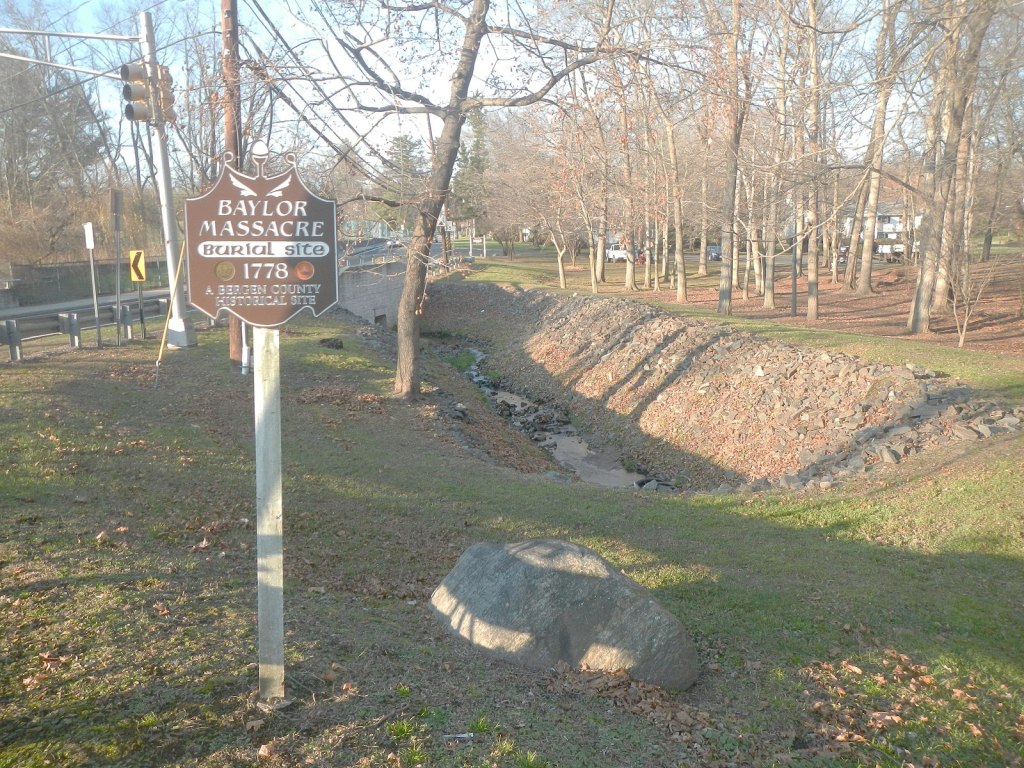
Featured Image Credit: Jim.henderson, English: Looking North from the Northwestern End of Old Tappan Road, at Historic Site on a Sunny Late Afternoon., December 13, 2012, December 13, 2012, Own work, https://commons.wikimedia.org/wiki/File:Baylor_Massacre_Historic_Site_1778_jeh.jpg.
 Retrospect Journal
