
Written By: Elizabeth Price
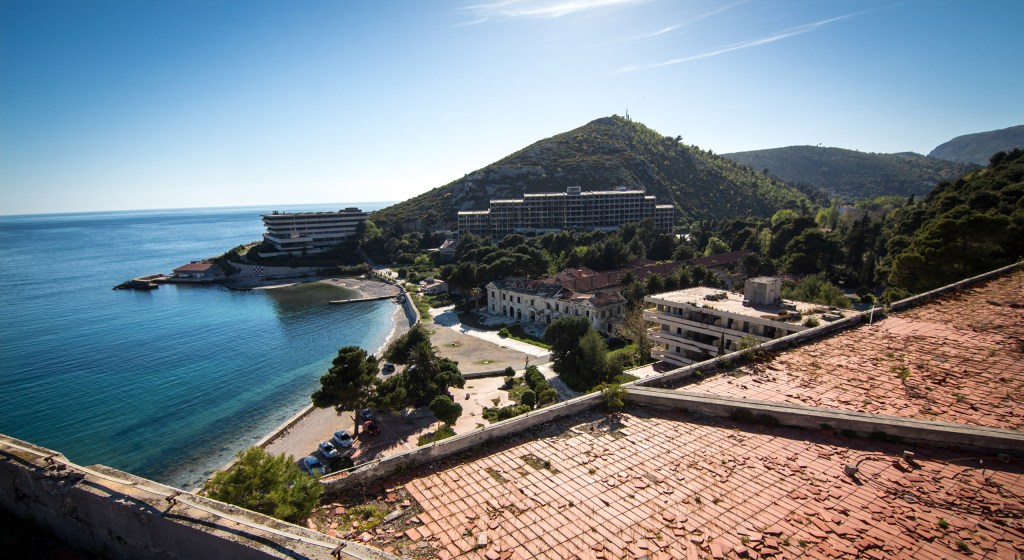
When holiday-goers and tourists alike board the water-taxi from Cavtat to Dubrovnik they likely expect the 45-minute boat journey to consist of panoramic views of the mountainous Croatian coastline and its sprawling beaches. What they likely do not expect to be greeted with is a relic of the Croatian War for Independence—or as the Croatians refer to it ‘The Homeland War’—in the form of the Abandoned Hotels of Kupari. When upon the boat myself, like many others, my eyes were immediately drawn to the abandoned complex with its graffitied and crumbling exterior. The etchings of ‘Climate Justice Now’ and ‘Fuck Trump’ raised questions of it being an abandoned hotel owned by the former President, having been graffitied to show the local’s distaste for his political stance. A quick Google search later brought a few brief articles up that suggested this was not the case and the ruins were instead a result of the Homeland War – yet the history goes much deeper than the Daily Mail’s account.
In 1911 entrepreneurs Jaroslav Fencl and Jan Masa bought the site where the ruins of the Kupari Complex now lie and subsequently founded Dubrovnická lázeňská a hotelová akciová společnost (‘Dubrovnik Spa and Hotel Stock Company’). Construction of the hotels began after the war with the first major hotel – the Strand – opening in May 1921. Throughout the 1920s the site expanded with the erection of Hotel Grand and various smaller annexes and buildings; by 1938 the Kupari Complex was the largest hotel in Dubrovnik and the surrounding region. By this time, the complex boasted around 330 rooms and 2 beaches, much larger than the second-largest Grand Hotel Imperial’s 159 rooms. The notoriety of the Hotel however permeated beyond just that of a vacationing resort; during the 1930s it was used as a filming location for two films, a popular tanning cream was named Kupari after the resort, and a 1928 interparliamentary conference between Yugoslavia and Czechoslovakia was held there, all of which emphasize the idyllic nature and allure of the resort. Even then, Yugoslav leader Joesph Tito was said to have considered Kupari an ideal holiday resort, and resultingly, in the post-war period, the popularity of the resort only increased further. The resort was developed by the state and Yugoslav People’s Army to facilitate vacationing military personnel and accompanying family members akin to other state-built military holiday resorts such as Duilovo near Split and Baška Voda near Makarska. Over a 25-year period, five new hotels were built by the company (Goričina – 1962, Pelegrin – 1963, Kupari – 1978 and Goričina II in the early 1980s) with the capacity to hold 1,600 visitors alongside a campsite designed for up to 4,500 holidaymakers, footing a cost of half a billion euros – adjusted to modern-day pricing. This resulted in over 14,000 domestic tourists in 1965 and reached up to 57,000 by 1980.
The 1990 election of Franjo Tudjman of the right-wing nationalist Croatian Democratic Union saw a new constitution promulgated in December 1990 which began to incite tension between the Croats and Serbs residing in Croatia. Such tension was heightened when Croatia declared independence from Yugoslavia in June 1991; the Serb minority in Croatia rejected this, asserting their right to remain within Yugoslavia. Aided by the JNA – the Yugoslav People’s Army – and Serbia, Croatian Serbs declared one-third of Croatian territory to be under their control. During the ensuing conflict the Serbs heavily bombed Croatian cities such as Vukovar and Zadar, and between October 1991 to May 1992, they undertook the Siege of Dubrovnik. The Kupari Complex was emptied of guests as a result whilst a delegation of Croatian forces remained behind to guard the resort. These remaining Croatian forces caused the JNA and Serbian forces to shell and fire on the Hotels throughout early October in an attempt to flush out such soldiers. The assault lasted for 3 weeks after which the Hotels were captured by JNA and Serbian forces who subsequently looted the complex and used phosphorous bombs to torch the interiors. A retaliatory assault was then launched by Croatian forces in May 1992 of which they were victorious, allowing for the recapture of the damaged hotels.
However, Kranjčević argues that the Homeland War simply ‘accelerated the decay’ of Kupari resorts which were ‘already on the road towards the dilapidation.’ Kranjčević’s reasoning is that the operational budget for Kupari – like other hotel complexes such as the ‘Haludovo Tourism Zone’ – was not diverting funds to the necessary maintenance, upgrading and landscaping of the area. Kranjčević alludes to improper expenditure of such funds. Furthermore, they argue that the hotel complex had little impact on the local community – citing a lack of population growth as evidence. One could argue that the resort provided Kupari and its surrounding area with jobs and thus did have a positive impact on the community, however, as Balban mentions, local Czech citizens were often employed in low-paying, second-rate jobs. Such employment also caused tension between the two factions as Yugoslav authorities were adverse and opposed to employing foreign workers.
Croatian troops finally vacated the hotel complex in 2001, and in the years following, ‘Project Kupari’ protested for a revival of the site that would oversee the demolition of all the hotels except for Hotel Grand which would be developed into a high-end tourism resort. These plans, however, have yet to come to fruition leaving the complex in its derelict and graffitied state. Yet this abandonment has paradoxically turned it into a somewhat popular tourist destination, attracting urban explorers with an affinity for dystopian-esque ruins while also standing as an emblem of political discontent – via the graffiti – and a ‘sobering reminder of an all too recent war in Europe.’
Bibliography
Bennetts, Mark, ‘Visiting the Bay of Abandoned Hotels in Kupari, Croatia,’ Katmandu & Beyond (2019), https://www.kathmanduandbeyond.com/bay-of-abandoned-hotels-kupari-croatia/.
Smith, Duncan JD, “A Resort in Ruins: The Rise and Fall of Kupari,” Hidden Europe 50 (Winter 2016/2017): 34-37, https://hiddeneurope.eu/a-resort-in-ruins-kupari.
Kranjčević, Jasenka, “Abandoned Tourism Resorts in Croatia: The Consequences of Discordant Spatial Planning and Tourism Development Policies,” in Evolution of Destination Planning and Strategy: The Rise of Tourism in Croatia, ed. Larry Dwyer, Renata Tomljenovic, and Sanda Corak, (Palgrave Macmillan, 2017), 173-200.
Jeschke, Feliz, “A Shakespearean Prophecy Fulfilled? Slav Solidarity and the Colonial Gaze in Czech Tourism on the Eastern Adriatic (1890s-1930s),” Austrian History Yearbook 54, (Cambridge University Press, 2023): 47-60, doi: 10.1017/S0067237823000048.
Tchoukarine, Igor, “’The Sea Connects’ It Does Not Divide’: Czech Tourism on the Interwar Adriatic,” Journal of Tourism History, vol. 6, issue 2-3, (2014): 139-157, https://doi.org/10.1080/1755182X.2014.953214.
Balaban, Milan, “Czechoslovak Tourists in the Yugoslav Adriatic in the Interwar Period (1918-1939),” Acta Histriae 25, No. 3 (Jan. 2017): 747-766, Doi: 10.19233/AH.2017.34.
 Retrospect Journal