
Written by Ella Gibson
When we think of Shakespeare’s history plays, we envision sweeping battles and violent plots, a long side evil monarchs and valiant heroes. And while if the realities of history were so it would be far easier to follow, can we really take plays like Richard III at face value? Or should we analyse the validity of literature as a source which has manipulated the way we view historical figures, perhaps not always for the better?
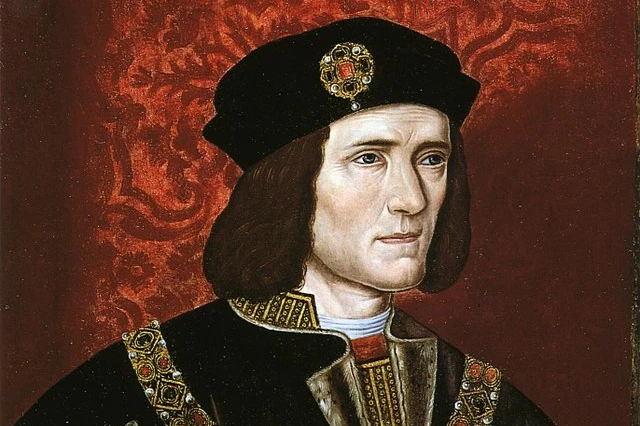
Perhaps the most villainous of William Shakespeare’s anti-hero’s is Richard III, whom we know to be the evil uncle who perniciously butchered his young nephews. Shakespeare introduces and continues to describe him as a hatchback, whose physical deformities seem to mirror that of his ‘evil’ soul.
“Thou lump of foul deformity”
William Shakespeare, Richard III, Act 1 Scene 2
We can now discount Shakespeare’s physical depictions of Richard as sixteenth-century ableism, as following the excavation of Richard’s body from a car park in Leicester in 2012, evidence for scoliosis was found yet no evidence suggested that Richard would have had any physically noticeably disabilities, and certainly not a hunchback. While there have been certain attempts to rectify the reputation of Richard, most notoriously by the Richard III society, there is an obvious lack of nuance when it comes to analysing him as a monarch and an individual. With such polarising accounts of one individual, how can we fully analyse the true extent of Shakespeare’s legitimacy? To start, it is important to gain some background regarding both the reign of Richard III, and the political context which influenced how Shakespeare displays him.
Following the death of his brother Edward IV in April 1483, Richard became Lord Protector and gained the custody of his nephews (and heirs to the throne) swiftly. Within the months that followed it appeared Richard transformed from being a loyal supporter of his brother’s lineage to a figure ambitious for the throne. While Shakespeare depicts this as being his plot all along, with the famous “Now is the winter of our discontent” monologue (Act 1, Scene 1) having Richard exclaim the line “I am determined to play the villain”; when analysing the events that pre-dated Richard’s ascension to the throne, this depiction is just not plausible. Richard was evidently a key supporter of the Yorkist cause, having weighed in heavily in some of the Key battles of the Wars of the Roses which ensured Edwards successful hold of the throne. He was even rewarded with the position of warden of the North, a post he fulfilled very successfully, maintaining good relations with the local people. Furthermore, the suggestion by Shakespeare that Richard had plotted from the very foundations of Edward’s reign to usurp the throne is simply not substantiated by evidence, as he was an incredibly young boy when Edward’s ascension occurred, and much removed from courtly politics.
The death of Richard and Edward’s brother, George, Duke of Clarence, is another event which has been used to sully Richard’s reputation by Shakespeare. While George and Richard certainly had their differences, most notoriously their dispute regarding the Beauchamp inheritance, there is little to no evidence to suggest that Richard was responsible for the murder of Clarence, as Shakespeare would suggest. In contrast, his role in the death of the Princes in the Tower is more likely and would align with Richard’s necessity to validate his rule, particularly following the death of his son and heir. The murder of Clarence was caused due to Edward’s suspicions of him having ambitions for the throne, which can certainly be validated due to the previously formed ‘unholy alliance’ with Lancastrian leader Margaret of Anjou, which had ensured Clarence’s betrayal of Edward.
We may then question why Shakespeare was so set on damaging the reputation of Richard III, and blatantly fictionalising real events. Having written the play during the reign of Elizabeth I, any criticism of Elizabeth’s grandfather Henry Tudor, who defeated Richard at the battle of Bosworth in 1485, would have been exceedingly foolish. In turn, Shakespeare had to be careful not to criticise the likes of Edward IV, who, although the brother of Richard III, was also the father of Elizabeth of York, who united the Yorkist and Lancastrian factions with her marriage to Henry Tudor, laying the foundations for the Tudor dynasty. Thus, Shakespeare uses Richard III as a scapegoat to aid in bolstering the Tudor dynasty, with the aim to encourage the unification of the masses, who would have a key villain to point their fingers at, rather than turning upon one another, or indeed the Queen herself.
It is also worth noting that one of Shakespeare’s key patrons and friends, Fernando Stanley, was a direct descendent of Thomas Stanley, who is notorious for switching sides to Henry Tudor at Bosworth and swaying the battle in favour of Tudor. Both factors solidify that Shakespeare had both personal and political reasons for depicting Richard as the Villain.
On a secondary note, it can also be argued that this perhaps was not as politically motivated as one may think upon first appearances- rather, this is just an early example of individuals enjoying the equivalent to historical fiction or period dramas, while there were clearly certain lines Shakespeare had to be careful not to cross; the willfully inaccurate presentation of Richard III can also be seen as mere escapism for the masses. This is evidenced by the wider literary context of Richard III not being the only historical figure whose history Shakespeare alters, rather he is in the company of many including Julius Caesar, Henry VI and even Cleopatra.
So how should we view Richard? With such differing accounts of his life, it is hard to come to one general conclusion. To do so I believe we must first look at his earlier years and how this shaped his actions in later life. Richard’s father and brother both died at the battle of Wakefield in 1450, leaving him and his brothers in a precarious position regarding their status as nobles. He was then forced to flee as a teenager following Clarence’s plot with Warwick the ‘Kingmaker’ to oust Edward. While these events themselves may not be enough to cause the tumultuous events of his reign, when pairing this with the wider political instability which was brought about by the wars of the Roses, and the lack of neutral sources from which to analyse Richard from, due to the Tudor domination of Historical records, I believe it is evident that we can neither view Richard as the villain depicted by Shakespeare, or the hero shown by the Richard III society. When faced with using literature such as Shakespeare’s plays as our primary sources in analysing historical figures it is easy to expect historical rulers to fall into easily categorical boxes of ‘heroes’ or ‘villains’ or ‘good’ or ‘evil,’ when individuals are obviously more nuanced than this, with Richard being no exception to this rule.
Whether the accusations of murder placed upon Richard were true or not is not the key issue to be addressed, but rather why these accusations were made, and what this can reveal to us about Shakespeare’s intentions as an author, and the political context of the era.
In removing the play Richard III from its historical context it can be seen as the equivalent to an action movie, with clear villains and heroes, yet as historians we must engage in the discussion regarding if it possible for us to separate art forms from their historical context, and is it possible for us to put figures like Richard III on trial retrospectively when the majority of our critical thinking is based around one account written by Shakespeare?
Bibliography
Shakespeare, William. A Midsummer Night’s Dream. Barbara Mowat, Paul Werstine, Michael Poston, and Rebecca Niles, eds. Folger Shakespeare Library. Accessed 01/11/23. Washington, DC: Folger Shakespeare Library. https://folger.edu/explore/shakespeares-works/a-midsummer-nights-dream/
Barton, Saxon. Richard III Society. Accessed 01/11/23. https://richardiii.net/about/
Shakespeare Birthplace Trust. Accessed 01/11/23. https://www.shakespeare.org.uk/explore-shakespeare/blogs/shakespeares-richard-iii-myth-or-reality/
Featured image credit: Richard III. NPG. https://commons.wikimedia.org/wiki/File:King_Richard_III.jpg
 Retrospect Journal
