
Written by Naomi Wallace
“here’s an equivocator … who committed treason enough for God’s sake, yet could not equivocate to heaven.”
William Shakespeare, Macbeth, Act 2 Scene 3.
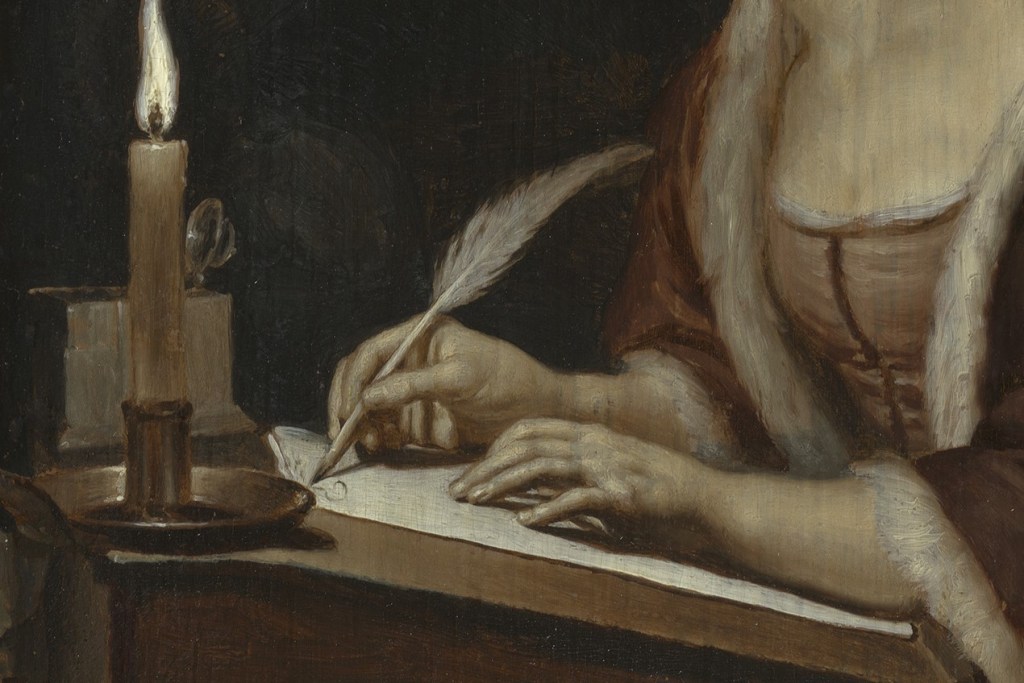
She touches the pen to her lips, and the sweet tang of the ink faintly lingers as she continues the strenuous task of inscribing words onto the page. Writing by flickering candlelight is difficult enough; doing so with this citrussy fluid that barely leaves a mark is arduous, and she is exhausted. Her eyes are weary and strained, damp with tears that do not abound freely yet cannot quite be kept at bay. She squints, desperately seeking the faint letters left by her own hand, but the parchment is an empty blur. Blinking determinedly, she dips the quill into the orange juice once again. Without this correspondence, Anne Vaux has nothing left.
Garnet has been in the Tower for some weeks now, and no matter how desperately she implores her mind to banish the terrible thoughts that invade, they persist. Any fleeting hope that she and her beloved priest may be reunited is extinguished by reason, by the knowledge that his fate is a foregone conclusion, has been since his arrest- no, since he first crossed paths with Catesby. Catesby – God! – the loathing she holds in her heart for him, more severe than could ever be justified against a dead man. But it is a festering wound, this hatred, that putrefies as she watches the persecution against her people worsen, and for what? A failed plot that has nothing to show for it, just bodies in the ground and a renewed malevolence against her people, who simply wish to practice their faith in peace. As she sees it, Catesby got off scot-free, one merciful bullet and he took his leave of the world. Those left in his wake, poor souls – some of them innocent – who were ensnared in his web, now pay the price. It is not Catesby who is subject to heinous torture on the rack, stretched until his limbs snap for crumbs of information. It is not Catesby who is interrogated relentlessly, plucked for intelligence about that fateful November night. No, it is her dear, dear friend, who, in all probability, will suffer the severest punishment for his failure to inform the authority of Catesby’s scheme.
Henry Garnet knew of the plot, of gunpowder and tunnels and a convocation at Parliament. They all knew, even those without an inkling of the details, something was afoot. Catesby was a time bomb waiting to explode, and he ticked every time the government imposed another target on Catholic backs. She herself, harbouring her own suspicions, had beseeched Garnet, practically begged him for God’s sake to talk with Mr. Catesby, to temper the beast. And Garnet himself had acquired the illicit knowledge of the plot under the Seal of Confession; his hands were tied by the oaths he had made when he had assumed his vocation. For that, surely, he does not deserve to die. To convict every Catholic who held a breath of knowledge about this ordeal would be to eradicate them all. Perhaps that is what Salisbury wants. Catholic blood to satiate his thirst for division.
Their letters are a lifeline, but they are also an incendiary device. Salisbury’s men are no fools, and even the covert messages they scribble in juice are tinged with caution, should they be discovered. Oh that I might see you, her hand scrawls on the page nonchalantly. She tries not to dwell on how this may be construed, of how their enemies might twist and disfigure her words of affection into something perverse. It is easy pickings, the closeness of a priest and his unmarried female companion, but if they desire to spew such rot, let it be so. Father Garnet is the most benevolent of all men, and the devotion between them is the purest of its kind. If ever their relationship trespassed beyond friendly recompense – after all, she is a woman of earthly desires – this would have been unreciprocated by him, a man who observes his vows with the utmost sincerity. He has remained so loyal to his oaths that they may become his death sentence. Any man with sound judgement would surely, therefore, realise it is ludicrous to suggest he would be so fickle as to compromise himself for a woman.
Her concern, of course, is not merely for him, but for her own self. She daren’t write anything that could incriminate her, though of course it all does. She knows they’re intercepting every letter, watching every move, hell, it feels like they are in the walls, crawling on her skin. It won’t be long before they come for her. It was her name on the lease to the house in Enfield Chase where the conspirators plotted; it was she who smuggled Garnet into his hiding place at Hindlip Hall. Never has she committed treason, but she is embroiled in this mess, collateral damage in the rubble. She could, of course, leave London, escape to one of the safehouses she and the other Catholics keep. Safe is a grim overstatement, however. They have Little John, and there is very little doubt that he endures unimaginable torment at their hands. If they can rack him into spilling his guts, there is not a safe place for a priest left on this bleak island. Regardless, she has promised Garnet that she is resolved to remain in the capital so long as he is here. To leave without him is not life but death, and she still seeks his advice and counsel from within the stony walls of the Tower. She stays put, a mouse in a cat’s lair, and will do until the day she sees Garnet’s head on a spike with her own eyes.
They are running out of time. In his recent communication, he confessed he was forced to burn a letter of hers before he could read it, relinquish it to the flames to save them from the same scorching fate. Salisbury’s men are closing in, and every letter she writes could be her last. Every breath he takes could be his. They are criminals for their conviction – their very existence is heretical. Each time another one of them is slaughtered in this bloody persecution she feels her endurance wavering, hope curdling into fear.
I beseech you for God’s sake advise me what course to take. I am and ever will be yours and so I humbly beseech you to account me, she begs with her pen.
She signs her name, and watches the orange juice sink into the page.
Bibliography
Anstruther, Godfrey. Vaux of Harrowden: A Recusant Family. Newport: R. H. Johns Limited, 1953.
Fraser, Antonia. Faith and Treason. Anchor, 2014.
Nicholls, Mark. “Vaux, Anne (bap. 1562, d. in or after 1637), recusant.” Oxford Dictionary of National Biography. 23 Sep. 2004; Accessed 29 Oct. 2023. https://www.oxforddnb.com/view/10.1093/ref:odnb/9780198614128.001.0001/odnb-9780198614128-e-28159.
Featured image credit: Yeager-Crasselt, Lara. “A Young Woman Writing a Letter” (2022). In The Leiden Collection Catalogue, 3rd ed. Edited by Arthur K. Wheelock Jr. and Lara Yeager-Crasselt. New York, 2020–. https://theleidencollection.com/artwork/a-young-woman-writing-a-letter/ (accessed November 04, 2023).
 Retrospect Journal