
Written by Ailsa Fraser
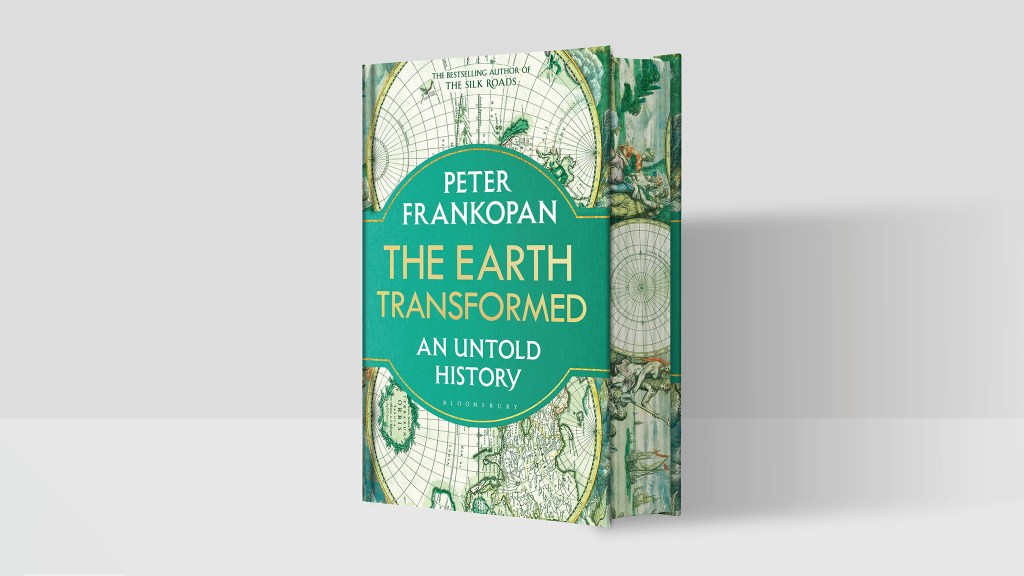
The Earth Transformed: An Untold History is an enormous book which aims to address an enormous topic: how climate and the environment has shaped global history across time. Volcanoes, floods, disease, weather patterns—Frankopan argues that they are not actors in human history, but rather the stage on which it is performed. ‘Like most stages, it can be all too easy to think only about what happens on them—what the protagonists do and say—without thinking about the fabric of the set itself,’ he writes in the conclusion. With a historian’s emphasis on nuance, he does not assert that environmental or climatic factors totally determined the outcome of history, just as a stage does not determine the plot of a play; rather, he emphasises their importance in shaping what happened, and that these factors have been frequently overlooked in the scholarship thus far.
At nearly 700 pages, the book is long enough that the author and publishers decided not to include the footnotes within the text itself, but rather publish them online. The book could hardly have been any shorter: it is a sweeping, thoroughly researched overview of the topic that spans the period from roughly 4.5 billion BCE to the present day, 2023. As a history, it is certainly an achievement; as a historian, Frankopan ensures it remains thoroughly grounded in fact and analysis. Importantly, it is an overview. Of the twenty-six chapters, including the introduction and conclusion, most of them focus on the themes of a specific period of time, such as the first cities (c.3500–c.2500BCE), the role of disease in shaping a new world (c.1250–c.1450CE), and industry and extraction (c.1800–c.1870). I picked up the book at its launch event in Edinburgh in March, with the intent of perhaps finding inspiration for a subject in environmental history on which to write my dissertation. I found plenty of inspiration, but little detail on each subject. By nature, the book jumps from region to region and decade to decade to draw out the chapter’s argument, not dwelling long or in-depth on each particular case study. For more detail on the areas that interest me, I will have to go online and download the footnotes—a PDF document that in itself is over 200 pages long.
The book’s breadth is a weakness as well as a strength. In many chapters, such as the four chapters focusing on the twentieth century, Frankopan regularly drifts away from the subject of climate and the environment to provide context for the political and social drivers of change in a way that sometimes feels off-topic, though he eventually emphasises how these drivers intersected with environmental ones and vice versa. Likewise, its breadth can make it difficult at times to digest the incredible amount of information it presents—though this only means that rereading it is just as rewarding as reading it. The Earth Transformed’s strength is in its approach as much as the individual arguments it makes. Its interest in the broader picture—the ‘stage’—underlines what it aims to do: re-frame history to include, if not centre, climate and the environment as significant factors. From environmental changes that made it possible for humans to evolve at all, to the volcanic eruption that made 1816 the Year Without Summer, to geoengineering attempts that involved filling the atmosphere with dry ice, Frankopan emphasises time and time again how important climate and climate changes have been to human history—for better or for worse. His conclusion reflects on the potential impacts of our current climate crisis and what history suggests the future may hold.
However, while the current climate crisis is naturally the shadow which hangs over the whole book, the politics of it are conspicuously absent. Frankopan does mention the impacts of capitalism and of colonialism on the global environment, but the link through to our lifestyles today is tenuous at best, and key philosophies are hardly mentioned at all. Humans’ relationship with our environment is nominally the core topic of the book, but beyond observations of themes within specific time periods, there is little theoretical engagement with it. A chapter on nature and the divine near the start of the book could have provided a possibility later to reflect on the Christian roots of most Western thought about the environment; likewise, numerous chapters on the exploitative impact of empires failed to connect more than perfunctorily with the exploitation performed by neoimperialism today. Frankopan’s conclusion is also less than cheerful. Despite emphasising that genuinely fantastic progress has been made, he concludes that the only way to return to ‘the sustainable, lush paradise of our fantasised past’ is through significant population decline, ignoring the massive range of solutions being proposed today and also ignoring the implications for how the population could decline so rapidly. Climate anxiety and the impending feeling that the apocalypse is nigh are serious problems among activists and the general public today, making it constantly harder for people to engage in activism; such a depressing outlook in a book touted as a triumph for climate history is unlikely to help. Frankopan says in the acknowledgements that to write the book he had to engage with new source material, particularly from the natural sciences—there was no reason he could not have engaged with sources from the social and political sciences, as well.
That said, The Earth Transformed: An Untold History is precisely that: an untold history. Frankopan’s aim was to emphasise the importance of climate as a historian, and to use historical evidence to reflect on today’s crisis, a task which he accomplished with flying colours. And historical evidence is not optimistic. As the last line of the book reads: ‘Perhaps we will find our way back [to a sustainable paradise] through peaceful means; a historian would not bet on it.’ Positivity and climate optimism were not the aim: breadth, analysis, and historical accuracy were. Frankopan’s book is breathtakingly researched, full of useful and interesting information, and reframes history and its themes in a much-needed way that hopefully inspires more research in this vein, in history and other disciplines. As a book about the past, it is extraordinary. But it is not necessarily a book about the future—it was not meant to be.
Bibliography
Frankopan, Peter. “The Earth Transformed Notes.” Accessed September 11, 2023. https://www.bloomsbury.com/uk/discover/superpages/non-fiction/the-earth-transformed-notes/
Frankopan, Peter. The Earth Transformed: An Untold History. London: Bloomsbury, 2023.
Featured image credit: Image via Bloomsbury Books on Twitter.
 Retrospect Journal